DarkWind
DarkWind is a text-based multiplayer RPG set across Blackmar, its continents, its moons, and the strange places between them. The world has been under development since 1992 and continues to grow through player activity, staff building, quests, guilds, professions, events, and long-running story threads.
You play by typing commands. Movement, combat, conversation, crafting, travel, shopping, guild abilities, spellcasting, and social systems all happen through the command line.
Start Here
| Page | Use |
|---|---|
| Getting Started | First steps after character creation |
| Basic Commands | Common commands for movement, inventory, help, and character status |
| Account And Session | Tutorial, saving, quitting, passwords, reboots, and switching characters |
| DarkWind City Services | Shops, bank, church, training, donation room, and city landmarks |
| Communication | Channels, tells, mail, emotes, language, and social tools |
| Combat | Attacking, assessing, healing, wimpy, and staying alive |
| Death And Recovery | Ghosts, prayer, resurrection, avengement, and recovery |
| Travel | Recall, ferries, ships, domains, hazards, and navigation |
| Guilds | Guild roster, joining, changing guilds, and future-facing guild structure |
| Economy | Gold, banks, shops, auctions, professions, inns, pubs, and markets |
Useful Commands
| Command | Use |
|---|---|
help <topic> | Read in-game help |
tutorial | Start or resume the newbie tutorial |
newbie <message> | Ask the newbie channel for help |
look | Look at your room |
examine <thing> | Inspect an object, exit, creature, or feature |
score | View your character's current condition |
inventory | Check what you are carrying |
equip | Wear and wield available equipment |
where | See where players are, when visible |
areas | Browse areas by level range |
uptime | Check reboot timing |
Connection
Come join the friendly player base at DarkWind now.
Just click here or telnet
to darkwind.ai port 4242. We'll see you soon!
Getting Started
When you complete character creation, you will find yourself in the adventurer's guild.
The Center of Town (COT) is north, east (or n, e) from there.
COT is the 4-way intersection on the map of Darkwind, and all the directions in this guide start from there.
See DarkWind City Services for a practical city checklist.
See Account And Session for tutorial commands, saving,
quitting, passwords, reboots, and registered character switching.
To begin adventuring you will need equipment.
Erga's Newbie Shop (4 west, 1 south) will give you free equipment.
At level 2 you will have access to the donation room (5n,e).
Here you can get equipment donated by higher level players.
Please return it when you are done with it so that the next Newbie will have access to it.
Remember to wear and wield all.
You can do this with one command by typing equip.
See Basic Commands and Equipment for more.
Now that you have equipment you will want to gain experience and gold so that you can gain levels.
The Adventurers' Guild (w,s) will give you an idea of how much gold and experience is required for your next level.
Keep in mind that levels are only the ability to further increase your stats.
So in most cases it is generally best to spend experience on stats until you get the message that says you must increase your level before gaining more stats (See help stats).
Some players skip stats to reach the next level faster.
That raises the level number without giving the same practical power as trained stats.
When you kill something you will want to get the gold and the loot from the corpse.
You can get all from corpse.
Or you can burn the corpse with a corpse burner and get all.
You can sell the loot in the shop (5w,2s,w).
When you leave the game, many carried, worn, and wielded items save with your character.
Some items never save, including donated gear, broken gear, food, drinks, uniques, items inside containers, and items directly restricted by the game.
Guild and shop storage rooms are temporary and do not survive reboots.
Put extra coins in the bank (5w,3s,e) for safe keeping and a better restart after death.
See Economy for banks, corpse ash, markets, auctions, pubs, and inns.
Death Happens
It is part of the game.
Luckily it isn't permanent.
If you die, go to the church (5w,n) and pray.
When you die you will lose one from each stat, all of the experience you have on hand and one level.
Note that this penalty does not exist if you are level 5 or lower.
Until then, praying at the church will restore all of your stats and your level.
Some guilds have the ability to raise people from the dead.
This saves them some of the stat loss, but not the level or the experience on hand.
You can get someone to avenge your death.
This is a way to get some experience back (help deathavengement).
Don't do this if you are level 5 or below, because Dierdre works every time.
See Death And Recovery for death, ghosts, prayer, and avengement.
Next Steps
- Account And Session for tutorial, save, quit, uptime, password, and switching characters
- Communication for channels, tells, mail, and language
- Combat for fighting, healing, wimpy, and newbie combat commands
- Travel for ferries, recall, ships, domains, and hazards
- Parties for grouping with other players
- Quests for structured objectives and rewards
- Rules before using client triggers, PK, or multichars
Basic Commands
DarkWind is played by typing commands. Most commands are short verb phrases: look, get sword, say hello, kill rat, wear armor, wield sword
Looking Around
| Command | Use |
|---|---|
look or l | Look at the room |
look <thing> | Look at something in the room or your inventory |
examine <thing> or exa <thing> | Examine something more closely |
gl | Glance at the room |
inventory or i | Show what you are carrying |
who | Show who is online |
finger <player> | Show public information about a player |
Room descriptions often contain nouns you can inspect. If a room mentions a statue, sign, trail, table, corpse, altar, or doorway, try looking at it.
Moving
Most movement uses compass directions.
| Long | Short |
|---|---|
north | n |
south | s |
east | e |
west | w |
northeast | ne |
northwest | nw |
southeast | se |
southwest | sw |
up | u |
down | d |
Some rooms have special exits such as enter, climb, portal, knock door, or exit. Room text usually hints at these.
Items
| Command | Use |
|---|---|
get <item> | Pick up an item |
get all | Pick up everything you can carry |
get all from corpse | Loot a corpse |
put <item> in <container> | Put an item into something |
give <item> to <player> | Give an item to another character |
drop <item> | Drop an item |
keep <item> | Mark an item as kept |
unkeep <item> | Remove kept status |
wear <armor> | Wear armor or clothing |
wield <weapon> | Wield a weapon |
equip | Wear and wield available equipment |
weight | Check carried weight |
If there are several similar objects, add a number: look corpse 2, get sword 3, sell knife 2
Combat
| Command | Use |
|---|---|
kill <target> | Start fighting |
assist <player> | Help another player fight their target |
. | Show a quick HP/SP report |
monitor or mon | Toggle HP/SP monitoring |
wimpy <percent> | Run when your HP drops below that percent |
wimpycmd <direction> | Set the direction used by wimpy |
consider <target> | Judge a target where available |
Levels 1–5 have nheal, ncot, ndomain, npunch, and nkick. From levels
6–49, use their adventurer forms: aheal, acot, adomain, apunch, and
akick.
Help
The in-game help system is large and useful.
| Command | Use |
|---|---|
help | Show help overview |
help <topic> | Read a topic |
help <section> <topic> | Read a topic inside a help section |
help list | Show help sections |
help list <section> | Show topics in a section |
help all | Show all help topics |
commands | Show general commands |
Aliases
Aliases shorten commands you use often.
| Command | Use |
|---|---|
alias list | Show saved aliases |
alias <name> <command> | Create an alias |
alias <name> | Show an alias |
alias remove <name> | Remove an alias |
talias <short> <player> | Create a tell alias for a player |
talias list | Show tell aliases |
Examples:
alias ga get allalias la look attalias bob bobert
Some commands cannot be aliased, including get, drop, equip, wear, wield, take, and unwield.
Account And Session
This page covers the commands that keep your character, login, tutorial, and play session in order.
Tutorial
The tutorial teaches the first layer of play: looking, examining, moving, inventory, channels, Erga's equipment, wearing and wielding gear, newbie combat, score, and a first newbie quest.
| Command | Use |
|---|---|
tutorial | Start or resume the tutorial |
tutorial status | Show your current tutorial progress |
tutorial hint | Get a hint for the current tutorial step |
tutorial skip | Skip the current tutorial step |
tutorial restart | Restart the tutorial from the beginning |
The tutorial is useful even for players familiar with other MUDs, because it teaches DarkWind-specific city locations and commands.
Saving And Quitting
| Command | Use |
|---|---|
save | Save your character |
quit | Save and leave the game |
uptime | Check current uptime and reboot estimates |
Your character saves automatically when you quit. Many carried, worn, and wielded items save with your character, but some items never save: donated gear, broken gear, food, drinks, unique items, items inside containers, and items directly marked as temporary.
Guild storage, shop storage, boats, helpers, ponies, and temporary followers do not preserve everything across reboot. Keep important coin in the bank and check Equipment for item saving rules.
Password
| Command | Use |
|---|---|
password <old password> | Change your password |
password <none> | Set a password when the character currently has a blank password |
After entering the command, the game prompts for the new password twice.
Passwords must be 8 to 16 printable characters long. Spaces are allowed, and all characters are significant. Accounts using the older password format are prompted once at login to choose a replacement password.
Use a password that is not your character name, not a common word, and not reused from another site. Shared or guessed passwords can compromise every registered character on the account.
Switching Characters
Registered multichars can be reached without fully disconnecting.
| Command | Use |
|---|---|
switch | List registered characters available to switch to |
switch <character> | Switch to that registered character |
Only one registered character can be active at a time. When you switch, the current body is parked linkdead, and inventory and equipment stay with that body. Client-side aliases, triggers, highlights, and chat scrollback remain with your client.
You cannot switch while in combat or during the attack-quit cooldown. Parked characters idle out after a while, so return to them before relying on anything time-sensitive.
See Multichars for the rules, unlocks, shared banking, and social visibility settings tied to registered characters.
Reboots
DarkWind reboots periodically for memory cleanup, code updates, and once-per-boot world resets. Unscheduled reboots happen during crashes or emergency maintenance.
Before a reboot:
- Save with
save - Bank extra coin
- Finish active purchases, auctions, quests, and risky fights
- Retrieve anything important from temporary storage
- Expect helpers, ponies, summons, temporary guild storage, and some placed items to vanish
Money on your character, bank balances, registered character data, and many carried or equipped items survive normal quitting and reboot.
DarkWind City Services
DarkWind City is the main starter hub. Most directions in beginner help start from Center of Town, often shortened to COT.
Use this page as a practical city checklist.
First Stops
| Place | Use |
|---|---|
| Adventurers' Guild | Starting guidance, level information, newbie resources |
| Erga's Newbie Shop | Free starter equipment for new adventurers |
| Donation Room | Donated gear from other players |
| Newbie Inn | Affordable food and drink for low-level players |
| Main Shop | Sell ordinary loot |
| Bank | Store coins and access account services |
| Church or Temple | Return from death by praying |
Common Directions From COT
Directions can change as areas are rebuilt. These are the traditional starter routes from Center of Town.
| Place | Direction |
|---|---|
| Adventurers' Guild | w, s |
| Erga's Newbie Shop | 4w, s |
| Donation Room | 5n, e |
| Newbie Inn | 4w, n, e |
| Main Shop | 5w, 2s, w |
| Bank | 5w, 3s, e |
| Church | 5w, n |
| Weapons Training | 2s, w |
| PK Registration | 2w, 2s |
Equipment Loop
New adventurer equipment loop:
- Visit Erga's Newbie Shop
equip- Hunt a beginner area
- Inspect useful loot and
get all from corpse - Return to the Main Shop and sell ordinary loot, or carry a corpse burner
with
set autosell onto send ordinary equipment to Taylor as you hunt. Alternatively,set autorefine onconverts refinery-eligible equipment directly into saved profession materials - Bank spare coins
Taylor deducts 10% for automatic selling after applying the same Charisma and reputation appraisal he would use at his counter. Noteworthy gear is left on the corpse rather than transmitted.
Autosell and autorefine cannot be active together. Autorefine does not require a burner, uses normal Refinery yields, and permanently processes eligible equipment before autoloot. Keep it off when you want to inspect drops first.
At level 2 and above, check the Donation Room. Return useful donated gear when you are done with it.
Recovery Loop
After a hard fight:
- Leave danger
- Sit
- Eat food or drink ale
- Check
scoreor. - Restock before returning
New players can use the Newbie Inn before player-owned pubs and inns become affordable.
Death Loop
After death:
- Go to the church
pray- Recover your corpse if safe
- Ask for help if the corpse is in a dangerous area
- Replace food, light, and basic gear
- Bank coins before leaving again
See Death And Recovery.
Travel Services
The city connects to ferries, ships, gates, roads, and domains.
Useful services:
- Ferry tickets near docks
- Ship shop and ship customizer
- Scroll shop for travel knowledge
- Lunar gate for moon-linked travel
- Roads out of the city gates
Social Services
DarkWind City also has social and account services.
- Post office and mail
- Newsroom
- Boards
- Chambre of Commerce
- Player-owned pubs and inns
- Clan and guild meeting points
- Profession building
- Weapons training
If you are lost, ask on newbie, use where, or return to COT with ncot or recall when available.
It was nearly 1800 years ago that the dark wind appeared and ravaged our cities, countries, towns and villages. From where this evil came and what the cause was, I regret to say is not known to us, for most of the immortals were still children at the time. Some say it was an evil birthed of the foul arts of Alarian, the great Necromancer, and that he was its first victim, but that is just a legend from the mists of time. Whatever the cause, the effects were obvious. Not even the longest of wars killed as swiftly and effortlessly as that unliving wind of malice.
The dark wind has come and gone several times during my life, during the life of the city, and during the rebuilding. Not even Mitra, Gaea and Set fully stopped the destruction. But the first occurrence of the wind was the worst by far. We shall start our history at that time, for history of the time before the coming is lost, just as the lives and cities were lost. The clades of Darkwind were thrown into confusion, and the blancmanges, who had been decimated by the wind, were pushed to the brink of extinction by the resulting wars.
The clade wars were bloody affairs. The ogres, orcs and trolls banded together, and with their combined raw strength launched raids and besieged the elves, gnomes and dwarves as they attempted to rebuild. The humans fell victim to massive infighting. The faerie and the halflings managed to escape most of the bloodshed, however they found themselves unable to do much rebuilding of their shattered culture.
The death and barrenness caused by the dark wind caught the eye of three gods: Gaea, the earth mother; Mitra, the goddess of goodness; and Set, the god of chaos. Gaea set about to restore the land, the plants, and the animals. Mitra and Set, however, made themselves known to the inhabitants of Darkwind. Gaea worked so very hard at rebuilding life. Mitra and Set, however, attempted to lead the people to a better life. Co- existence between the factions, the clades, and families was not to be at this time. The religious wars that followed were unfortunate, and only served to dilute the population even more.
No one but the gods know what happened to change things. 24 years after the cleansing by the dark wind, representatives from the different clades met at the bay where Darkwind City now stands. Many say that Gaea herself came to the representatives and entranced them, giving them power from her own body, as well as power from both Set and Mitra. Thus she bestowed upon them immortality; the ability to command flesh, stone, air, water, and spirit, and the determination to create a better life.
With the immortals in place, she forbade Set and Mitra from taking a direct hand in the world, allowing them to only work through the priests and the immortals. The age of immortals had begun. The first act was the creation of a city on the very ground where they were given their power. And the city was called Darkwind, and it was open to one and all.
The clades of Darkwind thrived, and explored the surrounding countryside and the oceans. The immortals created many things, guided by Mitra, Set and Gaea.
World
Work in progress: these pages describe the Blackmar setting we are building toward, and current game content differs in places.
Blackmar is the known world of Darkwind: a continent of old roads, rebuilt cities, dangerous wilderness, and domains that feel like their own countries. Most of Blackmar uses medieval fantasy technology. Swords, ships, temples, caravan roads, guildhalls, old keeps, and dangerous ruins form the common shape of daily life.
That common shape breaks in a few places. Ashad runs on AshPunk craft, where ash, pressure, brass, glass, and alchemy create machines that look impossible beside a knight's forge. Tekal, the green moon, is stranger still: a technological domain of cybernetics, virtuality, and machine cities.
Use areas <domain> in game for current level guidance. These pages focus on what the places are, what they feel like, and what kinds of stories live there.
Start Here
| Page | Description |
|---|---|
| Blackmar | The known world, its domains, and the scars left by the Dark Wind |
| Darkwind | The rebuilt heartland and starting crossroads of Blackmar |
| Calendar | Days, months, dates, and the three visible moons |
| The Three Moons | Dailos, Markas, and Tekal as full domains beyond the sky |
Domains
| Domain | Description |
|---|---|
| Darkwind | Rebuilt city, open roads, forests, plains, sewers, keeps, and old scars |
| Ashad | AshPunk desert of pressure engines, soot, brasswork, and furnace cities |
| Souvrael | Great desert domain of dunes, oases, sultans, pyramids, snake temples, and caravan myth |
| Hyperborea | Northern domain of fjords, vikings, giants, dwarves, gnomish wars, and Asgardian legend |
| Kerei | Connected jungle islands of ninja clans, Amazon villages, hidden temples, and faerie courts |
| Lerquird | Swamp continent of black water, luminous wetlands, and giant mushroom forests |
| Virodia | Tropical coastland of reefs, ports, storms, gardens, and bright sea roads |
| Dramasa | Barren ice land of white plains, frozen roads, and aurora-lit ruins |
| Iglantu | Hellish fire continent of lava rivers, basalt, smoke, and elemental heat |
| The Bodachian Fallows | Shadowed horror land of haunted forests, old manors, ghosts, and grave roads |
| Islands | Sea and sky frontiers that gather stranger pocket-realms around Blackmar |
| Underworld | Deep roads, mines, tunnels, old cities, and hostile realms beneath the surface |
Moons
Blackmar has three moons. Each one is a separate domain with its own landscape, dangers, and powers.
| Moon | Description |
|---|---|
| Dailos | Magenta moon of disease, chaos, plague, and savagery |
| Markas | Red moon of strength, stability, healing, and sanctuary |
| Tekal | Green moon of knowledge, balance, Luna, and advanced technology |
Blackmar
Work in progress: this page describes the Blackmar setting we are building toward, and current game content differs in places.
Blackmar is the known world of Darkwind. The name covers the great continent, the seas and island frontiers around it, the deep roads beneath it, and the three moons that hang above it as separate domains.
The Dark Wind defines the beginning of remembered history. It destroyed cities, scattered clades, broke old nations, and left enough ruin behind that rebuilding became the central story of the age. Darkwind City rose from that rebuilding. Other domains kept their own scars, their own gods, their own styles of magic, and their own answers to survival.
Most of Blackmar feels medieval: roads, ships, guilds, temples, castles, caravans, farms, forges, monster-haunted borders, and old ruins. Two places break the pattern openly. Ashad turns ash, brass, pressure, and alchemy into AshPunk machines. Tekal turns the sky itself into a reminder that Blackmar's moons are not just lights overhead.
Domains
| Domain | Description |
|---|---|
| Darkwind | Rebuilt heartland, open city, forests, roads, ruins, and first adventures |
| Ashad | AshPunk desert of furnace cities, pressure engines, soot, and brass |
| Souvrael | Mythic desert of dunes, oases, pyramids, sultans, snake temples, and caravans |
| Hyperborea | Northern fjords, vikings, dwarves, giants, gnomish wars, and Asgardian myth |
| Kerei | Jungle island chain of ninjas, Amazons, temples, hidden courts, and faeries |
| Lerquird | Swamp continent of luminous wetlands and giant mushroom forests |
| Virodia | Tropical coastland of reefs, harbors, orchards, storms, and sea trade |
| Dramasa | Barren ice land of frozen roads, white plains, and aurora ruins |
| Iglantu | Fire continent of lava rivers, basalt citadels, and elemental heat |
| The Bodachian Fallows | Haunted land of shadowed woods, ghost roads, manors, and grave magic |
| Islands | Sea and sky frontiers with stranger pocket-realms gathered around Blackmar |
| Underworld | Deep roads, mines, tunnels, old cities, and hostile realms beneath the surface |
The Moons
| Moon | Color | Description |
|---|---|---|
| Dailos | Magenta | Disease, plague, chaos, savagery, and the God of Disease |
| Markas | Red | Sanctuary, strength, stability, beauty, and healing |
| Tekal | Green | Knowledge, balance, Luna, machines, cybernetics, and impossible science |
Travel
Blackmar is a world of hubs and thresholds. Roads connect the central cities. Ports and wharves open the island routes. Caves, mines, grave roads, and old temple paths lead downward. The moons answer gates and celestial timing.
For player use, the areas command shows current level guidance. The world docs describe where a place belongs in the setting and what kind of story a player is stepping into.
Darkwind
Work in progress: this page describes the Darkwind setting we are building toward, and current game content differs in places.
Darkwind is the rebuilt heart of Blackmar. The first immortal city rose here after the Dark Wind, on the bay where the surviving clades gathered and began again. Its streets are open to almost everyone, which makes the city less pure kingdom and more living crossroads: merchants, guilds, pilgrims, rogues, adventurers, priests, and old grudges all pass through the same gates.
The city is the safest place many players learn to name, but it is not a soft place. The sewers, old roads, nearby forests, and ruined holdings keep the past close. Darkwind is where civilization starts making promises, and where the world immediately tests them.
Darkwind City is the social and practical center of the domain, with banks, boards, shops, guild access, public roads, and a constant flow of travelers. Center of Town is the common navigation anchor. The Church of Mitra marks holy influence within the city, while the Lunar Gate answers Dailos, Markas, and Tekal when the moons are right.
DarkWood Forest spreads west of the walls, thick with roads, clearings, and stranger paths. The northern roads lead toward mountains and colder frontiers. The southern shore holds abbeys, keeps, pirate paths, and old settlements.
Areas
| Area | Description |
|---|---|
| The Sewers | Low tunnels beneath the city where early danger lives close to home |
| The Haunted Keep | A small ruined keep that teaches new adventurers to distrust empty stone |
| The Four Dragon Temple | A broad early temple complex tied to dragon lore and old city dangers |
| The Four Dragon Shrine | A companion shrine beyond the first city roads |
| The Realm of Ashkenazy | A nearby realm of strange rule, old enemies, and early heroic work |
| The Faerie Mound | A faerie crossing with gardens, caverns, winter valleys, and hidden country |
| Endive's Garden | A deceptively pleasant garden with danger that scales far past its first paths |
| The Pirate Ship Albion | A shipboard adventure reachable from the coast |
| Pirate Town | A northern port of thieves, sailors, rough alleys, and salt-stained trouble |
| The Pirate Cave | A deeper coastal danger hidden past pirate country |
| Haxton Province | A large old province with villages, plains, roads, and many levels of trouble |
| Glavia | A village, castle, swamp, monastery, river, mountains, and demon-haunted woods |
| Beneath the Roots | Deep Glavian danger under the old earth |
| Stoker | A town with forest roads, mine paths, and a castle shadowing the region |
| Syldenith | An ancient forest and tunnel complex with old elven memory |
| Canith | A settlement near holy roads and abbey lands |
| The Abbey of Saint Dominic | Religious holdings, farms, precincts, infirmary rooms, and church grounds |
| The Convent of St. Lyra | Holy sisterhood grounds near the abbey roads |
| The Northwestern Mountains | Mountain paths, elven villages, brutal old woods, and old caves |
| The Skeleton Caves | A deep cave network under the mountain roads |
| The Forest of Terror | A darker mountain forest where the wilderness becomes openly hostile |
| The Ancient City of Sheritym | A high-danger ruin from an older age |
| Qazaash | A dangerous realm of outposts, rifts, and enemies that reward careful judgment |
| Hades and the Underworld Road | A mythic descent from Darkwind into darker realms below |
Darkwind is built for discovery in layers. New players find streets, farms, sewers, and familiar roads first. Returning players learn the same roads hide portals, keys, old factions, and routes to places that felt impossible at level one.
The city stays busy and practical. It has taverns, boards, shops, banks, guild access, donation rooms, roads, gates, ferries, and public landmarks. The fantasy comes from walking out of an ordinary street and finding the impossible two rooms later.
Ashad
Ashad lies west and slightly south of the Darkwind mainland, beyond the mountains west of Syldenith and Endrael. Its western Oasis of Life opens onto the Mirage Sea, while the Ocarian Sea curls around the continent's southern approaches. Travelers can come ashore at the Oasis and follow the soot roads into a full continental progression.
Ashad is the desert that learned to burn productively. Its cities do not merely survive the heat; they harvest it, refine it, and build with it. Where Souvrael is mythic desert, Ashad is industrial desert: furnace towers, brass pipes, soot-black walls, pressure gauges, glass lenses, ash mills, and caravan engines coughing across the dunes.
Ashad's technology is called AshPunk. It uses ash, pressure, alchemy, scavenged bone-white fuel, desert oils, and heat engines to create wonders that look like machines and behave like spells. A knight from Darkwind sees a forge. An Ashadi engineer sees a prayer with valves.
Furnace cities anchor the domain with stacks, pressure towers, foundries, water vaults, ash mills, and glasswork. Soot roads carry caravans between refinery houses, engineer-priests, furnace families, machinewright orders, and blackened waystations.
Glasswork is everywhere: lenses, warded windows, distillation towers, mirrors, heat traps, and signal lamps. Ashad's beauty is smoky, dangerous, improvised, expensive, and practical.
Areas
| Area | Description |
|---|---|
| Oasis of Life | Protected western port, wayshard hub, market, public mendery, and Lifehouse |
| Cinder Flats | Vast soot-road wilderness crossed by pressure lines, mirage engines, predators, and fixed waystations |
| Scraplands | Active salvage claims full of old machinery, living rivets, and a self-directing breaker |
| Keeo | Pressure observatory whose storm charts, condensers, and signal mirrors watch the continent |
| Sandstorm Ridge | Permanent wall of salt and glass crossed by guide ropes, shelters, and storm anchors |
| Sunken City | Buried civic roofs, drowned archives, and an impossible engine beneath the wells |
| Crystal Caves | Resonant eastern caverns with protected moth nurseries and a sealed crystal heart |
| Dunmoss Char Spires | Black northern peaks supporting soot-fed moss, grazers, harriers, and wyverns |
| Ashad Ruins | Oldest civic kilns and the dormant Brass Crucible foundation at the southern tip |
| Pyre | Vertical plateau city built along Ashfall Road, with working lifts, public refuges, an ash exchange, pub, shop, and inn |
| Cinder Watchtowers | Four corner outposts that relay road conditions and keep rescue supplies open to travelers |
| Cinder Wells | Deep mineable ash vents whose pressure bells warn of geyser-like eruptions |
| Ashcar Outcrop | A minor western rise occupied by one caravan keep, wild rams, and raiders |
Heat
Ashad rewards preparation. Severe and extreme heat ramps up rather than
striking immediately. The first sustained exposure leaves a traveler Exposed;
remaining outside then applies Burning stacks. Full daylight checks most often
and applies the strongest stacks, dawn and twilight are milder, and night is
half strength. Type heat in an Ashad room to see the local tier, cadence, and
the stacks expected for your character.
Marked shelters stop new exposure. Resist Heat prevents it, Ranger desert survival reduces Burning stacks, and Souvraeli adaptation helps further. Ordinary fire resistance mitigates the resulting Burning damage. Existing Burning decays normally after reaching safety, and Exposed expires shortly afterward.
Heat, scarcity, machines, and human ambition all matter. A player feels the desert pressing in from every direction while civilization hisses, clanks, and refuses to die.
The continent is one irregular 96 by 92 travel grid rather than a hub with detached area maps. Every live region occupies its own cells in that shared geography and meets the Cinder Flats through narrow, defended approaches. Pyre climbs through only part of its exact 30 by 30 civic reserve, leaving unbuilt terraces honestly blank for later growth.
Souvrael
Work in progress: this page describes the Souvrael setting we are building toward, and current game content differs in places.
Souvrael is the great desert domain of Blackmar. Its walls rise from the Segovia Desert, its beaches touch the Gearnat Sea, and its roads vanish into dunes, oases, pyramids, snake temples, and older empires buried under sand.
Where Ashad is mechanical, Souvrael is mythic. It is a land of sultans, caravans, veils, scimitars, date palms, gold mines, ancient curses, and temple doors that open only when the desert accepts the question.
The city of Souvrael is a walled desert hub of markets, banks, temples, opium dens, docks, and trade. The Segovia Desert surrounds it with vast dunes, stone trails, salt wind, heat shimmer, and routes that only patient travelers learn to trust.
The Gearnat Sea is Souvrael's harbor route into the wider world. Water sellers, camel yards, bazaars, desert guides, and noble houses turn the domain into a place where survival and commerce are never far apart.
Areas
| Area | Description |
|---|---|
| Arabia | Desert road culture of veils, blades, trade, and old tales |
| Babylon | Ancient city memory, trade routes, and monumental ruin |
| The Realm of Egypt | Pyramids, curses, pharaoh memory, and tomb danger |
| The Pyramid | A focused tomb adventure in the deep desert |
| The Snake Temple | Serpent worship, venom, ritual chambers, and desert trial |
| The South Desert | Open sands, oases, vaults, and dangerous heat roads |
| The Dune Sea | Shifting dunes, stone markers, mirage paths, and faith in distant water |
| The Kingdom of the Dao | Earthbound realm beneath the desert's surface |
| The Gold Mines | Desert mines where wealth and danger share the same tunnel |
| The Paladin Outpost | Militant holy holding on the desert frontier |
| The Dwarven Colony | A hardy settlement dug into desert stone |
| The Carnival | Bright danger, masks, spectacle, and Four Dragon echoes |
| The Ludi | Public games and contests open across experience levels |
Souvrael is about heat, belief, wealth, and hidden doors. It is bright at the surface and old underneath. Players cross it by reading roads, respecting water, and learning that every oasis has a shadow.
Hyperborea
Work in progress: this page describes the Hyperborea setting we are building toward, and current game content differs in places.
Hyperborea is the northern domain of fjords, mountain passes, snow forests, old walls, and mythic war. Grimsfjord stands against the cold as a practical village of gates, outfitters, wharves, ponies, fires, and hard roads. Beyond it, the land climbs into icy valleys where clouds swallow the ridges.
Hyperborea carries the weight of northern legend: vikings, dwarven halls, giants, gnomish conflicts, frozen rivers, wolf-haunted roads, and Asgardian realms that touch the mortal map.
Grimsfjord is the main town, mountain gate, wharf, and practical northern hub. The River Alsvid cuts through canyon rock and ice, while the western valleys rise into snow paths, glacier lakes, cloud ridges, cliffs, and alpine forests.
Longhouses, raids, honor feasts, cold-weather craft, and sea routes define much of its mortal culture. Divine realms, trials, world-tree imagery, Valhalla, and mythic enemies pull that culture toward legend.
Areas
| Area | Description |
|---|---|
| Asgard | Mythic realm of icefields, Valhalla, Nidavellir, Nifelheim, Muspelheim, and Odin's palace |
| Viking Village | Northern settlement of warriors, sailors, kinship, and old feuds |
| Wolfjord | Fjord country with black forests and long danger bands |
| The Ice Ruins | Early northern ruins where cold and history meet |
| The Powder Plateau | Beginner plateau on the northern map |
| The Icefloe | Seal hunting grounds and frozen water travel |
| The Ice Fort | High-danger fortress in the deep cold |
| North Hyperborea | Broad northern passes, roads, and high-level wilderness |
| Wind Valley | Forest, path, tower, and cathedral spaces bound by northern weather |
| Rath-Khan's Realm | Forest, cavern, tower, and old power gathered around one name |
| Kryzelle Trail | Mountain trail for seasoned travelers |
| Fire Island | A volcanic counterpoint to the snowbound mainland |
| Four Dragon Castle | Hyperborean expression of the Four Dragon theme |
Hyperborea is physical. The world is steep, cold, and loud with wind. Travel feels like earning ground: a trail, a ledge, a pass, a bridge, a gate, a fire.
Hyperborean stories put small settlements against impossible weather and impossible enemies. The warmth of a room matters because the next step outside matters.
Kerei
Work in progress: this page describes the Kerei setting we are building toward, and current game content differs in places.
Kerei is a chain of connected jungle islands. It mixes fortress roads, river travel, coastal docks, hidden temples, faerie borders, ninja clans, Amazon villages, and old island cities. The land feels lush, but not gentle. Paths disappear under leaves, river crossings hide politics, and the next shrine may belong to a faction that does not name itself twice.
Kerei's central settlements are Odako and Chimotage. Odako is the fortress hub. Chimotage is an island city with its own roads, docks, forests, and mountain paths.
Odako is the fortress domain, with river roads, an arena, markets, guarded halls, and watched routes. Chimotage is quieter and stranger: docks, Ichi-Ban Way, forests, mountains, old alleys, and island politics.
Ninja clans, Amazon villages, hidden temples, catacombs, remote shrines, and faerie borders turn the islands into a web of guarded paths and half-spoken allegiances.
Areas
| Area | Description |
|---|---|
| The Fortress of Odako | Main hub, arena, banks, shops, training access, and river routes |
| Chimotage City | Quiet island city of docks, spice smells, old roads, and controlled streets |
| Chimotage Forest | Forest paths, island wildlife, and routes into deeper Kerei |
| Chimotage Mountains | Mountain jungle, old maps, and hidden approaches |
| The Amazon Village | Jungle warrior settlement and cultural anchor |
| The Temple of Mintohdar | Temple trial with variable danger and strong identity |
| The Village of Iyashii | Island village with local roads and regional stories |
| The Kingdom of the Faeries | Faerie courtlands spread across jungle, moat, wall, and wild border |
| The Gargoyle Village | Stone-winged settlement and manor spaces near Kerei roads |
| The Fortress of Sunnah | Fortified jungle site tied to an old sword legend |
| The Catacombs of the Shaedorian Brotherhood | Subterranean brotherhood site and secretive danger |
| The Tower of Xu Wenlong | Four Dragon tower rising from Kerei's path network |
| The Temple of Tortured Souls | High-danger temple with a grim spiritual weight |
| The Old Eastern Temple | Bamboo paths, ritual quiet, and hidden threat |
Kerei is movement through concealment. It favors players who read social space as much as terrain: which gate is watched, which river crossing is safe, which village is only friendly from the road, and which temple has been waiting for them.
Lerquird
Lerquird is a swamp continent of black water, peat roads, fungal towers, and luminous wetlands. The sky often feels low there. Mist hangs over canals, insects sing in the reeds, and giant mushrooms rise like forests where ordinary trees drown. Broad open swamplands separate its named regions, leaving room for paths and settlements still to grow. Wandering spore clouds, pearl-moss stalkers, and walking root knots make those crossings dangerous without turning every channel into a forced battle.
The people of Lerquird build upward, sideways, and carefully. Homes cling to stilts, bridges, root platforms, floating shrines, and hollow fungus trunks. The swamp is not empty space between villages. It is the oldest power in the domain.
Giant mushroom forests replace normal woodland. Blue-green marsh light, spore glow, and strange water reflections make distance uncertain. Stilt towns, reed boats, wet markets, bridge law, and canal villages keep civilization above the waterline.
Mire magic works through damp earth, spores, rot, preservation, poison, and slow transformation. Sacred causeways make pilgrims read omens in water, fog, and fungus bloom. Dense sporefall can inflict Swamp Blight; the spores command reports the local concentration, shelter, and risk.
Areas
| Area | Description |
|---|---|
| Heartmire | Safe stilt-town arrival, market, inn, trainers, and wayshard |
| Outer Mire | First wilderness ring beyond Heartmire's maintained glowcaps |
| Singing Fen | Reed-song and scent paths where beautiful directions lie |
| Rotgarden Warrens | Giant compost gardens, tendril gates, and cheerful reclamation |
| Drowned Settler Ruins | Reclaimed homes and civic memories beneath moss and water |
| Bloom-Bog | Luminous giant flowers, pollen, nectar, and choking sporefall |
| Mycelial Undercrossing | The island's buried memory network and traversal route |
| Heartbloom Mire | Xuarlam's living fungal cathedral and cultivated royal mire |
| Handcrow Mere | Toothfrogs, hand-footed crows, and Grinmaw's living ribcage colony |
| Bellglass Delta | Drowned bells, transparent choir eels, and backward funeral processions |
| Unwaking Orchard | Eyelid moths, toothfruit, backward deer, and a dreaming heartwood intelligence |
Lerquird is slow danger. The swamp does not rush, and that makes it worse. Routes shift, poison matters, light lies, and an enemy can be nearby for a long time before the first strike.
Druids and Gaean Acolytes find living rot and stubborn recovery here without stepping into Garou moon-wilderness. Lerquird is wet, fungal, communal, and ancient.
Virodia
Work in progress: this page describes the Virodia setting we are building toward, and current game content differs in places.
Virodia is tropical, but not jungle. It is a bright coastland of reef harbors, warm rain, fruit terraces, tiled villas, sea roads, island temples, pearl markets, and storms that arrive with theatrical force.
The domain is lush because it is cultivated, watered, sailed, sung over, and fought for. Its danger lives in reefs, trade rivalries, ritual storms, corsairs, old sea shrines, and gardens that remember blood in the soil.
Coral ports, pearl trade, shipwrights, sea walls, and watch towers define the coast. Inland, fruit terraces, tiled courts, fountain plazas, and bright-painted houses make the domain feel cultivated rather than wild.
Weather magic, lighthouse omens, festival bargains, merchant princes, naval houses, temple patrons, private fleets, ship routes, reef gates, smugglers' cuts, and sacred channels keep the sea at the center of Virodian life.
Areas
| Area | Description |
|---|---|
| Coralward Coast | Bright coastal heartland of beaches, seawalls, and public markets |
| Pearlwake Harbor | Trade port of pearls, spices, ship repair, and political gossip |
| Stormglass Reefs | Dangerous reef maze where wrecks glitter below clear water |
| The Verdant Terraces | Layered fruit gardens, aqueducts, shrines, and noble estates |
| Saltwind Roads | Open coastal roads washed by spray and patrolled by naval houses |
| The Sunken Baths | Ancient bath-temple half claimed by tide and ritual memory |
| The Lighthouse of Vows | Storm shrine where captains, lovers, and liars all leave offerings |
Virodia is color, weather, salt, and social consequence. It is tropical without becoming another jungle: more harbor intrigue, stormlight, reefs, gardens, and sea law than vine-choked wilderness.
Dramasa
Work in progress: Heffenpurt is the first implemented Dramasa area. Ships can reach it through the Cold Sea, while a scheduled ferry and the inland regions remain under construction.
Dramasa is a barren ice-covered land. It is not the lived-in northern myth of Hyperborea. Dramasa is harsher, emptier, and more alien: white plains, frozen roads, black rock, silent ruins, and auroras that make the snow look haunted.
Travel in Dramasa feels exposed. Shelter is rare, warmth is political, and the oldest structures are half buried under ice that has no interest in giving them back.
White barrens stretch across the domain, wide enough for weather to become the main enemy. Frost ruins, cracked towers, buried roads, aurora omens, survival houses, heat vaults, and oath-bound host customs shape every journey.
Ice pilgrimages cross the barrens as tests of endurance, memory, and sacrifice. In Dramasa, reaching the next shelter is already a kind of answer.
Areas
| Area | Description |
|---|---|
| Heffenpurt | Western log-built port, safe hub, public hearth, and wayshard |
| Shtun Forest | Frozen forest between Veshte and the impassable Hyperborean cliffs |
| Veshte | Vast frozen lake crossed by wind, old roads, and frost-giant settlements |
| Feern Caverns | Shifting cavern country beneath Veshte |
| Veyrglass Ruins | Aurora-lit Veyr city beyond Veshte's southeastern causeway |
In Hearth Square, sit by fire clears Chilled and Freezing and grants 15
minutes of Hearth-Warmed protection. Touch the aurora-pale wayshard to remember
Heffenpurt for later travel.
The White Barrens, Frostglass Coast, Sunken Road, Last Watch, Cathedral of Rime, Dead Aurora, and Hoarfrost Vaults remain possible names and themes for later expansion beyond the initial map.
Dramasa is quiet pressure. Hyperborea asks players to endure a living north. Dramasa asks them what remains when the world has already gone still.
Iglantu
Work in progress: this page describes the Iglantu setting we are building toward, and current game content differs in places.
Iglantu is a hellish continent of elemental fire. It is not simply hot. Heat is the weather, the road, the border, the weapon, and the law. Rivers of lava cut the land into black islands. Basalt cities cling to shelves above molten channels. Smoke makes daylight red.
Iglantu is Blackmar's fire realm as a continent rather than an abstraction. It has ports, roads, citadels, mines, temples, rulers, prisoners, and travelers. It is a place people live in because power there is too valuable to abandon.
Lava rivers divide territory and shape travel. Black stone settlements rise on shelves, vents, and fireproof foundations. Ember law binds rulers, warbands, temple courts, and tribute pacts around heat as both resource and threat.
Living flame, heat spirits, ash storms, furnace magic, obsidian weapons, heat wards, vent armor, and cooled-lava architecture are ordinary facts of survival here.
Areas
| Area | Description |
|---|---|
| River Pyre | Main lava river and trade barrier across the continent |
| The Basalt March | Black stone road guarded by heat towers and tribute posts |
| Ember Citadels | Fortified city-states built above molten channels |
| Ashfall Bridges | Dangerous crossings where cooled crust and active lava meet |
| The Obsidian Temples | Fire cult sanctuaries cut from glass-black stone |
| The Cinder Mines | Deep extraction sites for metals, gems, and emberstone |
| The Red Horizon | Open lava plain where distance, heat, and mirage distort the map |
Iglantu is pressure, risk, and spectacle. The domain turns fire into a civilization. A player crossing it feels every road asking the same question: how much heat can ambition survive?
The Bodachian Fallows
Work in progress: this page describes the Bodachian Fallows setting we are building toward, and current game content differs in places.
The Bodachian Fallows are a shadowed land of horror. Fields lie under permanent dusk. Roads bend through haunted forests. Old houses keep lights in windows no one admits to lighting. Graves are too shallow, bells ring without hands, and fog carries voices that know names they were never told.
The Fallows make fear local. They are not a distant underworld or a fire realm. They are villages, orchards, churches, farms, manors, and lanes that look familiar until something moves wrong.
Haunted forests, ghost roads, fallow villages, black manors, abandoned chapels, grave fields, and locked family houses give the domain its shape. Spirits, death marks, grave ash, forbidden formulae, and Bodachian study keep the dead involved in daily life.
Fear in the Fallows often begins in familiar rooms: a village inn, a family orchard, a chapel lane, a nursery, a cellar, a portrait hall, a road home after sunset.
Areas
| Area | Description |
|---|---|
| Duskwood | Haunted forest where the day never feels complete |
| The Ghost Roads | Old lanes that move through memory as much as geography |
| Fallows Cross | Main village market, gallows square, chapel, and inn |
| Blackbriar Manor | Noble estate of locked doors, inheritance, mirrors, and old sin |
| The Hollow Chapels | Abandoned holy sites where bells and dead prayers remain active |
| Widowmere | Still lake where reflections answer before speakers finish |
| The Gravefields | Wide cemetery country with mausoleums, grave ash, and restless ground |
The Bodachian Fallows are about dread, investigation, and consequences. Players are pressed to ask what happened before they arrived, who benefits from silence, and which dead thing is still waiting to be paid.
The Fallows also give Mage a natural path into forbidden Bodach and Arcanarton study without making Necromancer a public guild.
Islands
Work in progress: this page describes the island frontiers we are building toward, and current game content differs in places.
The islands around Blackmar gather the world's strangest edges. Some are coastal kingdoms. Some float in the sky. Some feel like pocket-realms caught around a volcano, a cloud, a ruined tower, or a door that never belonged on a map.
The island frontiers keep the world from feeling like one continuous continent. They are reached by ship, sky, storm, portal, and rumor.
Ferries, wharves, passenger ships, private vessels, cyclones, cloud paths, floating keeps, and aerial sanctuaries all belong to island travel. Local laws and isolated communities make each island feel like its own answer to distance.
The island frontier also gathers pocket-realms: small worlds around volcanoes, halls, gates, clouds, and impossible thresholds.
Areas
| Area | Description |
|---|---|
| Aeris Sanctorum | Airborne sanctuary reached through violent sky and storm signs |
| The Floating Keep | High-danger keep suspended beyond ordinary roads |
| Briton | Island realm of city, tower, forest, river, mist, and plains |
| Cloud Isle | Sky island where air, altitude, and cloud travel become terrain |
| Dwork | Island adventure with variable danger and old coastal charm |
| Hyndor | Island town tied to the swamp of Toran and deeper island danger |
| Volcano Island | Major strange-realm hub gathered around volcanic force |
| Crescent-Moon Nightclub | Unusual high-level social danger inside Volcano Island's world network |
| Elemental Caverns | Variable elemental realm beneath the island frontier |
| Elvandar | Elven pocket-realm linked through Volcano Island |
| The Mushroom Swamp | High-danger swamp world on the island network |
| The Plains of Grorg | Variable high-level field beyond a cavern threshold |
The islands are where the map starts making side deals. They are perfect for self-contained stories, experimental zones, strange travel, and places that feel real without needing to explain why they sit beside the mainland.
Underworld
Work in progress: this page describes the Underworld setting we are building toward, and current game content differs in places.
The Underworld is the deep realm beneath Blackmar: mines, tunnels, old cities, lava breaches, dwarf halls, broken towns, worm roads, and darker places where surface law has no reach. It is not one culture. It is a stacked geography of pressure, hunger, secrecy, and forgotten architecture.
Darkwind has paths downward, and many domains have their own rumors of what lies below. The Underworld is where those rumors begin sharing walls.
Deep roads, mine paths, worm tunnels, old trade routes, buried cities, garrisons, ruins, hostile capitals, fire breaches, dwarven works, and surface echoes all share the same lower dark.
The Underworld is full of dark reflections: surface towns repeated as ruins, surface gods echoed in mines, surface wars continuing where sunlight never reaches.
Areas
| Area | Description |
|---|---|
| The Mitran Mines | Holy mining complex where faith and labor descend together |
| The Dwarven Caves | Stonework, craft halls, and underground conflict |
| Arathia Caves | Fire-breach caverns tied to heat, stone, and violent descent |
| Rhuddlan | Underground town, garrison, sewers, and the remains of Tyr |
| The Worm Tunnels | Living tunnel network of deep travel and sudden danger |
| Giant City | High-danger underground city of overwhelming scale |
| The Demon Plain | Infernal lower plain reached through labyrinthine descent |
| The Underdark | Deepest mapped darkness, old city spaces, and high-danger exploration |
The Underworld is descent as a genre. Every step down makes food, light, return routes, and trust feel more important. It is where players go when they want the map to close over them.
Calendar
DarkWind uses its own calendar, moon cycle, and date commands.
Commands
| Command | Use |
|---|---|
time | Show the current time in DarkWind |
date | Show the current date and year |
The year is calculated from DarkWind's opening day.
Time
DarkWind's calendar uses:
- 300 days in a year
- 10 months in a year
- 30 days in a month
- 3 ten-days in a month
- 10 days in a week
- About 20 hours in a day
Days Of The Week
| Short Name | Full Name |
|---|---|
| Godsday | Day of the Gods |
| Moonday | Day of the Placid Moon |
| Seasday | Day of the Open Seas |
| Windsday | Day of the Whispering Winds |
| Treesday | Day of the Towering Trees |
| Hearthday | Day of the Hearth Fire |
| Starday | Day of the Blinking Stars |
| Sunday | Day of the Living Sun |
| Peaksday | Day of the Soaring Peaks |
| Marketday | Day of the Golden Harvest |
Months
| Month | Nickname |
|---|---|
| Hammer | Deepwinter |
| Alturiak | The Claws of Winter |
| Ches | The Claws of Storms |
| Tarsakh | The Melting |
| Mirtul | Time of Flowers |
| Kythorn | Summertide |
| Flamerule | Highsun |
| Marpenoth | Leafall |
| Uktar | The Rotting |
| Nighal | The Dawning Down |
Moons
Blackmar has three moons:
| Moon | Color |
|---|---|
| Dailos | Magenta |
| Markas | Red |
| Tekal | Green |
The moons matter to lore, omens, divine systems, lunar travel, and future guild features.
The Three Moons
Work in progress: this page describes the lunar domains we are building toward, and current game content differs in places.
Blackmar has three moons: Dailos, Markas, and Tekal. They are visible in the sky, woven into calendars and omens, and reachable as separate domains. To most people they are celestial powers. To adventurers they are also places with roads, cities, monsters, shrines, and rules.
Each moon has a color, a temperament, and a divine or cosmic association.
| Moon | Color | Description |
|---|---|---|
| Dailos | Magenta | Disease, chaos, plague, savagery, and the God of Disease |
| Markas | Red | Strength, stability, beauty, healing, and sanctuary |
| Tekal | Green | Knowledge, balance, Luna, cybernetics, and advanced technology |
Lunar Travel
The lunar gate near Darkwind's center uses three moonstones: magenta for Dailos, red for Markas, and green for Tekal. The moons matter as bodies in the sky and as destinations underfoot.
Moon phases affect travel time, but no phase closes a route. A visible destination moon opens its gate immediately. If the destination is new, the Afterlight Relay borrows light from the brightest visible moon and opens after three seconds. During the rare alignment when all three moons are new, the Eclipse Reserve releases stored afterlight and opens any route after eight seconds. These slower passages cost nothing; the traveler only needs to remain still, alive, connected, and out of combat while the route forms.
The gate and each portal chamber describe their current travel mode when examined. Return travel from a moon to Darkwind remains immediate.
Each moon moves through eight phases on a real-time clock. Markas changes phase every 2.5 hours, Dailos every 3.75 hours, and Tekal every 10 hours. Their complete cycles take 20, 30, and 80 hours respectively, and continue independently of game reboots.
Lunar stories connect especially well to Acolytes, Druids, Garou, Mages, omens, portents, and pilgrimages. A character does not need to belong to a lunar tradition to feel the moons acting on the world.
Dailos feels sickly, savage, dangerous, tempting, and corruptive. Markas feels luminous, restorative, guarded, beautiful, and sacred. Tekal feels clean, strange, electric, precise, and almost impossible by Blackmar standards.
Player Hooks
The moons matter in several kinds of play.
- Travel through lunar gates and moon-linked thresholds
- Omens and divine timing
- Acolyte patron work, especially Luna and Gaea-adjacent rites
- Druid moon rites and natural cycles
- Garou tension between Gaea, rage, and lunar influence
- Mage research into lunar runes, residues, and impossible domains
- Calendar, night sky, and seasonal flavor
Tone
| Moon | What It Feels Like |
|---|---|
| Dailos | Fever, threat, rot, hunger, mutation, and forbidden vitality |
| Markas | Safety, restoration, ritual strength, guarded beauty, and hard mercy |
| Tekal | Signal, glass, metal, machine thought, Luna, and calm impossibility |
The moons are not just remote lore. They give the world a larger ceiling: a medieval adventurer can look up, see three lights, and eventually walk under alien skies.
Dailos
Work in progress: this page describes the Dailos setting we are building toward, and current game content differs in places.
Dailos is the magenta moon of disease, chaos, plague, and savagery. It is the home of the God of Disease and the lunar domain that punishes casual curiosity. The land feels infected rather than merely dangerous: forests sicken, cities rot, foothills corrupt, and ruins curse the memory of whoever built them.
Dailos is not only decay. It is also endurance through decay, power taken from sickness, and faith twisted into survival.
The God of Disease is the divine presence behind plague, infection, fever, rot, and blighted worship. Magenta moonlight carries chaos, savagery, mutation, and a sense that the land itself has symptoms.
Plague cults, desperate healers, heretics, survivors, corrupted forests, sick swamps, altered beasts, and ruined cities all treat disease as more than an illness. On Dailos, disease is law, language, and revelation.
Areas
| Area | Description |
|---|---|
| The Plague-Ridden City | Urban ruin of fever houses, sealed gates, and desperate faith |
| The Pestilent Swamp | Wetland of infection, leeches, rot, and poisonous bloom |
| The Corruption Foothills | Broken hills where stone, blood, and disease mingle |
| The Diseased Forest | Sick woodland of warped roots, fever lights, and hostile growth |
| The Cursed Ruins | Old lunar ruin where plague becomes memory and trap |
What Players Find Here
- Diseases, poisons, fevers, and hostile environments
- Corrupted beasts and altered survivors
- Plague cults and blighted rites
- Ruins that remember sickness as history
- Tempting power wrapped in obvious danger
- Strong hooks for Set, Bodach, Arcanarton, and forbidden magic themes
Travel Mood
Travel on Dailos is stressful because the land feels contagious. Camp, food, water, healing, and status cures matter. Safe rooms feel temporary. Victories often leave players asking what they carried back with them.
Dailos is a pressure test. It asks players to manage risk, corruption, disease, and temptation. Victory here feels less like being clean and more like leaving before the moon names a price.
Markas
Work in progress: this page describes the Markas setting we are building toward, and current game content differs in places.
Markas is the red moon of strength, stability, healing, and sanctuary. It is beautiful in the way a protected place is beautiful: ordered gardens, crystal water, enchanted forests, high mountains, and gates that feel closer to heaven than to stone.
Markas is not harmless. Sanctuary has guards, rites, tests, and enemies. Its healing power comes with expectations of courage, steadiness, and service.
Red moonlight is tied to strength, healing, protection, and endurance. Markas is governed by sanctuary law: hospitality, oaths, guarded healing, and consequences for anyone who violates sacred refuge.
Its gardens, lakes, mountains, forests, and gates restore the spirit, but every protected place is also a trial. Markas asks pilgrims to prove they can defend what heals them.
Areas
| Area | Description |
|---|---|
| The Celestial Garden | Luminous sanctuary of flowers, quiet paths, and guarded restoration |
| The Crystal Lake | Healing water, reflected omens, and dangerous purity |
| The Rainbow Mountains | High passes, color-lit stone, and strength trials |
| The Enchanted Forest | Protective woodland where healing and test share the same path |
| Heaven's Gate | Sacred threshold where sanctuary becomes judgment |
What Players Find Here
- Healing waters, sanctuary rites, and sacred gardens
- Strength trials rather than simple safety
- Pilgrimage routes and guarded thresholds
- Enemies who threaten refuge, beauty, or oath
- A natural home for Mitra, Luna, Gaea, and protective Acolyte themes
- Places where rest has rules and mercy has teeth
Travel Mood
Markas gives relief, but it does not remove responsibility. A safe lake or garden often asks for service in return. Players come here to recover, prove steadiness, or learn what sanctuary demands from those protected by it.
Markas offers relief without removing stakes. It is the moon of being protected, then being asked what protection costs. Healing here is active instead of passive.
Tekal
Work in progress: this page describes the Tekal setting we are building toward, and current game content differs in places.
Tekal is the green moon of knowledge, ash-electric steam technology, sealed archives, Vyra refinement, and forbidden augmentation. It is the technological step beyond Geshtei's medieval world, but it is not a gunpowder or laser future. Tekal's wonders are made from ash-fired furnaces, pressure engines, copper conduits, green glass, calculation halls, Vyrariums, academies, observatories, and locked doors.
Later Tekal expansions may push farther into robotics, quantum computing, virtual reality, and official cybernetics labs. The first Tekal arc should establish the ash-electric foundation before those higher-tech layers become playable.
Tekal's tagline:
The light of knowledge casts the deepest shadows.
The Tekai believe knowledge is sacred, dangerous, and earned through discipline. Surface Tekal is beautiful and brilliant, but also class-bound and secretive. The ruling Knowledge Houses decide who may learn, who may heal, who may build, and who must remain outside the next gate.
Core Concepts
- Ash-electricity powers Tekal through ash-fired steam systems, turbines, coils, lamps, gates, and pressure infrastructure.
- Miniaturized ash-electric ranged weapons are unstable and banned after the Small Coil Catastrophe. Tekal has no guns, no lasers, and no ranged ash-weapons.
- Vyra is the root liquid refined into the Core Four.
- Vyrariums are shops or clinics that sell, refine, serve, or administer Vyra and its variants.
- Nethrys Undercity uses banned cybernetics, implants, and Vyra-enhanced augmentation beneath the surface.
The Core Four
| Liquid | Color | Associated Effects |
|---|---|---|
| Azurene | Blue | Focus, hydration, cognition |
| Viridene | Green | Healing, regeneration, vitality |
| Pyrene | Red | Strength, aggression, adrenaline |
| Aurene | Yellow/Gold | Speed, reflexes, perception, energy conduction, luminosity |
Areas
| Area | Levels | Description |
|---|---|---|
| The First Vestibule | 175-180 | Arrival courtyard, credential checks, public notices, and first access hub |
| Veyr Akada, The Sealed Capital | 180-190 | Capital city of license gates, public archives, Council politics, and legal Vyrariums |
| Cindervault Basin | 190-202 | Industrial ash-electric power zone of refineries, turbines, workers, and steam hazards |
| The Verdant Canopy | 202-214 | Greenhouse region of Viridene medicine, rare plants, controlled ecology, and quarantine houses |
| The Grand Academy of Leth Vora | 214-226 | Elite academy of research labs, credentials, knowledge trials, and censored history |
| Nethrys Undercity | 226-238 | Large underground city of black markets, forbidden schools, banned tech, Vyrariums, and implants |
| The Observatory Crown | 238-248 | High-altitude observatories, moon-tracking towers, weather engines, and celestial archives |
| The Small Coil Memorial | 248-250+ | Sealed disaster site of the Small Coil Catastrophe and endgame ash-electric secrets |
Nethrys And Reca
Nethrys is not a small sewer district. It is a large underground city beneath Tekal, full of black-market Vyrariums, forbidden schools, smugglers, worker refuges, ripperdoc implant clinics, and banned cybernetic technology.
Its mastermind is Reca, Ringleader of the Green Door Society. Reca is part man and part machine, a charismatic and ruthless visionary who believes Tekal's future lies in unrestricted technological evolution. He opposes the Knowledge Houses, the Council, and the surface belief that knowledge must stay locked away.
Later Expansion Concepts
These remain canon for future Tekal expansion content:
| Area | Description |
|---|---|
| Assembly Halo | Robot factory district of automata production, machine dormitories, scrap markets, and synthetic intelligence questions |
| The Thousand Worlds Arcade | Virtual reality and simulation district for training, memory rooms, historical reconstructions, and dangerous identity play |
| Argus Cybernetics | Official surface cybernetics lab for legal prosthetics, neural interfaces, and licensed body modification |
| QCC-Prime | Quantum computing center where Tekal models routes, weather, lunar phases, encryption, and possible futures |
What Players Find Here
- Green-glass cities, sealed archives, pressure gates, and ash-electric machinery.
- Licensed Vyrariums on the surface and black-market Vyrariums below.
- Knowledge ranks, credentials, scholar-guards, and controlled civic access.
- Industrial ash hazards, greenhouse experiments, academy trials, and celestial moon-lore.
- Banned implants and cybernetics in Nethrys. The Forbidden Replacement Table in the Ripperdoc Quarter is a staffed clinic for implant installation and extraction.
- The truth of the Small Coil Catastrophe.
Travel Mood
Tekal feels precise, beautiful, and judgmental. Doors open only for the credentialed. Lamps glow behind green glass. Machines breathe steam beneath stone. Scholars speak softly while hiding entire histories.
The danger is not wilderness. The danger is a society that understands systems better than mercy, and knowledge better than freedom.
Organizations
Blackmar is full of groups that shape how players live, travel, fight, trade, and ask for help.
Adventurers' Guild
The Adventurers' Guild is the first practical home for new characters. It gives early guidance, level information, and access to the Newbies' Tome. It is also the place many players use as a common meeting point.
Guilds
Guilds are adventuring paths. A guild gives commands, abilities, restrictions, training identity, and a community of players with similar tools.
Current guild directions:
- Acolyte
- Bard
- Berserker
- Druid
- Fighter
- Garou
- Mage
- Monk
- Ninja
- Ranger
- Swashbuckler
- Thief
Clans
Clans are player-created organizations outside the guild system. They provide a clan channel, headquarters, shared coffers, storage, reputation, and optional clan wars.
Religions
Divine systems tie characters to patrons, omens, shrines, tithes, and pilgrimages. This matters most for Acolytes, but any character can encounter divine signs and patron systems.
Major patron powers include:
- Mitra
- Set
- Gaea
- Luna
Player-Owned Businesses
Player-owned pubs and inns are part of DarkWind's economy. Owners control menus, descriptions, prices, staffing, and business funds. See Economy.
City Services
Darkwind City has public services that matter to nearly every character.
- Banks
- Shops
- Donation rooms
- Post office and mail
- Adventurers' Guild
- Guild halls
- Weapons training
- Ferry tickets
- Ship shop
- Chambre of Commerce
- Temples
Staff
Wizards and administrators build, maintain, and moderate the game. Players must follow staff instructions in-game. Reports, bugs, typos, and ideas are covered in Feedback And Reports.
Stats
Stats measure a character's physical, mental, and social strengths. DarkWind has six core stats.
Strength
Strength affects raw physical power.
- Carry heavier loads
- Hit harder in melee
- Handle heavier weapons and gear more comfortably
- Reduce the practical burden of loot and supplies
Constitution
Constitution affects toughness and stamina.
- Increase HP
- Survive longer in combat
- Endure physical strain
- Recover from hard fights with more room for error
Your guild sets Constitution's base HP multiplier. That multiplier increases by one at every 50th level, so reaching Champion, Hero, Legend, Epic, and Mythic increases maximum HP even when Constitution does not change.
Dexterity
Dexterity affects coordination, balance, aim, and reflexes.
- Improve accuracy with many physical attacks
- Improve missile weapon use
- Help with dodging
- Support guilds that rely on speed, stealth, and precision
Intelligence
Intelligence affects memory, reasoning, tactical judgment, and magical study.
- Support spellcasting and mental powers
- Help characters use equipment intelligently
- Improve the ability to recognize openings and weaknesses
- Matter heavily for arcane or knowledge-driven guilds
Wisdom
Wisdom affects awareness, instinct, and judgment.
- Improve survival sense
- Support divine and spiritual powers
- Help with defensive awareness
- Matter in combat where timing and caution are important
Charisma
Charisma affects force of personality and social influence.
- Improve social presence
- Support guilds that rely on charm, leadership, or subtlety
- Influence some shop and interaction systems
- Matter for characters who guide, perform, bargain, or persuade
Stat Raises
Characters begin with 1 in each stat and 10 stat raises to spend.
Each level grants 5 additional stat raises. Every 10 levels grants 10 extra raises, for 15 total at those levels.
Major level ranks grant another 10 stat raises:
- Champion at 50
- Hero at 100
- Legend at 150
- Epic at 200
- Mythic at 250
A base stat can be raised to 300.
Stat Limits
A stat can be raised up to 3 times your level.
Examples:
- A level 1 character can raise a stat to 3
- A level 10 character can raise a stat to 30
- A level 100 character can raise a stat to 300
Bonuses And Penalties
Clades, equipment, guild abilities, buffs, debuffs, sigils, and other effects can raise or lower total stats.
Base stats are the points you train. Total stats are what your character has after bonuses and penalties.
Character Info
These commands show information about your character, other players, and personal notes.
Score
| Command | Use |
|---|---|
score | Show abbreviated character information |
sc | Show a more detailed score |
Score shows important character details:
- Level
- Experience
- Guild points
- Coins carried
- Coins in the bank
- HP and max HP
- SP and max SP
- Stats
- Age
- Wrathful Avatar charge where available
Finger
| Command | Use |
|---|---|
finger <player> | Show public information about a player |
finger -text <player> | Force text output |
Finger works even when the player is offline. Darkflow clients can open a GUI modal by default; use finger -text for a text version.
Who And Laston
| Command | Use |
|---|---|
who | Show who is online |
who <filter> | Show a filtered online list |
laston <player> | Show when a player last logged on |
Useful who filters include new, ghost, pk, hero, legend, level <#>, guild names, clades, and clan names.
Personal Notes
Every adventurer carries a personal notebook.
| Command | Use |
|---|---|
pnote | Read your notes |
pnote a- <text> | Add a note |
pnote d- <number> | Delete a note |
Use notes for quest hints, routes, prices, rare spawns, recipes, and reminders.
Announcements
DarkWind announcements are official staff notices.
| Command | Use |
|---|---|
checkannounce | Show unread announcement count |
announcehist | Show recent announcements |
The web client also has an Announcements interface with read and unread status.
Metaphysician
The Metaphysician helps high-level adventurers improve beyond ordinary training.
The Metaphysician can raise:
- Constitution
- Strength
- Intelligence
- Dexterity
- Wisdom
- Charisma
- HP
- SP
Requirements and limits:
- Requires level 90
- Primary stats can receive 100 total metaphysical increases
- HP and SP do not use that same primary-stat limit
- HP and SP increase by 2 to 7 per metaphysical raise
- Cost rises as your stats grow
Clades
Work in progress: Clades are being built toward this design. Some current rooms and commands still use the older word "race".
A clade is the body, ancestry, culture, and old magic a character carries into the adventuring life. Clades change stats, size, vision, resistances, languages, hunger, thirst, flight, natural damage, and sometimes guild access.
Most adventurers begin as Darkwinders, then find a Hall of Races or a stranger place of reincarnation when they want a different life.
Reading Clades
- Positive stat traits make that stat grow better over time
- Negative stat traits make that stat harder to raise
- Small clades handle some equipment differently and have trouble with very large weapons
- Large clades handle larger weapons more easily
- Alignment traits make movement toward that alignment easier
- Resistance traits reduce damage from that source
- Vulnerability traits increase danger from that source
- Flight and wings matter for travel, restrictions, and special checks
Regional Clades
Darkwinder
Darkwinders are the humans of Darkwind City and its surrounding lands. They are adaptable, well liked in trade, and unusually comfortable with reincarnation.
- Home: Darkwind
- Lineage: Human
- Traits: charisma, experience gain, race change affinity
- Languages: Common
Barbarian
Barbarians are the rugged humans of Canith, south of Darkwind City. Their lives favor strength, stamina, blunt honesty, and the pursuit of common good.
- Home: Darkwind region
- Lineage: Human
- Traits: strength, constitution, charisma, experience gain, good tendency
- Languages: Common
Glavian
Glavians are humans from the mountain kingdom of Glavia. They are peaceful and open-minded by habit, but their history of resisting demonic forces leaves a strong goodward pull.
- Home: Glavia
- Lineage: Human
- Traits: charisma, experience gain, good tendency
- Languages: Common
Faerie
Faeries are woodland sprites, brownies, dryads, atomies, and other small fae folk. They are wise, winged, flighty, and more resilient against mental force than their size suggests.
- Home: Darkwind and faerie places
- Lineage: Faerie
- Traits: small size, wings, flight, wisdom, psionic resistance
- Languages: Common, Faerie
Halfling
Halflings love food, comfort, stories, jokes, and trouble that looks harmless until it is already happening. Adventuring halflings tend to be quick, charming, and hard to pin down.
- Home: Darkwind region
- Lineage: Halfling
- Traits: small size, dexterity, charisma, weaker strength, lower wisdom, food and drink endurance
- Languages: Common
High Elf
High elves come from the elven kingdom south of Darkwind City. They are bright, graceful, persuasive, and fragile in the way old glass is fragile: beautiful until someone tests it badly.
- Home: Darkwind forests
- Lineage: Elf
- Traits: vision, dexterity, intelligence, wisdom, charisma, lower constitution, light resistance, good tendency
- Languages: Common, Elvish
Kender
Kender are small, fearless wanderers with quick hands and very little respect for the idea that danger deserves solemn behavior. They are agile, lucky, and deeply annoying to people who like quiet plans.
- Home: Hidden Darkwind enclaves
- Lineage: Kender
- Traits: strong vision, small size, strength, high dexterity, low wisdom, psionic resistance, evil vulnerability
- Languages: Common, Kenderspeak
Rift Duergar
Rift duergar are subterranean dwarves twisted by old darkness. They are hardy, strong, suspicious, and more comfortable under stone than under any honest sky.
- Home: Rift depths
- Lineage: Dwarf
- Traits: strong vision, small size, strength, constitution, lower intelligence, lower charisma, magic resistance, psionic resistance, light vulnerability, drink endurance, evil tendency
- Languages: Common, Dwarvish, Shel-zaran
Shel-zaranite
Shel-zaranites are an ancient underground branch of elvenkind. They are agile, clever, and steeped in the customs of a hidden city that remembers forgotten gods too fondly.
- Home: Shel-zaran
- Lineage: Elf
- Traits: strong vision, dexterity, intelligence, wisdom, lower constitution, light vulnerability, evil tendency
- Languages: Common, Shel-zaran, Elvish
Silver Elf
Silver elves, also called moon elves, live along the road between Darkwind and the frozen north. Their culture honors Luna, favors grace and charm, and keeps its sharpest eyes for the night.
- Home: Silver elf settlements
- Lineage: Elf
- Traits: strong vision, dexterity, intelligence, charisma, lower wisdom, lower constitution, good tendency
- Languages: Common, Elvish
Stone Dwarf
Stone dwarves are surface dwarves bound by tradition to mines, stonework, and the service of Mitra. They are compact, stubborn, and built for places where the ceiling is too low for fools.
- Home: Darkwind mines and underworld roads
- Lineage: Dwarf
- Traits: strong vision, small size, strength, constitution, lower dexterity, psionic resistance, drink endurance, strong good tendency
- Languages: Common, Dwarvish
Uruk
Uruk are orcs from warlike tribes around Darkwind. They prize strength, stamina, weapons, raids, and survival in rough ground over scholarship or diplomacy.
- Home: Darkwind borderlands
- Lineage: Orc
- Traits: vision, strength, constitution, lower intelligence, lower wisdom, lower charisma, weapon specialization, disease resistance, poison resistance, evil tendency
- Languages: Common, Orcish
Northman
Northmen are the humans of Hyperborea, especially Grimsfjord and the northern trade routes. They are hardy travelers, capable hagglers, and stubborn enough to call freezing weather a local custom.
- Home: Hyperborea
- Lineage: Human
- Traits: charisma, experience gain, northern cold affinity
- Languages: Common, Northern
Arctic Elf
Arctic elves are northern elves adapted to Hyperborea's ice, wars, and ancient ruins. They are quick and bright, but their bodies carry the familiar elven fragility.
- Home: Hyperborea
- Lineage: Elf
- Traits: dexterity, intelligence, wisdom, lower constitution, fire vulnerability, northern cold affinity, evil tendency
- Languages: Common, Northern, Elvish
Hyperborean Gnome
Hyperborean gnomes are small, practical folk from the habitable edges of the north. They survive through nimble hands, clever heads, and a surprising tolerance for harsh environments.
- Home: Hyperborea
- Lineage: Gnome
- Traits: small size, dexterity, intelligence, wisdom, fire resistance, acid resistance, poison resistance, drink endurance, northern cold affinity, good tendency
- Languages: Common, Northern, Gnomish
Ice Gnoll
Ice gnolls are predatory northern hunters with more appetite than mercy. They are strong, fast, and direct in a way that makes other clades choose longer roads.
- Home: Hyperborea
- Lineage: Gnoll
- Traits: strength, constitution, dexterity, lower intelligence, lower charisma, food endurance, northern cold affinity, evil tendency
- Languages: Common
Ice Ogre
Ice ogres are huge mercenary brutes from the cold wastes. They are immensely strong, thick-bodied, and poor company for anyone who values subtle thought.
- Home: Hyperborea
- Lineage: Ogre
- Traits: large size, high strength, high constitution, lower dexterity, lower intelligence, lower wisdom, lower charisma, disease resistance, psionic vulnerability, food and drink endurance, northern cold affinity, evil tendency
- Languages: Common
Souvraeli
Souvraelis are city-dwelling humans of the desert continent. Trade, education, and politics shape them into quick learners with good manners and sharper motives.
- Home: Souvrael
- Lineage: Human
- Traits: intelligence, charisma, experience gain, water vulnerability, desert affinity
- Languages: Common, Souvraeli
Desert Nomad
Desert nomads are the wandering peoples of Souvrael. Hospitality, faith, endurance, and open sand shape their lives.
- Home: Souvrael
- Lineage: Human
- Traits: constitution, charisma, experience gain, fire resistance, water vulnerability, desert affinity, good tendency
- Languages: Common, Souvraeli
Desert Dwarf
Desert dwarves keep small, peaceful settlements in Souvrael's dry places. They are strong, hardy, resistant to magic, and accustomed to long thirst.
- Home: Souvrael
- Lineage: Dwarf
- Traits: vision, small size, strength, constitution, wisdom, lower dexterity, magic resistance, psionic resistance, drink endurance, desert affinity, good tendency
- Languages: Common, Souvraeli, Dwarvish
Wayfarian
Wayfarians are elves marked by a holy legacy. Their stories remember oppression, Mitra's blessing, and the bright aura that lets them strike evil with more than steel.
- Home: Wayfare
- Lineage: Elf
- Traits: good damage, evil resistance, chaos resistance, strong good tendency
- Languages: Common, Elvish, Talamh
Sidhe
Sidhe are unseelie fae touched by old corruption and a vampiric strain. They are clever, winged, magically quick to recover, and frail in body.
- Home: Talamh Darag
- Lineage: Faerie
- Traits: small size, wings, flight, dexterity, intelligence, spell point recovery, lower strength, lower constitution, drink endurance, strong evil tendency
- Languages: Common, Talamh
Pixie
Pixies are small fae tricksters with silk-like wings and a talent for making other people's plans worse. They are bright, magical, and morally inconvenient.
- Home: Talamh Darag
- Lineage: Faerie
- Traits: small size, wings, flight, intelligence, magic resistance, evil tendency
- Languages: Common, Talamh, Faerie
Crannian Gnome
Crannian gnomes are earth-dwelling, misshapen, treasure-guarding cousins of gnomes and dwarves. They are quick, clever, charming, and uncomfortable with the needs of ordinary flesh.
- Home: Talamh Darag
- Lineage: Gnome
- Traits: strong vision, small size, dexterity, intelligence, charisma, experience gain, lower constitution, weaker food and drink endurance
- Languages: Common, Gnomish, Talamh
Hidden And Exotic Clades
Gypsy
Gypsies are bright-clothed wanderers, performers, fortune tellers, and artful travelers. Their lives reward charm, quick fingers, strong stories, and a talent for leaving before the bill arrives.
- Home: Darkwind wanderer camps
- Lineage: Human
- Traits: dexterity, charisma, experience gain, lower wisdom, drink endurance, good tendency
- Languages: Common, Romani
Scro
Scro are disciplined orcs adapted to wildspace and organized war. They are less brutish than uruk, more mentally capable, and trained to treat the strange as a military problem.
- Home: Hidden wildspace outposts
- Lineage: Orc
- Traits: vision, strength, constitution, intelligence, lower charisma, weapon specialization, psionic resistance, astral resistance, evil tendency
- Languages: Common, Orcish
Sylph
Sylphs are high-air fae from mountains, tall trees, and places where the wind has room to think. They are graceful, clever, charming, and lighter than a front-line warrior wants to be.
- Home: Kerei and high faerie places
- Lineage: Faerie
- Traits: strong vision, wings, dexterity, intelligence, wisdom, charisma, lower strength, lower constitution, food and drink endurance, good tendency
- Languages: Common, Faerie, Elvish
Thraxian
Thraxians are draconian humanoids from eastern Hyperborea. They carry wings, breath, harsh features, and enough dragon-blooded presence to make tools and polite society both slightly awkward.
- Home: Thrax, Hyperborea
- Lineage: Draconian
- Traits: vision, wings, flight, breath, strength, constitution, intelligence, wisdom, lower dexterity, lower charisma, food endurance, northern cold affinity
- Languages: Common, Draconian
Swamp Troll
Swamp trolls are large, ugly survivors from wet and hungry places. They heal well, hit hard, and dislike sharp punctures more than flames.
- Home: Swamps and troll marshes
- Lineage: Troll
- Traits: large size, high strength, hit point recovery, lower dexterity, lower intelligence, lower wisdom, lower charisma, fire resistance, piercing vulnerability, food and drink endurance
- Languages: Common
Dragon
Dragons are enormous mythic bodies rather than ordinary ancestry. A dragon life changes scale, appetite, language, travel, equipment, and the way the world decides whether a doorway is a joke.
- Home: Dragon class rites
- Lineage: Dragon
- Traits: huge size, slower experience, dragon language
- Languages: Common, Dragon
Crinos
Crinos is the war-form of the wolf-blooded: part person, part wolf, all claws, rage, and terrible presence. It is a transformed clade rather than a normal birth clade.
- Home: Garou and lunar transformations
- Lineage: Lycanthrope
- Traits: vision, large size, high strength, dexterity, high constitution, lower intelligence, lower wisdom, very low charisma, food endurance
- Languages: Varies
Wolf
Wolf form trades hands, speech, and polite society for speed, instinct, teeth, and the clean honesty of a hunt.
- Home: Garou and lunar transformations
- Lineage: Lycanthrope
- Traits: vision, strength, high dexterity, high constitution, lower intelligence, lower wisdom, low charisma, food endurance
- Languages: Varies
Yugoloth
Yugoloth form is a fiendish bargain-body: powerful, cruel, resistant to evil and chaos, and deeply vulnerable to holy order.
- Home: Deathknight bargains
- Lineage: Fiend-touched human
- Traits: vision, strength, constitution, wisdom, low charisma, evil damage, evil resistance, chaos resistance, good vulnerability, law vulnerability, light vulnerability, food endurance, weaker drink endurance, evil and chaotic tendency
- Languages: Common, Demonic
Future Unlock Clades
The following clades are design targets for remort, shrine, quest, class, or other special unlocks. They are not normal Hall of Races choices.
Ashborn
Ashborn bodies carry the desert ash of Ashad in their lungs and blood. Their skin runs warm, their scars darken like soot, and their best work happens around flame, engines, burners, and ruined corpses.
- Unlock: Ashad remort shrine or ash research chain
- Traits: fire resistance, ash crafting, weaker water tolerance, strong endurance
Gearborn
Gearborn are Tekal-touched souls rebuilt with tiny machine miracles. Their hearts tick too evenly, their hands remember measurements, and their bodies make poor peace with wild magic.
- Unlock: Tekal moon shrine
- Traits: crafting, traps, devices, precision, magic vulnerability
Markasi
Markasi are moon-sanctuary descendants from the light of Markas. They are calm, beautiful, difficult to frighten, and drawn toward healing, protection, and astral travel.
- Unlock: Markas pilgrimage
- Traits: light resistance, fear resistance, healing affinity, lower brute force
Dailosi
Dailosi are plague-moon survivors touched by the God of Disease. Their bodies understand sickness too well: resistant to some corruption, unnerving to the healthy, and watched closely by temples.
- Unlock: Dailos shrine or disease quest
- Traits: disease resistance, poison resistance, grim aura, social penalties
Rimebound
Rimebound clades come from Dramasa's barren ice. Their breath fogs even in warm rooms, their blood chills quickly, and their patience outlasts storms that kill ordinary people.
- Unlock: Dramasa remort shrine
- Traits: cold resistance, endurance, slower recovery in heat, calm focus
Cinderkin
Cinderkin are Iglantu-born bodies shaped by lava rivers and elemental fire. They live close to combustion and carry a dangerous brightness under the skin.
- Unlock: Iglantu fire rite
- Traits: fire resistance, burn effects, heat vision, water vulnerability
Sporekin
Sporekin come from Lerquird's mushroom forests and wet fungal depths. They are patient, quiet, strange to read, and more comfortable with rot than with sun.
- Unlock: Lerquird mycelium pact
- Traits: poison resistance, disease resistance, regeneration, light sensitivity
Fallowsworn
Fallowsworn souls come back from the Bodachian Fallows with too much shadow still attached. They see ghosts in the corner of the eye and make haunted places feel almost welcoming.
- Unlock: Bodachian Fallows remort or ghost story chain
- Traits: fear resistance, spirit sight, shadow affinity, light vulnerability
Tideborn
Tideborn are Virodian sea-folk from warm coasts and reef cities. They are graceful swimmers, charming traders, and hard to keep away from salt water.
- Unlock: Virodia sea shrine
- Traits: water resistance, swimming, charisma, fire vulnerability
Lotuskin
Lotuskin are Kerei island mystics whose bodies carry jungle pollen, temple incense, and old faerie bargains. They move quietly and read omens in petals, smoke, and blood.
- Unlock: Kerei hidden temple chain
- Traits: dexterity, stealth, minor omen affinity, poison vulnerability
Serpentblood
Serpentblood clades descend from Souvrael's snake temples and dune cults. They are graceful, patient, venom-wise, and hard to surprise in hot places.
- Unlock: Souvrael serpent temple rite
- Traits: poison resistance, desert affinity, dexterity, cold vulnerability
Stormtouched
Stormtouched are Hyperborean souls claimed by thunder, giants, and old sky wars. Their voices carry, their tempers arrive early, and lightning treats them like distant kin.
- Unlock: Hyperborean storm pilgrimage
- Traits: lightning resistance, strength, loud presence, stealth penalties
Areas
Areas are the places you explore, hunt, quest, gather, and die in. The areas command gives a rough sense of where to go next.
Area Command
Use:
areas <domain>
Domains include:
darkwindhighwayhyperboreaislandskereisouvraeltalamh daragunderworld
The list shows rough level ranges. Treat those ranges as guidance, not a guarantee.
Variable Areas
Areas marked with {*} have variable-level NPCs.
Variable NPCs can change level to match the first player they encounter. They do not always go below the area's base level, and they return to normal if left unfought for a while.
New Adventurer Areas
Good early places around Darkwind include:
| Area | Range | Notes |
|---|---|---|
| Old farm | 1-5 | Farm animals and easy early kills |
| Newbie meadow | 1-5 | Gentle early hunting |
| Forest in Darkwind | 1-5 | Woodland creatures near the city |
| Church of Mitra graveyard | 1-5 | Requires a key |
| Ezekiel's property | 1-9 | Good place to learn simple questing |
| Haunted Keep | 1-10 | Undead and early danger |
| Demon-infested forest | 1-10 | Early evil creatures |
| Darkwind sewers | 1-15 | City-adjacent tunnels |
| Realm of Ashkenazy | 1-25 | Broad early progression |
Use monitor, wimpy, and where while learning an area.
Reading Area Danger
Signs that an area is too dangerous:
- Aggressive enemies attack immediately
- Your HP drops faster than food or sitting can recover
consideror guild judgment tools look bad- You cannot safely drag one enemy at a time
- Exits are blocked or unclear
- Status effects appear faster than you can answer them
Leaving early is part of learning the map.
Directions
Many old area directions start from Center of Town in Darkwind City. Use the in-game direction helps and areas <domain> for current route hints.
Common travel anchors:
- Center of Town
- Adventurers' Guild
- Docks
- Ferry ticket shops
- Domain town plazas
- Underworld pit
See Travel for ferries, ships, recall, and domain hazards.
Guilds
Work in progress: the guild roster is being built toward this design, and current game behavior differs in places.
Guilds are organizations, disciplines, faiths, orders, and traditions. A guild is something a character learns to do as a skill. It gives the character a social home and a trained way to act in the world. Innate character identities belong to Classes, not the guild roster.
Guild Roster
| Developer | Guild | Status |
|---|---|---|
| Acer | Bard | Open |
| Cales | Berserker | Open |
| Acer | Cleric of Mitra | Open |
| Acer | Fighter | Open |
| Dink | Garou | Open |
| Cales | Mage | Open |
| Cales | Ninja | Open |
| Acer | Paladin | Open |
| Cales | Priest of Set | Open |
| Cales | Swashbuckler | Open |
| Cales | Thief | Open |
| Acer | Druid | Open |
| Acer | Monk | Open |
| Cales | Necro | Open |
| Acer | Ranger | Open |
| Dink | Bastet/Gurahl | Closed |
| Cales | Charlatan | Closed |
| Cales | Blood Mage | Closed |
| Cales | Deathknights | Closed |
| Acer | Street Samurai | Open |
How Guilds Work
- Guilds give characters a trained discipline and shared home
- Classes are innate identities, separate from learned guild skills
- Advancement uses traits, devotion, mastery, renown, paths, or other guild-native measures
- Some paths are hidden and discovered in play
Joining A Guild
Most characters begin outside the major guilds and join after learning the basics of play. Many guilds require level 5 before they accept new members. Individual guilds can add their own requirements, including stats, alignment, patron ties, reputation, initiation tasks, sponsors, quests, or hidden discovery.
Useful commands and habits:
| Command | Use |
|---|---|
checkout <guild> | View available information about a guild, when supported |
help guilds | Read the in-game guild overview |
who | See which players are online |
tell <player> <message> | Ask a guild member for advice |
areas | Find places to train and earn gold before joining |
Pick a guild by the kind of play you want to do every day: the resource loop, the combat rhythm, the social home, the restrictions, and the tools it gives you outside combat.
Leaving Or Changing Guilds
Guild membership is a major character choice. Changing guilds costs time, resources, and in some cases access to training, powers, or relationships built inside the old guild.
DarkWind City has ways to sever guild ties, but the price is serious enough that guild choice remains meaningful. Talk to current members, read the guild page, and try the early command set before committing to a long-term path.
Guilds And Classes
Guild and class choices can both shape combat, equipment, and advancement, but they represent different parts of a character. A guild is learned. A class is innate. See the class roster for Artificer, Dragon, Morpher, Psionicist, and Vampire.
Bard
Work in progress: Bard is being built toward this design, and current game behavior differs in places.
Bards turn attention into power. Songs, stories, rumors, morale, reputation, old lore, loyal fans, and enchanted instruments all become tools in the hands of a practiced performer.
In Play
Bards walk into a room and change what the room believes.
- Learn songs, chants, tricks, and stories
- Perform in rooms where the audience matters
- Keep a lute, drum, fiddle, flute, blade, or fan in the act
- Build Renown through useful performances, public deeds, and lore work
- Open stronger performances and deeper legends
Renown
Renown is the Bard's public memory. It rises through active performances, combat rallying, panic or fear soothing, useful lore, composed material, and witnessed public deeds.
Renown opens new songs and tricks and stays with the character.
| Threshold | Opens |
|---|---|
| Local Name | Basic songs, lore, soothe, simple tricks |
| Known Voice | Chants, rally, perform, audience hooks |
| Troubadour | Legends, muse, stronger morale effects |
| Court Favorite | Reputation play, public counters, sharper satire |
| Master Bard | Great performances, group-defining songs, rare lore |
Acts
Every Bard learns the same guild, but the act gives the Bard a favorite way to hold the room.
| Act | Work |
|---|---|
| Motley | Jokes, insults, tumbling, misdirection, false weakness, and cruel timing |
| Virtuoso | Stronger songs, animated instruments, combat rhythm, and grand performances |
| Lorekeeper | Lore, legends, omens, old names, memory, and protective stories |
An act is a polished habit. A Bard can retrain the act when the old material goes stale.
Repertoire
Repertoire grows through study, travel, discovered stories, composing, and guild training.
| Material | Use |
|---|---|
| Morale songs | Steady groups and resist fear |
| Chants | Push battle tempo |
| Hymns | Take longer and pay off harder |
| Dirges | Rattle enemies and undead |
| Satire and villain songs | Turn attention against a target |
| Lore and legend | Answer practical questions about the world |
Chorus Companions
Bards can keep parts of the song moving while their hands are busy. A chorus companion is an animated instrument, loyal fan, or enchanted weapon that follows the Bard and carries a melody, rhythm, or refrain.
The old fan fits here: a devotee drawn in by performance who cheers, distracts, carries gossip, and helps the Bard stay public. Singing weapons fit here too: the blade remembers the song and cuts in time with it.
| Companion | Use |
|---|---|
| Fan | Cheers, distracts, carries rumor, and makes public work easier |
| Lute | Keeps a melody running for morale, charm, or healing songs |
| Drum | Holds rhythm for chants, rally, incite, and battle tempo |
| Fiddle | Sharpens quick songs, dancing tricks, and sudden reversals |
| Flute | Carries soothe, sleep, animal, and quiet-road music |
| Singing Blade | Keeps a weapon-song alive and fights beside the Bard for short bursts |
A Bard can keep one lead companion active. Higher Renown opens backup parts that sustain a weaker refrain while the Bard performs something else.
Chorus companions take cues from the Bard:
carrykeeps a chosen melody going at reduced strengthanswerrepeats the last performance as an echoguardturns the companion toward defense, distraction, or body-blockingsololets the companion take a brief featured actiondismissends the act cleanly
Virtuosos get the most from animated instruments. Motleys use companions for misdirection and embarrassment. Lorekeepers use them to hold protective or memory-heavy refrains.
Audience
Audience changes performance strength, Renown gain, morale recovery, enemy hesitation, and tricks such as distraction or misdirection.
Performances
| Performance | Use |
|---|---|
| Rally | Restores morale and helps allies resist fear |
| Soothe | Calms aggression and reduces panic |
| Hymn | Slow song with stronger group payoff |
| Chant | Fast rhythm for combat |
| Dirge | Fear, hesitation, and anti-undead work |
| Satire | Public ridicule against one target |
| Legend | Reveals history, weakness, or old context |
| Refrain | Lets a companion carry part of a song |
| Crescendo | Turns a sustained song into a stronger finish |
Tricks
| Trick | Use |
|---|---|
| Ventriloquism | Misdirection and thrown sound |
| Play Dead | Emergency deception |
| Distract | Breaks focus or creates an opening |
| Juggle | Builds attention before a performance |
| Compose | Adds personal material to the repertoire |
| Lore | Identifies history, creators, rumors, and useful context |
| Legend | Calls deeper lore tied to named places, people, and artifacts |
| Incite | Pushes battle rage and works especially well with Berserkers |
| Singing Sword | Resonates a weapon or briefly wakes it into the chorus |
Advancement
Bards advance through Renown, repertoire, composed material, public deeds, audience work, lore discoveries, and companions that survive enough songs to earn a name.
| Rank | Opens |
|---|---|
| Street Voice | Bard channel, basic lore, knife tricks, simple songs |
| Fochlucan | Play dead, scroll work, coin tricks |
| Rhymer | Distract, perform, first audience hooks |
| MacFuirmidh | Fan companion, juggling, drinking tricks |
| Doss | Fame, defame, speech tricks |
| Lyrist | Soothe, spellsong, defensive spin |
| Canaith | Hero, villain, hymn, flute crafting |
| Troubadour | Act training, incite, restoration of reputation |
| Sonateer | Compose, sanctuary, taunt |
| Cli | Ventriloquism, fire-eating, impress |
| Anstruth | Muse, stronger chorus companions |
| Muse | Chant, brew, sustained refrains |
| Racaraide | Hum, Otto's dance, shout |
| Ollamh | Rally, singing weapons, companion echoes |
| Magna Alumnae | Wail, grand chorus, masterwork performance |
Stage Commands
| Command | Use |
|---|---|
bard, bards | Speaks on the Bard channel or lists Bards |
bardhist, bgmhist | Reviews recent Bard channel history |
perform | Begins a performance |
rally | Steadies allies |
soothe | Calms a room or target |
hymn, chant | Starts a longer song or faster combat chant |
lore, legend | Reads practical history or deeper named lore |
compose | Creates or refines personal material |
distract, juggle, playdead | Uses stagecraft tricks |
vent | Misdirects speech or sound |
incite | Pushes a target toward battle rage |
fame | Reviews public reputation |
Sing <name> | Draws a loyal fan into the act |
ssing <weapon> | Resonates a weapon with song |
chorus | Reviews active companion, refrain, and act |
tune <instrument> | Prepares an instrument as the lead companion |
carry, answer, guard, solo, dismiss | Directs a chorus companion |
Acolyte
Work in progress: Acolyte is being built toward this design, and current game behavior differs in places.
Acolytes serve a divine patron. They heal, curse, bless, bargain, cleanse, resurrect, read omens, walk pilgrimages, consecrate ground, and protect allies through faith.
In Play
Every Acolyte has a patron and a vocation.
Daily service looks like this:
- Serve a patron through prayer, taboo, offering, and rite
- Build Devotion through service, pilgrimages, trials, and prayer use
- Use shared prayers in the patron's style
- Unlock patron rites and vocation training at Devotion thresholds
- Read omens, follow portents, and keep shrine work active
Patron choice remains until the character leaves the guild. Vocation shapes play without replacing the patron.
Patrons
| Patron | Power | Training | Taboos |
|---|---|---|---|
| Mitra | Light, mercy, truth, cleansing, resurrection | Healing, holy wards, undead repulsion, warhorses, paladin training | Cruelty, corruption, dishonor, hostile bargains |
| Set | Chaos, ambition, shadow, bargains, curses | Dark pacts, leeching, fear, fragility, anti-paladin training | Weakness, broken bargains, wasted power, betrayal of Set |
| Gaea | Stewardship, renewal, purification, sacred law | Blight cleansing, living wards, rain, stone, roots, no metal | Metal armor, unnatural corruption, severance from the living cycle |
| Luna | Moonlight, dreams, silence, hidden roads | Night protection, dream omens, quiet travel, moonlit healing | Profaned sanctuary, betrayed hidden roads, abuse of the hunted |
Vocations
| Vocation | Work | Training |
|---|---|---|
| Ministry | Healing and service | Best healing, best resurrection, strongest shrine and pilgrimage work |
| Doctrine | Divine casting | Stronger curses, seals, judgments, combat omens, and offensive prayers |
| Oath | Martial service | Shields, weapons, armor, auras, smites, rushes, and divine weapon seals |
Devotion
Devotion measures service to the patron and mastery of Acolyte rites. It opens thresholds and stays with the character.
Devotion rises through shrine prayer, tithes, offerings, pilgrimages, patron quests, healing, cleansing, resurrection, consecration, marked enemies, taboo keeping, prayer use in combat, and patron or vocation trials.
Devotion Ranks
| Rank | Title | Shared unlocks |
|---|---|---|
| 1 | Listener | Patron symbol, mend, bless, ward, omen insight |
| 2 | Devotee | cleanse, shrine offerings, first vocation training |
| 3 | Keeper | consecrate, pilgrimage bonuses, first patron rite |
| 4 | Vessel | guiding strike, mail training, stronger patron channel |
| 5 | Seer | commune, clearer portents, first resurrection training |
| 6 | Oracle | rebuke, improved shrine rites, second vocation training |
| 7 | Exemplar | sanctuary, stronger wards, patron trial rite |
| 8 | Herald | Resurrection mastery, advanced armor training, major vocation rite |
| 9 | Radiant | Plate Vow or equivalent capstone training, major patron aura |
| 10 | Avatar | Patron capstone, strongest omen reading, highest resurrection aftermath |
Patron Rites
| Rank | Mitra | Set | Gaea | Luna |
|---|---|---|---|---|
| 1 | Spark of Mercy | Whispered Bargain | Seed-Breath | Moonlit Murmur |
| 2 | Lesser Blessing | Blood Price | Clean Water | Silver Hush |
| 3 | Holy Light | Chaos Bolt | Rooted Sanctuary | Dream Omen |
| 4 | Seal of Warding | Dreadspike | Thorn Aegis | Quiet Step |
| 5 | Truthsense | Fragility | Blight Purge | Reflection Rite |
| 6 | Repel Undead | Leech | Rain Blessing | Tide of Mercy |
| 7 | Angelic Intercession | Anathema | Living Aegis | Silver Veil |
| 8 | Warhorse | Shadow Step | Earthmeld | Hidden Road |
| 9 | Sunray | Dark Pact | Stone Oath | Moonlit Vigil |
| 10 | Radiant Avatar | Dread Avatar | Verdant Avatar | Lunar Avatar |
Vocation Training
| Rank | Ministry | Doctrine | Oath |
|---|---|---|---|
| 1 | Better mend | Better omens | Basic shield prayer |
| 2 | Better cleanse | Minor judgment | Weapon blessing |
| 3 | Stronger offerings | First curse or binding | Guarded stance |
| 4 | Group healing rite | Stronger offensive prayer | Mail training |
| 5 | Resurrection preparation | Portent blessing | Shield rush |
| 6 | Strong shrine prayer | Stronger rebuke | Divine weapon seal |
| 7 | Group sanctuary | Major curse or seal | Front-line aura |
| 8 | Resurrection mastery | Major omen rite | Heavy armor training |
| 9 | Mass cleansing | Patron judgment | Plate Vow |
| 10 | Miracle of return | Divine sentence | Avatar's oath |
Omens And Pilgrimage
| Practice | Acolyte edge |
|---|---|
| Omens | Clearer prophetic language and patron warnings |
| Portents | Short tactical blessings, especially for Doctrine and Luna |
| Pilgrimage | Devotion, favor, and temporary patron rites |
| Shrines | Prayer refreshes minor rites or strengthens consecrated ground |
| Tithes | Aligned offerings grant Devotion |
| Holy Hour | Patron prayers strengthen and taboos tighten |
| Marked enemies | Defeating them grants Devotion and moves the omen cycle |
Sigils
| Sigil | Use |
|---|---|
| Faith | Reduces Acolyte prayer costs |
| Consecrated | Strengthens prayers cast on consecrated ground |
| Protection | Reduces incoming damage |
| Warding | Improves shield strength received |
| Mercy | Improves healing received and given |
| Bargained | Reduces immediate costs while reserving a future price |
| Rooted | Reduces forced movement and knockdown |
| Moonlit | Improves quiet recovery and omen clarity at night |
| Pilgrim | Improves shrine and pilgrimage rewards |
| Martyr | Reduces ally damage while increasing personal strain |
Shared Prayers
All patrons use the same common prayer list. Patron choice changes messaging, damage type, side effects, taboos, and secondary bonuses.
| Prayer | Use |
|---|---|
| Mend | Heal over time or close wounds |
| Bless | Short blessing |
| Ward | Defensive shield |
| Cleanse | Remove affliction |
| Consecrate | Mark room or ground |
| Guiding Strike | Weapon or attack prayer |
| Rebuke | Push back hostile force |
| Commune | Ask for guidance |
| Sanctuary | Protect or stabilize |
| Resurrect | Return the fallen |
Resurrection
Resurrection returns the fallen, helps recover the corpse, stabilizes the target after death, and gives a chance to restore lost level progress.
| Patron | Aftermath |
|---|---|
| Mitra | Protective shield, brief courage, cleansing light |
| Set | Chance to recover some lost experience, with debt or bargain weight |
| Gaea | Regeneration, poison or disease cleansing, temporary bond to soil or water |
| Luna | Quiet movement, dream clarity, protection from immediate pursuit |
Shrine Commands
| Command | Use |
|---|---|
acolyte, acolytes, ahist | Uses Acolyte communication |
prayers | Lists available prayers and rites |
patron | Shows patron, taboos, favor, and rites |
vocation | Shows Ministry, Doctrine, or Oath training |
devote | Reviews Devotion rank, vows, debt, and thresholds |
offer | Makes offerings or fulfills bargains |
consecrate | Prepares ground for stronger rites |
omens, portents | Reads the current divine balance |
pilgrimage | Shows Acolyte pilgrimage guidance |
pray at shrine | Prays at a shrine in the room |
tithe <amount> at shrine | Tithes at a shrine in the room |
Fighter
Work in progress: Fighter is being built toward this design, and current game behavior differs in places.
Fighters are trained combatants. They own weapons, armor, shields, positioning, endurance, discipline, and the practical art of keeping a battle from falling apart.
In Play
Fighter owns the hard middle: stand, strike, guard, recover, and keep other people alive.
- Consider the enemy
- Choose the weapon and shield that fit the fight
- Turn on the defensive techniques worth paying for
- Use bash, disarm, charge, cleave, or defend at the right moment
- Surge when endurance runs low
- Call an armsman or guild help when the line starts to break
Endurance
Endurance is the Fighter's tactical reserve. Defensive toggles and hard maneuvers spend it when they matter. Combat bars can show endurance and active techniques.
Defensive Techniques
| Technique | Use |
|---|---|
| Feint | Reduces the impact of dangerous hits |
| Guts | Absorbs pain through endurance |
| Shieldblock | Uses a large or huge shield to block hits |
| Counter | Turns a would-be hit back on the attacker |
| Defend | Pulls attacks off an ally |
| Surge | Restores endurance faster for a short time |
Weapons And Armor
Fighter uses almost every weapon family. The guild rewards matching weapon to maneuver.
| Family | Use |
|---|---|
| Blunt | Bash, stuns, shield work, hard targets |
| Edged | Hack, cleave, sustained melee |
| Piercing | Thrust, weak-point attacks, precise openings |
| Polearm | Reach, heavy swings, battlefield control |
| Two-handed | Large damage swings and killing blows |
| Shield | Defend, shieldblock, rush, ally protection |
| Unarmed | Punch and desperate fallback work |
Weapon inspection reads balance, quality, and use. Armor inspection reads coverage, protection, warmth, and fit. Balance improves a suitable weapon.
Maneuvers
| Maneuver | Use |
|---|---|
| Punch | Basic direct strike |
| Kick | Wild strike with knockdown force |
| Shield Rush | Rushes a target with shield force |
| Bash | Heavy head strike with a chance to reduce combat efficiency |
| Hack | Edged attack without mercy |
| Thrust | Piercing attack at a weak spot |
| Disarm | Knocks one or more weapons loose |
| Charge | Attempts to drive a target into another room |
| Cleave | Heavy slashing blow with a large weapon |
| Frenzy | Focused burst of repeated attacks |
| Frenzy! | Dangerous room-wide attack burst |
| Behead | Takes a trophy from a corpse |
Armsmen
| Feature | Use |
|---|---|
| Armsman | Recruited fighting companion who answers the Fighter's call |
| Assist call | Broadcasts a call for help during a difficult fight |
| Lost call | Broadcasts location when the Fighter is lost |
| Motto | Public declaration visible to other Fighters |
| Career stats | Tracks damage, kills, and session performance |
| Tapestry | Guild memory of active Fighters and past service |
| Trophy heads | Visible proof of kills and martial bravado |
Advancement
Fighters advance through battle. Every worthy NPC kill (killing blow, or at least 10% of the victim's health dealt) awards Fighter XP — more for tough prey and bosses, less for repeat farming, nothing for trivial kills. Guild levels 2 through 15 pop automatically as XP accumulates; there is no exp or gold cost and no purchase step.
Two gates hold advancement back: your guild level can never exceed your
character level, and your combined guild levels across guilds can never
exceed your character level. XP earned while gated is banked and the levels
pop when you next advance your character. Skills unlock by guild level as
listed under fs.
| To level | Fighter XP | To level | Fighter XP |
|---|---|---|---|
| 2 | 1,000 | 9 | 16,000 |
| 3 | 2,000 | 10 | 20,000 |
| 4 | 3,000 | 11 | 24,000 |
| 5 | 5,000 | 12 | 28,000 |
| 6 | 7,000 | 13 | 32,000 |
| 7 | 10,000 | 14 | 36,000 |
| 8 | 13,000 | 15 | 40,000 |
Total to Battle Lord (level 15): 237,000 Fighter XP. fstats shows your
progress; the battle record survives leaving the guild and is restored on
rejoining.
Fighter Commands
| Command | Use |
|---|---|
fhelp | Opens Fighter help |
fs, fskills | Shows Fighter skills |
fstats, ftimers | Shows stats or recovery timers |
fwho | Lists active Fighters |
fchat, efchat, fhist | Uses the Fighter channel |
declare <text> | Sets a Fighter motto |
fassist, flost | Calls for help or location aid |
fcall | Calls the Fighter's armsman |
| `ftoggle | off>` |
fconsider <target> | Compares the Fighter against a target |
winspect <weapon>, ainspect <armor> | Studies equipment |
fbalance <weapon> | Balances a suitable weapon |
make shield, make torch | Creates field gear |
fdefend <ally> | Defends an ally from attackers |
disarm <target>, fcharge <target> | Controls weapons or position |
bash, fhack, thrust, cleave | Uses weapon attacks |
fpunch, fkick, frush | Uses body and shield attacks |
frenzy, frenzy!, fsurge | Uses burst aggression or recovery |
fbehead <corpse> | Takes a trophy head |
Garou
Work in progress: Garou is being built toward this design, and current game behavior differs in places.
Garou are Gaea's werewolf children: protectors, predators, spirits, and warning teeth. They carry rage and duty in the same body.
In Play
Garou embodies Gaea's animal judgment.
- Read the room through scent, instinct, and balance
- Choose the right form for the work
- Build Rage through danger, pain, pursuit, and threat
- Spend Rage on decisive violence, protection, or spiritual answers
- Calm down before the Rage owns the body
Forms
| Form | Use |
|---|---|
| Human | Social presence, tools, speech, restraint |
| Wolf | Scent, chase, tracking, speed, instinct |
| Crinos | Fear, raw physical dominance, open violence |
| Spirit-Touched | Shamanic perception and balance rites |
Changing form is a commitment: wolf hunts, Crinos breaks, human speaks and uses tools.
Rage
Rage rises from pain, pursuit, corruption, pack defense, denial, moon pull, howls, roars, and form shifts. It gives stronger attacks, faster pursuit, and refusal moments. Too much Rage narrows judgment.
Pack
Pack is social memory: warnings, remembered targets, territory, pursuit, carrying, defense, and shared answers to corruption.
Dedication
Every Garou leans toward a duty.
| Dedication | Use |
|---|---|
| Warrior | Direct combat, Rage, chase, finishing work |
| Guardian | Protection, interception, pack defense |
| Shaman | Spirit sense, balance rites, corruption answers |
Moon And Balance
Moon state matters as instinct and omen. Balance reads corruption, spiritual sickness, and broken natural order.
Abilities
| Ability | Use |
|---|---|
| Transform | Changes form |
| Scent | Reads trails and nearby presence |
| Howl | Warns, rallies, challenges, or terrifies |
| Chase | Pursues a target through nearby spaces |
| Bite and Claw | Form-based attacks with instinct behind them |
| Carry | Moves allies or prey in wolf logic |
| Balance | Reads corruption or spiritual imbalance |
| Remember | Marks people, places, and pack history |
| Enrage | Builds Rage on purpose |
| Facedown | Forces a dominance contest |
Pack Commands
| Command | Use |
|---|---|
garou, ghist | Speaks on the Garou channel or reviews history |
transform, towolf | Changes form |
scent, sense, wsmell | Reads trails, nearby presence, or wolf senses |
howl, roar | Warns, rallies, challenges, or terrifies |
rage, enrage | Reviews or builds Rage |
chase, leap, lunge | Pursues or closes distance |
fbite, fclaw, slam | Uses form attacks |
carry | Moves a target in wolf form |
pack, remember | Reviews pack state or marks memory |
balance, judge | Reads spiritual condition |
Druid
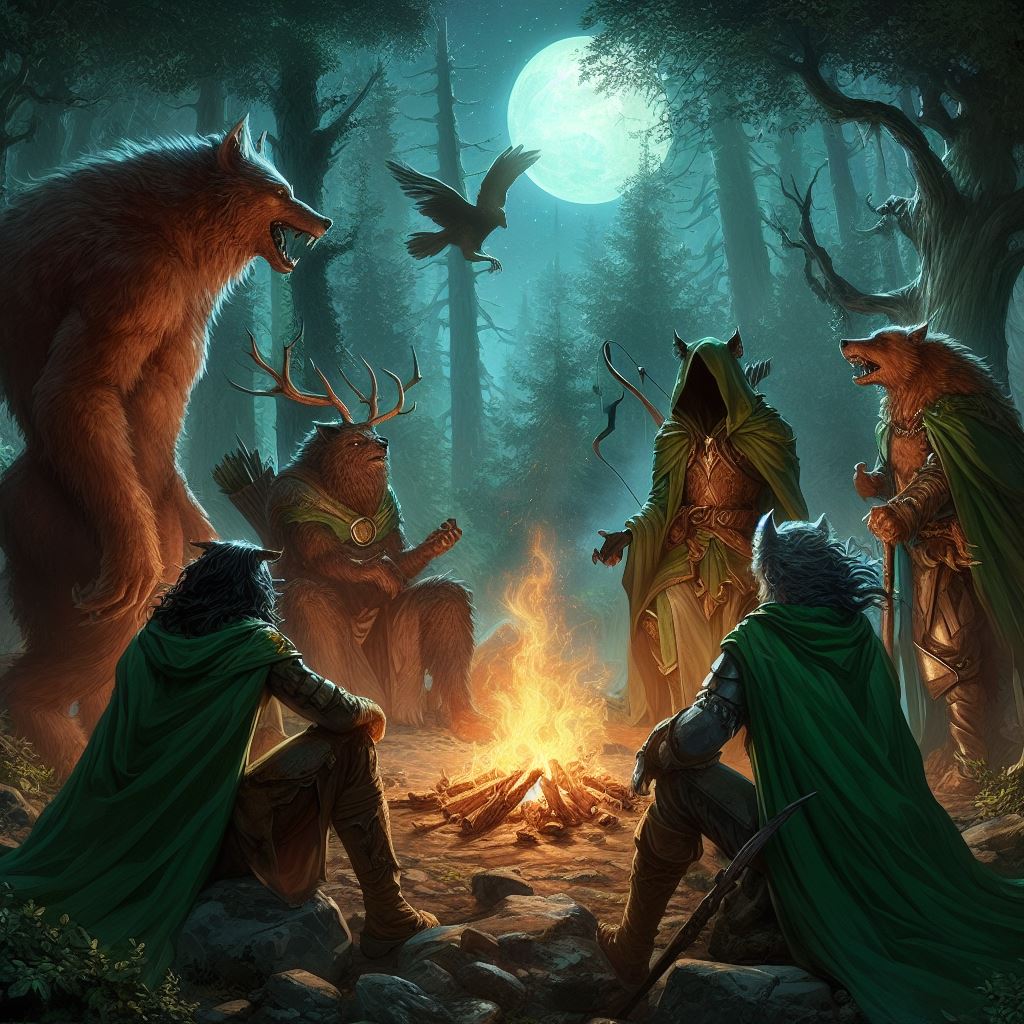
Work in progress: Druid is being built toward this design, and current game behavior differs in places.
Druids serve Gaea through grove, storm, root, beast, moon, water, stone, fire, rot, and renewal. The sea and stone, the storm and sun, the animals and plants, the patient work of decay, and the first green push after ruin all belong to their circle.
In Play
A Druid reads the ground first. Forest, swamp, desert, cave, storm, moonlight, and sacred grove all change which rites feel near at hand.
- Read the terrain
- Gather components and profession materials
- Tend a sacred grove
- Use rites that match the land, path, and form
- Craft Druid-only Alchemy blueprints
- Master favorite rites through real use
Natural Attunement
Natural Attunement rises through rite use, grove service, harvesting, path practice, living pilgrimages, and acts that restore natural balance.
| Rank | Opens |
|---|---|
| Seed | Calm Animal, Spirit Aura, Thorns, Produce Flame, Gust, Water of Life, grove planting, basic forage |
| Root | Create Water, Warp Wood, Growth, Stoneskin, Wild Speed, Wild Strength, Scry, Frighten, basic Verdant Alchemy |
| Bloom | Wolf Form, Water Walk, Frost Bolt, Flame Blade, Frost Blade, Whirlwind |
| Branch | Bear Form, Hawk Form, Entangle, Purify Blood, Taint Blood, Nature Step, Befriend Animal |
| Canopy | Serpent Form, Call Ravens, Resist Poison, Wind Walk, Resist Cold, Eagle Eye |
| Thorn | Resist Lightning, Locust Swarm, Resist Fire, Sunray, Mire, Call Lightning |
| Stone | Earth Meld, Shatter, Earthquake, advanced grove communion |
| Rain | Renewal, Inferno, Drown, improved components, stronger sanctuary work |
| Elderwood | Conjure Elemental, Reincarnate, ancient grove benefits |
| Verdant Myth | Deep path capstones, elder lunar rites, grove miracles |
Rite mastery moves from Known to Practiced, Fluent, Rootbound, and Elder. Higher mastery improves cost, recovery, terrain hooks, grove hooks, form hooks, and component use.
Sacred Grove
Every Druid has a sacred grove planted in the wild. It grows through care, components, and plant or renewal magic used nearby.
| Grove Stage | Use |
|---|---|
| Seedling | Faint recovery and a visible bond |
| Sapling | Clearer answers from the grove |
| Young Grove | Component storage, recovery, and personal rites |
| Mature Grove | Inner sanctum, deeper communion, reduced rite costs |
| Ancient Grove | Safety, memory, shared respect, stronger grove pulse |
| Grove Focus | Benefit |
|---|---|
| Garden | More herbs, rarer components, stronger plant work |
| Cavern | Stone, endurance, underground routes, earth memory |
| Sacred Pool | Healing, recovery, water rites, reflection |
| Archery Glade | Wind, sight, ravens, ranged nature magic |
| Primal Clay | Wild shape, beast memory, body change |
| Moonwell | Lunar alignment, tide, gravity, and astral rites |
Terrain And Components
| Terrain | Druid use |
|---|---|
| Forest, jungle, swamp | Plant rites, animal contact, thorns, entangle, wolf, bear, serpent |
| Plains, hills, path, farm | Movement rites, beast forms, weather signs, ravens |
| River, lake, sea, beach | Water rites, cleansing, tidecall, drowning work, moon work |
| Mountain, cavern, underground | Stone rites, earthmeld, endurance, elementals |
| Desert, barren land, ash fields | Fire, sun, drought, endurance, difficult component work |
| Sky and open weather | Wind, storm, lightning, hawk, ravens, moon signs |
Attunement reads the current terrain. Favorable terrain strengthens forms and changes certain rites.
Harvesting And Verdant Alchemy
Druids use Professions as part of guild life. Herbalism turns wild herbs into potions, poultices, grove offerings, rite catalysts, and blueprint ingredients.
| Blueprint Family | Examples | Use |
|---|---|---|
| Poultices and balms | Grove Poultice, Renewal Salve, Rootmender Balm | Healing, recovery, poison care |
| Wards and oils | Barkskin Resin, Storm Oil, Moon-Glass Wash | Defensive buffs and rite prep |
| Lures and bonds | Beast Lure, Raven Feed, Elemental Salt | Follower handling and summon focus |
| Terrain catalysts | Mire Spores, River-Stone Tincture, Skyseed Incense, Ashfield Ember | Shapes the next matching rite |
| Grove offerings | Seed Cakes, Root Tea, Moonwell Dew, Ancient Compost | Grove growth and root-stash expansion |
| Rebirth preparations | Last Breath Moss, Reincarnation Seed, Green Grave Oil | Renewal and reincarnation |
Blueprints unlock through Alchemy, Attunement, path work, and grove stage.
Paths And Spheres
| Path | Theme | Rites |
|---|---|---|
| Nurture | Healing, growth, cleansing, safe passage | Water of Life, Create Water, Purify Blood, Renewal |
| Erosion | Rot, venom, blight, breaking false permanence | Taint Blood, Mire, Shatter, Locust Swarm |
| Harmony | Balance, resistance, aura, sanctuary | Spirit Aura, Rainbow Aura, resistances, grove pulse |
| Convergence | Flesh, stone, beast, element, transformation | Wild Shape, Stoneskin, Enlarge Animal, Conjure Elemental |
| Impulse | Storm, speed, hunger, predatory motion | Gust, Wild Speed, Call Ravens, Call Lightning |
| Lunar | Moon, tide, gravity, mists, astral roads | Moonbeam, Moonlit Mists, Lift, Tidecall, Astral Walk |
Spheres are the spell lenses: Animal for companions and forms, Plant for growth and thorns, Water for healing and drowning, Air for wind and storm, Earth for stone and endurance, Fire for heat and harsh renewal.
Wild Shape And Followers
Druid forms are spirit-forms learned through Gaea's mysteries.
| Form | Use | Favored terrain |
|---|---|---|
| Wolf | Evasion, pursuit, fast hunting | Forest, jungle, swamp, plains, hills, path |
| Bear | Endurance, body strength, punishment | Forest, jungle, swamp, plains, hills, path |
| Hawk | Scouting, agility, sky movement | Sky, mountain, forest, plains, jungle, hills |
| Serpent | Venom, strength, tight places | Swamp, jungle, forest, underground, river, lake |
| Ally | Use |
|---|---|
| Befriended animal | Natural companion won through trust and rite work |
| Befriended plant | Rooted or ambulatory plant ally shaped by Gaea's spirit |
| Ravens | Short-lived swarm for distraction and harrying |
| Air elemental | Speed, disruption, lightning and wind resistance |
| Earth elemental | Durability, stone force, stability |
| Fire elemental | Aggression, heat, burning force |
| Water elemental | Recovery, flow, cold and drowning themes |
Rites
| Rite Family | Rites |
|---|---|
| First rites | Calm Animal, Spirit Aura, Thorns, Produce Flame, Gust, Water of Life |
| Growth and body | Create Water, Warp Wood, Growth, Stoneskin, Endurance, Wild Speed, Wild Strength |
| Sight and fear | Scry, Frighten, Eagle Eye |
| Blades and cold | Frost Bolt, Flame Blade, Frost Blade, Sky Blade, Ice Storm |
| Movement | Water Walk, Nature Step, Wind Walk, Earth Meld |
| Binding and terrain | Entangle, Mire, Shatter, Earthquake, Engulf |
| Blood and balance | Purify Blood, Taint Blood, Rainbow Aura, Resist Poison, Resist Cold, Resist Lightning, Resist Fire |
| Beasts and allies | Enlarge Animal, Befriend Animal, Call Ravens, Conjure Elemental |
| Storm and disaster | Whirlwind, Exterminate, Locust Swarm, Sunray, Call Lightning, Inferno, Drown |
| Restoration and cycle | Renewal, Reincarnate |
| Wild shape | Wolf Form, Bear Form, Hawk Form, Serpent Form |
Lunar Rites
| Lunar Rite | Use |
|---|---|
| Lunar Alignment | Reads the three moons and their present influence |
| Moonbeam | Calls moonlight as direct force |
| Moonlit Mists | Uses mist, reflection, and moon-shadow for defense |
| Moon Reflection | Turns moonlight into scrying and omen work |
| Lift | Bends gravity around a creature or object |
| Tidecall | Pulls water, blood, and weather through moon force |
| Moon Swarm | Calls restless lunar force around enemies |
| Scourge | Turns harsh moonlight into punishment |
| Moonblade | Shapes a temporary weapon from moonlight and sky force |
| Astral Walk | Travels through moonlit spirit roads |
Dailos brings disease and change. Markas brings sanctuary and healing. Tekal brings knowledge, balance, and strange gravity.
Restrictions
Druids favor leather, hide, wood, bone, stone, cloth, plant fiber, silver, and gold. Heavy plate and most forged metal armor break the covenant. Sickles, daggers, staves, spears, polearms, bows, thrown weapons, and simple blunts fit. Extreme holiness or corruption disrupts spellcasting.
Field Commands
| Command | Use |
|---|---|
dscore | Shows Druid status, terrain, grove, components, and known powers |
attune | Reads the current terrain |
dcomponents | Shows carried Druid components |
professions, reagents | Shows profession progress or stored materials |
gather herbs, forage components | Harvests herbs or natural components |
grove plant, grove status | Plants or checks a personal sacred grove |
grove stash | Stores or retrieves components from the grove |
groves, commune | Lists mature groves or enters a grove sanctum |
study, learn, meditate, master | Reviews, learns, or deepens powers |
begin, quickcraft, read, manufacture | Uses Alchemy and blueprints |
wildshape <form>, unshift | Enters or leaves spirit-form |
release, dismiss, secure, allow | Manages followers and carried items |
unleash, heel, toggle | Controls follower combat behavior |
dchat, edchat, dhist | Uses the Druid channel |
gaea, egaea, gaeahist | Uses the shared Gaean nature channel |
Mage

Peering into the Dark Wind, Magi learn to read and alter the patterns beneath the visible world. Heat has structure; distance can be folded; memory leaves a pristine copy behind the mind. Death, light, and even an interrupted moment can be written down if the Mage is patient enough. Those observations accumulate in a leather-bound spellbook, and the field is where they become more than theory.
In the guild's older vocabulary, gramarye is the art and a spell made real is a working. Cantrips, charms, and malisons describe the temper of particular workings rather than separate advancement tracks.
Mage is intended to feel useful immediately. Mana Shard and Missile are steady first-page attacks, while Analyze, Detect, and Blaze give a new member reasons to open the spellbook outside combat. Level-appropriate fighting supplies most Mage guild XP, or GXP. Useful field casting adds smaller, rate-limited awards, so varied play advances Arcane without rewarding empty repetition. Arcane has fifteen ranks, and every rank reveals another portion of the spellbook.
Learning the spellbook
A working develops its own history alongside Arcane. Its first useful casts move it from Copied to Practiced, then onward through Fluent, Inscribed, and Instinctive. The progression is compact enough to understand at a glance, but the consequences accumulate naturally: costs fall, rune sockets open, and automatic casting becomes quicker.
| Mastery | Useful casts | What changes |
|---|---|---|
| Copied | 0 | The working can be cast normally |
| Practiced | 50 | First rune socket and barrage access |
| Fluent | 150 | Better efficiency and a faster barrage |
| Inscribed | 250 | Second rune socket and further efficiency |
| Instinctive | 1,000 | Best ordinary cost and barrage efficiency |
The first rune socket makes a familiar page personal. Ashkenazy may push it toward raw force, Talek toward cold and Chilled, or Ravidel toward fire and Burning. By the time the second socket opens, two Magi can carry the same working and use it rather differently.
Workings and combat
| Arcane | Workings |
|---|---|
| 1 | Analyze, Blaze, Detect, Mana Shard, Missile |
| 2 | Find, Illuminate |
| 3 | Fireball, Recollection |
| 4 | Icestorm, Insane, Investiture |
| 5 | Teleport |
| 6 | Armor, Echoform, Mage Eye |
| 7 | Bolt |
| 8 | Levitate, Stasis |
| 9 | Invisibility, Mage Unlock, Necrosis |
| 10 | Phase |
| 11 | Gate, Glassstorm |
| 12 | Inferno |
| 13 | Powerup |
| 14 | Wrath |
| 15 | Singularity, Touch |
The combat pages are meant to form sentences rather than sit as isolated buttons. Fireball and Inferno leave Burning behind. Icestorm brings Chilled, and Stasis resolves a few seconds after casting with cold damage and Freezing. Glassstorm hangs written panes in the air before breaking them across nearby enemies and applying Exposed. Once the room is carrying enough hostile conditions, Singularity consumes them and gains fifteen percent damage from each, up to seventy-five percent. A group that brings its own statuses can help write the same ending.
Echoform waits beside the Mage's thoughts and copies the next direct offensive working for a thirty-five percent echo two seconds later. Recollection is the quieter signature spell. After a vulnerable four-second weave it restores all missing SP at the cost of ten percent maximum health. Its private timer begins at ten minutes. Recollection mastery removes one minute at Practiced, two at Fluent, three at Inscribed, and four at Instinctive; wielded FOCUS and worn AURA equipment each remove another minute, with a five-minute floor.
Delayed workings require commitment. Movement by the Mage or a chosen target tears the unfinished geometry loose, and another working cannot begin until the pending one resolves. The delay is visible through the normal buff/status display, making the risk legible to both the caster and the group.
Battlemage resonance
Barrage lets Mana Shard, Missile, Fireball, Icestorm, or Bolt cast a lighter
copy of itself beside ordinary combat. A Practiced working can be prepared with
barrage <working> and continues to improve as its automatic casts land. Its
cadence rises from every four combat rounds at Practiced to every three at
Fluent and every two at Inscribed. Mastery lowers its SP cost, Falx can quicken
the rhythm, and Instinctive barrage costs nothing.
Wielding a FOCUS brings that playstyle forward. Any known barrage working may be prepared while it is still Copied, its automatic casts cost no SP, and the weapon improves both cadence and damage. Worn AURA equipment completes the battlemage resonance, adding another improvement to each. A freshly Copied working therefore fires every four rounds with FOCUS alone or every three with both pieces; practice soon brings the fully resonant cadence to its floor of two rounds. The Mage still makes ordinary weapon attacks and may still choose manual workings, so the result feels like weapon-and-spell combat rather than a caster waiting between commands.
battlemage reports the current equipment resonance, prepared page, cadence,
SP cost, and Recollection timer. barrage off releases the prepared working.
Investiture opens at Arcane 4 and lets a Mage borrow one missing half of the
style. investiture focus writes temporary FOCUS resonance over an ordinary
wielded weapon, while investiture aura draws an AURA around the caster. The
working is bound to the chosen weapon and goes dormant if that weapon is no
longer wielded. Because only one Investiture can be sustained, it completes a
real FOCUS or AURA rather than conjuring full resonance by itself.
Runes and the old Isle
Four rune patterns belong to ordinary Arcane instruction. Five others wait for the spellbook to witness a feat or discovery.
| Rune | Tradition | Effect | How it opens |
|---|---|---|---|
| Ashkenazy | Exaltation | Stronger raw spell power | Arcane 3 |
| Falx | Alacrity | Faster barrage cadence | Arcane 3 |
| Saloman | Bastion | A small SP return | Arcane 4 |
| Talek | Boreal | Cold damage and Chilled | Arcane 4 |
| Marsellus | Augmentation | A chance of a force echo | Three Fluent workings |
| Mezari | Amity | Lower cost and cleaner shaping | One Inscribed working |
| Ravidel | Igneous | Fire damage and Burning | Fifty useful fire casts |
| Arcanarton | Entropy | Chaos, disease, and unstable force | The broken theorem |
| Bodach | Demise | Death magic and life siphoning | The silence beneath the Isle |
The Isle of the Magi lies south of Darkwind, still scarred by the war that separated Mage and Necromancer lore. At Arcane 9, a Mage can attune to the surviving Focus Point and enter the buried portion of Arcanarton's broken tower. A fused palimpsest and a violet fracture preserve more of the old argument than the official history admits. Bodach's page waits elsewhere, beneath the disused well, after the Wyrm's breath no longer overwhelms the quieter voices there. These discoveries remain in the spellbook permanently.
Long study and useful commands
GXP continues accumulating at Arcane 15. Surplus study opens Silverline,
Ember Script, Aurora Hand, and finally the Void Palimpsest. These marginalia
styles change the flourish around completed workings without making the cap
another compulsory power climb; marginalia lists the open styles and selects
one.
Most of the guild can be navigated through a small set of commands. research
or study describes Arcane progress and the next page. spellbook follows
mastery, rune sockets, equipment resonance, and the prepared barrage, while
spells is the working index. runes, inscribe, and unbind manage the
customization pages. battlemage explains the live weapon-and-AURA setup.
Guild conversation uses mage <message>—with m and ma as aliases—and
magi lists visible members.
Monk
Work in progress: Monk is being built toward this design, and current game behavior differs in places.
Monks train the body until discipline becomes a weapon. Breath, chi, staff work, empty-hand forms, notches, challenges, and combos define the guild.
In Play
Monk is breath, rhythm, posture, and the body used with complete intent.
- Choose a style for the fight
- Build or steady Chi
- Use staff, fist, sweep, kick, and point strikes
- Chain moves into combos
- Meditate, train, and earn notches from formal challenges
Chi
Chi powers burst, defense, recovery, transfer, and special techniques. It rises through meditation, clean combos, training, hard survival, and style triggers. It falls when spent on advanced techniques.
Styles
| Style | Use |
|---|---|
| Crane | Reach, balance, defense, countering |
| Snake | Body points, precision, disruption |
| Monkey | Mobility, evasion, misdirection |
| Tiger | Damage, grapples, decisive offense |
| Dragon | Chi power, roar, burst, mastery |
Styles change which attacks flow cleanly and which recovery options feel natural.
Combos
Combos are planned routes. Example routes:
- Sweep into staff strike
- Body point into open punch
- Grapple into tiger punch
- Chi focus into chi blast
- Crane defense into counterstrike
Notches And Challenges
Notches record training victories, formal tests, and memorable fights. Challenges open higher training, stronger combos, and better Chi control.
Abilities
| Ability | Use |
|---|---|
| Meditate | Centers the Monk and restores focus |
| Chi Focus | Stores power for techniques |
| Staff Strike | Reliable staff attack |
| Open Punch | Empty-hand strike |
| Leg Sweep | Knocks enemies off balance |
| Body Point | Weakens, slows, or interrupts |
| Combo | Runs a practiced chain |
| Chi Blast | Releases stored Chi as force |
| Chi Transfer | Sends focus to an ally |
| Resuscitate | Emergency recovery technique |
Training Commands
| Command | Use |
|---|---|
monk, monks | Speaks on the Monk channel or lists Monks |
monkhist | Reviews recent Monk channel history |
mskills | Shows Monk skills |
meditate | Centers and restores focus |
chifocus | Builds or steadies Chi |
mcombo | Reviews or uses combo routes |
rtrain | Reviews training |
mswitch | Changes style or training focus |
sstrike, opunch, tpunch | Uses staff or punch attacks |
lsweep, ppoint, grapple | Disrupts footing, breath, or control |
chiblast, chiburst, chitransfer | Spends Chi |
resuscitate | Uses emergency recovery |
Ninja
Ninja are disciplined assassins built around stealth, disabling strikes, bare-handed combat, and short technique combos.
Joining requires level 5 and at least 10 unmodified Dexterity.
Progression
Ninja have two independent progression tracks:
- Guild level rises only when Yagyu accepts proof of a newly completed unique assassination mark. Marks do not cost experience or guild XP. There are 50 marks and guild level 50 is final.
- Ninja rank rises every 250 guild XP (GXP). Each rank after rank 1 grants one training session. Rank does not change guild level.
Qualifying combat kills use the shared guild-kill award system; NPCs ten or more levels below the Ninja grant no battle GXP. A fully validated Ninja skill attempt awards 2 GXP, whether its reliability roll succeeds or fails, subject to per-skill pacing. Resolving a three-piece combo awards another 10 GXP.
Reliability and Training
Unlocked trainable skills start at 70% reliability. practice <skill> spends
one available session to add 5%, up to 100%. Failed reliability rolls charge
one fifth of the evaluated SP cost and do not consume required items, start the
normal cooldown, or add a combo piece.
nskills displays guild level, marks, Ninja rank, residual GXP, available
sessions, and each skill's reliability.
gscore ninja also reports whether nswitch is currently using bare hands
or ordinary weapons, including the screen-reader presentation.
Marks
Ask Yagyu in the Kerei guildhouse to accept challenge. Kill the assigned
target yourself, use bloody to mark the kunai with that exact target's
corpse, and give the kunai back to Yagyu. Suggested target level influences
assignment selection but is not an advancement gate.
Every assignment permits one free reroll challenge. The replacement is a
different incomplete mark; the rejected mark remains eligible later. Use
list challenge to review the active assignment and completion count.
Combos and Pummel
Successful offensive techniques add pieces to the wraps. Three recent pieces resolve during combat, producing a specialized result for recognized combinations or a general burst otherwise. Pieces expire after a short time.
Pummel applies a stacking physical vulnerability. Its duration is
min(90, 30 + 2 * guild level) seconds and it can end early after its extra
damage budget is exhausted.
Common Commands
| Command | Use |
|---|---|
ninhelp | Opens in-game Ninja help |
nskills | Shows abilities and both progression tracks |
practice <skill> | Spends a training session for 5% reliability |
ninja, ninjas, ninhist | Guild channel and history |
nfocus, nmed, nmark, ntrack | Setup and target study |
fade, nmelt, nshroud, onmitsu | Concealment and escape |
blind, cripple, kekomi, pummel, tsubo, tsuki | Combat control |
shuriken, heartstop, dimmak | Ranged and finishing attacks |
Ranger
Work in progress: Ranger is being built toward this design, and current game behavior differs in places.
Rangers are practical wilderness specialists. They know terrain, tracks, weather, tools, camps, animal helpers, and the quiet work that happens before the first arrow lands.
In Play
Ranger studies the land, reads the trail, and survives.
- Read the terrain
- Track or choose quarry
- Prepare a camp, trail mark, trap, or ambush
- Open from range or from cover
- Keep the fight on ground the Ranger understands
Terrain
Familiar ground gives better tracking, cleaner foraging, stronger ambushes, and safer camps.
| Terrain | Advantage |
|---|---|
| Forest | Concealment, foraging, animal movement |
| Swamp | Slow fields, poison, hidden routes |
| Road | Trail marks, pursuit, caravan knowledge |
| City | Rooftops, alleys, contacts, urban quarry |
| Cave | Echoes, darkness, stone routes |
| Coast | Weather, tide, fish, wet ground |
| Snow | Tracks, cold, silence |
Terrain familiarity rises by traveling, foraging, tracking, camping, and fighting on that type of ground.
Quarry
Quarry study improves tracking, ambush openings, called shots, companion behavior, trap placement, and material recovery.
Camps
Camps are temporary field positions for recovery, gear sorting, track reading, and planning. Familiar terrain and field materials make them stronger.
Companion
Ranger companions scout, track, distract, retrieve, guard, and help finish wounded quarry. Training and field use improve them.
Abilities
| Ability | Use |
|---|---|
| Forage | Finds food, herbs, components, and field materials |
| Camp | Creates temporary recovery and safety |
| Track | Follows a target through terrain |
| Stalk | Prepares an ambush |
| Trailmark | Leaves useful route memory |
| Ambush | Opens combat from preparation |
| Aim | Improves a shot through patience |
| Quickshot | Fast ranged attack |
| Heartshot | High-risk precision shot |
| Train | Improves companion behavior |
Field Commands
| Command | Use |
|---|---|
ranger, rh | Speaks on the Ranger channel or reviews history |
rhelp | Opens Ranger help |
terrain | Reviews terrain familiarity |
forage | Gathers field materials |
camp | Prepares a temporary camp |
track | Follows a trail |
stalk | Prepares an ambush |
ambush | Strikes from preparation |
aim, quickshot, heartshot | Uses ranged attacks |
quarry | Reviews studied targets |
train | Works with a companion |
Swashbuckler
Dashing rogues, gallant courtiers, outlaw kings, pirates, kensai, duelists, and dockside troublemakers all find a home in the Swashbucklers. They trust quick feet, light armor, a ready blade, a better insult, and the kind of nerve that turns a bad room into a story.
In Play
A Swashbuckler is at home in courts, taverns, alleys, ships, forts, and any place where someone important thinks they are safe. The guild fights in the open, usually with a jest on the tongue and a blade already moving.
A Swashbuckler steals the room. The guild wins by making the fight public, personal, flamboyant, and just a little haunted.
- Choose a proper blade
- Start one or more techniques
- Build Flair by holding the fight, landing criticals, and wielding named weapons
- Spend Flair on quick pressure or a decisive push
- Challenge, charm, parley, skulk, or toss a doubloon when the room turns ugly
- Steal attention with a flourish, insult, named blade, or ghostly echo
- Name the weapon that survives long enough to deserve it
Blades
Many Swashbuckler powers require a blade: knives, daggers, rapiers, sabres, cutlasses, short swords, katanas, and other light or one-handed swords. A good blade is more than a damage number. It has weight, balance, edge, story, and the right sort of arrogance in the hand.
sevaluate reads a weapon without making it magical. It tells the Swashbuckler
what the blade is good for, whether it suits slashing or thrusting, and whether
it has oddities worth noticing.
Finesse
Finesse measures how much blade work a Swashbuckler can keep alive at once. A young Swashbuckler handles one technique. A seasoned one layers styles until the fight looks unfair.
Technique strain comes from:
- Technique weight
- Blade type
- Armor weight
- Current tempo
- Charm and reputation
- Multiple offensive techniques
- Multiple defensive techniques
Too much strain makes the dance ugly. A good Swashbuckler knows when to add another flourish and when to stop before the feet get tangled.
Rank and Flow
Swashbuckler Rank is open-ended and earned through GXP from qualifying kills,
active combat windows, and triggered techniques. Ability Tier is
1 + floor(2 * sqrt(rank - 1)); it synchronizes the legacy guild level so
existing abilities, titles, and rooms remain compatible.
Flow rises by 5 on eligible combat heartbeats, to a maximum of 100. It holds for six seconds after combat ends, then falls by 10 per heartbeat. Flow discounts positive technique SP costs by up to 50%. At full Flow, each eligible combat round has a 5% chance to steal one guaranteed weapon hit. At Tier 15 and full Flow, Dance of Death can separately and very rarely make the next paid triggered technique free.
An effect that prevents fleeing does not disable in-room attacks such as Slip, Press, Wound, Sap, Thrust, or Flank. Physical restraint still blocks those maneuvers, while Skulk retains the fleeing/movement check because it actually changes rooms.
Flair
Flair is the visible part of Swashbuckler skill: the glove slap, the impossible bow, the lucky coin, the cutting joke, the named blade held high while someone bleeds on the floor. In combat, it is also a spendable momentum resource.
Flair starts at zero, decays outside combat, and caps at 10 + CHR/10. Each
active combat round offers a chance to gain Flair. Wielding a named weapon
provides an additional opportunity, and Flourish improves both chances. A
critical hit grants one Flair, at most once per combat round.
Flair spenders currently include:
| Skill | Guild level | Cost | Effect |
|---|---|---|---|
slip <foe> | 3 | 2 Flair, no SP | Makes a quick strike with a slashing or piercing main-hand weapon; uses a micro damage timer |
press <foe> | 8 | 8 Flair, no SP | Presses a controlled current foe: own Challenge grants a full round, hard control a main-weapon sequence, and soft control one swing plus four seconds of Exposed |
Techniques
Techniques are blade styles. Some trigger when the right moment appears. Others
pull effort every round. They can be started and stopped with starttech and
stoptech.
| Technique | What it does |
|---|---|
| Parry | Deflects the force of incoming blows |
| Slash | Trades refinement for direct power, scaling at each character-level bracket |
| Dodge | Lets footwork carry the Swashbuckler out of danger |
| Offensive Spin | Hides true attacks behind spinning steel |
| Called Shot | Finds weak places in armor and guard, scaling at each character-level bracket |
| Disarm | Relieves an enemy of a weapon |
| Riposte | Answers an incoming blow with a quick strike |
| Critical Strikes | Drives the blade deeper when a clean opening appears |
| Weapon Break | Catches a weapon and ruins it with a sharp twist |
| Phantom Strikes | Calls fallen brethren to lash through the enemy's defense |
| Impale | Follows through with deep piercing wounds, scaling at each character-level bracket |
| Flurry | Guarantees one extra swing when triggered; Hero and Legend levels unlock rank-heavy chances for a second and third extra swing |
| Flourish | Mesmerizes with beautiful, dangerous blade work |
| Thousand Blades | Buries the real attack inside false ones |
| Dance of Death | Full Flow can steal a weapon hit; Tier 15 adds the rarer chance for one free triggered technique |
| Spectral Siphon | Drains up to 12 SP and restores exactly what was drained |
Dance of Death is passive at Tier 15; sdance remains reserved only for
compatibility messaging. Spectral Siphon unlocks at Tier 18.
Phantom Brethren
The Order keeps company with its dead. Old duelists, drowned pirates, vanished kensai, and nameless bladesmen linger around the guild's flashiest work. They answer best when a Swashbuckler fights with a named weapon, holds the center of the room, or risks everything on a beautiful mistake.
The ghostly side stays concrete. phantom calls fallen brethren into the
attack. Black Flag Bravado leans harder into drowned pirates and haunted
boarding work. Named weapons and the Dance of Death give those echoes style
and timing while phantom remains the main ghostly technique.
Tricks
Swashbucklers are duelists. Style counts. So does leaving a room before anyone notices, buying luck with coin, insulting a foe into standing still, and talking a brawl into a truce.
| Trick | What it does |
|---|---|
| Challenge | Insults a foe into staying for the fight |
| Charm | Draws every eye in the room and sharpens presence |
| Kiss of True Love | Restores a little health to the Swashbuckler and another out-of-combat player |
| Parley | Negotiates a truce in the room |
| Skulk | Enters or leaves a room unnoticed |
| Doubloon | Offers coin for a lucky defensive charm |
| Slip | Spends a little Flair for a quick weapon strike |
| Press | Spends heavy Flair to exploit Challenge or another crowd-control opening |
| Flank | Sidesteps into extra blade work |
| Thrust | Finishes a wounded foe with precise force |
| Wound | Opens a cut that keeps bleeding |
| Sap | Drains dexterity through a ghostly blade cut |
| Stagger | Turns unsteady movement into a brief reset |
| Flame | Burns a target using intoxication, with a chance of a five-tick self-burn |
| Defensive Spin | Uses a slashing weapon to counter attackers for 60 seconds |
Some of the guild's theater is practical. Some of it is simply necessary. A dramatic bow, a glove slap, a carved initial, a lucky coin, and a weapon juggled while waiting all belong to the same tradition.
Named Weapons
Naming a weapon begins as style. It becomes history when the blade survives duels, escapes, wounds, insults, impossible victories, humiliations, and recoveries. The name makes the weapon personal.
Named blades can remember:
- Notable opponents
- Favorite techniques
- Public challenges
- Parley victories
- Broken weapons
- Lost duels
- Recoveries after embarrassment
Bravados
Bravado is a polished flavor of trouble. A Swashbuckler learns a Bravado from a branch, keeps one polished at a time, and can retrain when another kind of trouble calls louder.
Each Bravado gives one signature trick and nudges a small set of existing techniques. The core guild stays the same: blades, Finesse, tricks, named weapons, and nerve.
| Bravado | Learned from | Signature |
|---|---|---|
| Candlelight | Darkwind Order | Charm, challenge, or skulk can open a cleaner first cut |
| Spirit Mask | Kerei Kensai | Phantom and flourish can leave a short bad-luck mark |
| Firedance | Souvrael Desert Legion | A prepared blade can catch fire for short burning work |
| Buckler | Hyperborean Cave | Buckler work improves parry, riposte, and shield-side counters |
| Black Flag | Haunted coasts and the Fallows | Phantom attacks gain drowned-pirate bite during flurry or boarding-style attacks |
Advancement
Swashbucklers advance through Finesse, technique mastery, duels, daring escapes, public victories, blade work, and a reputation that can survive being seen.
| Rank | Opens |
|---|---|
| Novice Fencer | Parry, skulk, slice, name weapon, evaluate weapon |
| Mischievous Scoundrel | Slash, sharpen, candle, early roguish work |
| Merry Outlaw | Dodge, offensive spin, slip, better Finesse |
| Daring Desperado | Challenge, charm, first public tricks |
| Courtly Adventurer | Called shot, Swashbuckler call, better teamwork |
| Thrillseeking Explorer | Disarm, insult, locate Swashbucklers |
| Infamous Soldier of Fortune | Riposte, trouser-cutting humiliation |
| Dashing Courtier | Parley, press, thrust, cleaner duel control |
| Beguiling Rogue | Critical strikes, weapon break |
| Famed Swashbuckler | Phantom strikes, impale, doubloon |
| Legendary Duellist | Flurry, wound, chosen weapon |
| Paragon of Swashbucklers | Flourish, thousand blades, sap, inspire |
| Blademaster | Passive Dance of Death, blademaster line, legendary style |
| Tier 16 | Flame |
| Tier 17 | Defensive Spin |
| Tier 18 | Spectral Siphon |
Deck Commands
| Command | Use |
|---|---|
sb, esb, swash, eswash | Speaks or emotes on the Swashbuckler channel |
sbhist | Reviews recent Swashbuckler channel history |
swashies, swho, sbwho | Lists active Swashbucklers |
sbskills, sbhelp | Shows skills or help |
starttech <technique> | Starts a blade technique |
stoptech [technique] | Stops one technique or all techniques |
challenge <foe> | Challenges a foe to stay and fight |
charm, parley, skulk <direction> | Uses social or escape tools |
sbkiss <player> | Shares a small out-of-combat heal with another player |
sevaluate <weapon> | Studies a weapon |
sbsharpen <weapon> | Improves a suitable blade |
nameweapon <weapon> to <name> | Names a weapon |
bravado | Reviews or trains the active Bravado |
doubloon | Creates a lucky defensive charm from coins |
slip <foe>, press <foe> | Spends Flair for immediate blade pressure |
sbflank <foe>, sthrust <foe> | Uses position or thrust attacks |
wound <foe>, ssap <foe>, stagger | Uses dirty blade work |
flame <foe>, dspin [off] | Uses post-Blademaster fire and defense |
Thief
Work in progress: Thief is being built toward this design, and current game behavior differs in places.
Thieves turn information, access, timing, and opportunity into power. They case rooms, scout exits, steal coins, lift objects, plant evidence, trap paths, follow marks, hide in plain sight, poison blades, and strike when the target is already compromised.
In Play
Thieves care about the thing everybody else forgot to guard: the purse, the door, the evidence, the exit, the witness, the back.
- Case the target or room
- Scout exits and escape routes
- Steal, palm, pick, plant, trap, or shadow
- Let Heat rise only as far as the job is worth
- Enter combat with poison, marks, position, and dirty tricks
- Leave with the money, item, secret, or body
Jobs
Jobs are the Thief's real work.
| Job | Use |
|---|---|
| Roll Corpse | Finds hidden coins and valuables on a corpse |
| Money | Checks a target's carried coin |
| Case | Studies inventory, value, and physical threat |
| Scout | Looks into nearby rooms before entering |
| Silent | Leaves without showing the direction |
| Shadow | Follows a target quietly |
| Hide | Vanishes into shadow for a limited time |
| Palm | Picks up items without open notice |
| Pick | Steals an object from a target |
| Pilfer | Attempts broader item theft from a target |
| Peek | Looks into a target's container |
| Plant | Places an item on a target |
| Conceal | Hides an item from view |
| Break In | Forces access through a chosen direction |
| Trap Room | Prepares a room trap |
| Tripwire | Sets an alarm watched by guild apprentices |
| Contacts | Pays local informants for player information |
| Fast Talk | Talks a room out of combat |
Heat
Heat is the cost of being sloppy. Witnessed theft, repeated targets, botched jobs, public violence, and obvious escapes raise Heat. Clean escapes, time, contacts, and quieter work lower it.
Marks
Marks are prepared advantages from casing, shadowing, scouting, planting, trapping, or studying habits.
| Mark | Built By | Payoff |
|---|---|---|
| Target mark | Case, shadow, money, contacts | Better theft, strike timing, and escape choices |
| Room mark | Scout, trap, tripwire, silent movement | Safer entry, better ambushes, cleaner retreats |
| Container mark | Peek, pick, conceal | Better object theft |
| Evidence mark | Plant, palm, conceal | Frame jobs and misdirection |
| Blood mark | Poison, shadowstep, quick strike | Stronger bleeds and combat setups |
Dirty Fighting
Thief combat is unfair by design. The guild uses openings, bleeds, stuns, movement denial, poison, and prepared strikes.
| Trick | Use |
|---|---|
| Quick Strike | Early slash that opens or worsens a wound |
| Shadowstep | Fast shadowed strike with a deeper bleed |
| Trick | Dirty fighting tactic during battle |
| Critical Hit | Focuses on a stronger critical wound |
| Clever Strike | Uses dexterity, wit, and strength for a better cut |
| Sucker Punch | Punishes a weakness in the target's defense |
| Circle | Moves behind the target for a back cut |
| Disembowel | Heavy upfront cut followed by a large bleed |
| Tendon Strike | Attempts to stop movement through the hamstring |
| Back Stab | High-end strike from hiding against an exposed back |
| Poison Edge | Applies a poison packet to a weapon |
Advancement
Thieves advance through jobs, clean escapes, marks, contacts, traps, risky theft, and prepared violence.
Guild levels 2 through 20 are bought with gold coins carried on hand at the
guild hall: cost shows the price of the next level and advance guild pays
it. Your guild level must stay below your character level.
| Rank | Opens |
|---|---|
| Lookout | Roll corpse, quick strike, cant, guild communication |
| Pickpocket | Steal coins, money, basic poison access |
| Scout | Scout, shadowstep, tripwire |
| Quickfinger | Palm, squint, silent movement |
| Cutpurse | Contacts, trick, case |
| Burglar | Critical hit, conceal, unhide, plant |
| Shadow | Pick, trap room, shadow, hide |
| Knifeworker | Peek, circle, fast talk |
| Fixer | Break in, disembowel, tendon strike |
| Master Thief | Back stab, tactics, succor, assassin strike |
Job Commands
| Command | Use |
|---|---|
thelp | Opens Thief help |
tpowers, tskills, treport | Shows Thief powers |
thieves | Lists active Thieves |
ttell, thist, cant <message> | Uses Thief communication |
tnews, gtitle | Reads news or sets a guild title |
roll corpse, money <target>, case <target> | Starts basic jobs |
contacts | Pays informants for information |
scout <direction>, silent <direction> | Reads or leaves rooms quietly |
shadow <target>, `hide <on | off>` |
palm <item>, pick <item> from <target> | Lifts items |
tsteal <target>, steal <target> | Steals coins |
peek <container> on <target> | Looks inside a container |
plant <item> on <target> | Plants an item |
conceal <item>, unhide <item> | Hides or reveals an item |
tripwire, trap, breakin <direction> | Prepares access or alarms |
fasttalk | Attempts to stop combat |
poison <type> | Applies poison to a weapon |
qstrike, shadowstep, trick | Starts dirty combat |
crit, cstrike, spunch | Uses mid-fight precision attacks |
circle, disem, tstrike, stab | Uses high-risk finishing attacks |
Berserker
Berserker is an independent combat guild built around Fury, Frenzy, Madness, Vex training, and permanent scars.
Berserkers turn pain, fear, and bad odds into weaponized fury. They feed violence until it becomes a machine: build Fury, break into Frenzy, and keep Madness from taking the wheel.
In Play
Berserker starts simple.
- Fight and kill to build Fury
- Fury crests into Frenzy
- Frenzy tears through the enemy
- Vent, crash, recover, and start again
Mastery means riding Frenzy instead of ending it. Kills and heavy hits keep Fury moving. Staying in Frenzy builds Madness. Madness makes Frenzy stronger, opens harder effects, and raises the cost of losing control. A strong Berserker keeps Madness high enough to matter and low enough to survive.
Fury
Fury is the fuel. It rises from combat and falls when the Berserker vents, crashes, waits too long, or loses the chain of violence.
It can be tracked on the monitor bar if enabled (bstatus fury on) and ranges
from 0 to 100.
Fury rises from:
- Taking damage
- Landing heavy hits
- Killing enemies
- Being outnumbered
- Suffering a status condition
- Berserker skills
When Fury crests, Berserker Frenzy opens.
Automatic Frenzy performs five attacks, two seconds apart, and drains the entire Fury bar. Fury generation is suppressed until the barrage ends. The Berserker monitor shows the remaining Frenzy pulses and time, and reports when the Frenzy ends.
Frenzy
Frenzy is the Berserker's signature state and is available once Fury reaches its maximum. Initially, this presents as a barrage of attacks that happen automatically. This drains Fury, and prevents new Fury from being generated for a short duration.
Berserkers learn to hold onto Frenzy and release it by choice. This is Directed Frenzy.
While using Directed Frenzy mode, a Berserker who holds maximum Fury for too long gains Madness.
Directed Frenzy is unlocked through the Momentum Vex branch. Use
frenzymode directed, frenzymode automatic, and frenzymode release to
control it.
Madness
Madness is a measure of a Berserker that has given in to their rage. With Fury at its maximum, any additional Fury is tracked toward Madness, with each additional 100 Fury gained granting one level of Madness (up to 5).
It can be tracked on the monitor bar if enabled (bstatus madness on).
Madness falls when:
- The Berserker uses
vent - Frenzy ends naturally
- The Berserker leaves combat and remains calm
- Certain guild skills spend Madness
- Certain supernatural or alchemical effects soothe rage
Madness rises when:
- Fury would be gained while already at maximum Fury
- The Berserker scores a killing blow during Directed Frenzy
- The Berserker takes a large single hit while at maximum Fury
- The Berserker is stunned, paralyzed, feared, poisoned, or otherwise impaired
- The Berserker remains at maximum Fury without venting
The effects of each level are cumulative unless otherwise noted.
Madness Level 0
vent: At the cost of SP, the Berserker dumps all Fury and Madness- No passive Madness benefits or checks
Madness Level 1
- The Berserker gains minor passive damage resistance against weapon damage
- Berserker guild skills no longer consume Fury
- The Berserker occasionally suffers a Concentration block
- Dropping out of Madness gives a temporary stat penalty
Madness Level 2
- The Berserker cannot flee while actively fighting; normal movement returns when combat ends
- Berserker abilities remain usable while this no-flee restriction is active
- Weapon damage resistance improves
- Critical hit damage bonus
ventcost increases and reserves some SP
Madness Level 3
- The Berserker occasionally resists stun and paralysis effects
- Weapon damage resistance improves
- Chance to answer a weapon hit with one targeted main-hand or unarmed attack without changing combat targets
venthas a real failure chance
Madness Level 4
- Critical hit damage bonus
- Each main-hand attack has a 15% chance to gain at least one extra swing, a 4% chance to gain at least two, a 1% chance to gain at least three, and a 0.25% chance to gain four. One roll selects the whole long-tail result
- Momentum mastery improves every tier of that swing distribution; Madness 5 raises the baseline chances to 20%, 6%, 2%, and 0.5%
- High chance to lash out and attack random targets
Madness Level 5
Upon reaching Madness level 5, the Berserker loses control.
At this stage:
- Weapon damage resistance improves
- Higher chance to resist stun and paralysis effects
- The Berserker remains
Exposed - Outside combat, the Berserker suffers 2% of maximum health as blunt damage every 10 seconds until Madness falls below 5. A sufficiently strong Black Scar reduces or suppresses this damage
- Attacks can apply
Exposed
Scars
When Berserkers meet certain conditions, they receive a permanent mark on their body. They record what the Berserker survived and change what the Berserker becomes.
| Scar Type | Earned By |
|---|---|
| Blood Scar | Killing while badly wounded |
| Iron Scar | Surviving stuns, knockdowns, or heavy hits |
| Packbreaker Scar | Winning while outnumbered |
| Frenzy Scar | Holding Frenzy through multiple kills |
| Black Scar | Reaching max Madness |
Scars are permanent once earned. Training Flare allows one scar at a time to be activated for 60 seconds, increasing to 75 seconds at higher rank:
The full-strength duration appears as Flared Scar in the buffs display.
At sufficient Defiance mastery, its residual benefit continues quietly until
the Flare cooldown ends.
- Blood heals 8% of damage dealt at full scar strength, capped at 5% of maximum health per hit. Blood mastery 30 raises those values to 10% and 7%
- Iron increases weapon and control resistance
- Packbreaker improves combat performance while outnumbered
- Frenzy adds one pulse to the barrage, or two while fully flared, without increasing total Fury drain
- Black reduces Madness 5's out-of-combat self-damage and suppresses it at full strength
Vex Training
Berserker uses an independent, uncapped Berserker Rank. Its normal guild level remains at 1 for membership and dual-guild compatibility, so Berserker progression does not consume another guild's advancement allowance.
Rank starts at 1 and grants one Vex per Rank. XP required for the next Rank is:
250 + (3 * current Berserker Rank * current Berserker Rank)
Berserker XP is awarded automatically for meaningful NPC kills while Berserker is the active guild. The Berserker must land the killing blow or be listed among the killers after dealing at least 10% of the victim's maximum health. Pets, players, zero-XP NPCs, and enemies ten or more levels below the Berserker award none. The standard player kill tracker scales awards when too many recent kills come from the same area, encouraging varied hunting without eventually stopping combat XP altogether. Bosses are exempt from this scaling.
The Darkwind trainer also supports
convert berserker <normal-xp|next> outside combat. The conversion rate begins
at 1000 + (2 * Berserker Rank * Berserker Rank) normal XP per Berserker XP.
bstatus shows the current rate.
The 19 core nodes each have five ranks, making a 95-Vex core journey:
| Blood | Momentum | Defiance |
|---|---|---|
| Enrage | Batter | Shrug |
| Rend | Chain Violence | Thick Hide |
| Deep Wounds | Stomp | Repress |
| Rupture | Demoralizing Shout | Scar Attunement |
| Blood Price | Directed Frenzy | Iron Will |
| Primal Strike | Relentless | Flare |
| Roar |
Nodes in each column must be learned from top to bottom. A node cannot exceed
the rank of its predecessor. Use vex tree, vex info <node>, and
vex train <node> to inspect and raise them.
Completing every node in a branch unlocks vex mastery <branch>. Branch
mastery is uncapped:
- Mastery 1-10 grants 1% branch strength per point
- Mastery 11-20 grants 0.5% per point
- Mastery 21-30 grants 0.25% per point
- Mastery above 30 grants prestige rather than additional combat power
- Milestone effects unlock at mastery 10, 20, and 30
Blood mastery improves Blood skills and wounds, Momentum mastery improves Momentum skills and Frenzy, and Defiance mastery improves healing, control breaks, resistance, and scar use.
Thick Hide's listed 2-10% weapon resistance is its full-health baseline before mastery while Mad. The bonus grows as health falls and reaches twice the listed value at 25% health or lower.
Use retrain vex confirm at the trainer outside combat to refund all core and
mastery Vex for an escalating fee. Rank, XP, scars, and preferences remain;
current rage and active scar state are cleared.
Abilities
| Ability | Use |
|---|---|
| Vent | Spends SP to clear Fury and Madness outside combat |
| Incite | Creates a visible timed effect that drains 2 SP and grants 4 Fury per heartbeat while fighting |
| Wildrage | Grants the main weapon a temporary chaos-damage proc for three minutes plus six seconds per level, capped at ten minutes |
| Heave / Sheave | Heave converts weapon weight and Constitution into damage with a chance to break the weapon; Sheave uses a worn shield for slightly less damage without damaging it |
| Enrage | Spend 8% maximum HP to gain Fury and attack; rank 3 lowers the cost to 6%, and Blood Price rank 3 makes its Fury bonus unconditional |
| Rend | Savage weapon strike that applies Bleeding; its final rank can deepen existing Bleeding |
| Batter | Quick hit that grows stronger when chained |
| Rupture | Consumes Bleeding strength and remaining duration for burst damage |
| Shrug | Breaks entanglement or stun, with better odds at high Madness |
| Stomp | Slams the ground to disrupt a target; at Madness 3+, it automatically spends one Madness for a Chaos DoT |
| Demoralizing Shout | Domain-wide battle cry that briefly weakens nearby enemies |
| Roar | Applies Exposed to a target; rank 5 affects and engages every valid enemy in the room |
| Primal Strike | Spends one Madness and adds Strength to its damage; later ranks increase damage, shorten its cooldown, and can apply Exposed for fourteen seconds |
| Flare | Spends HP to wake a scar and gain its benefit |
| Repress | Burns Madness for quick healing and a random drawback |
Fury Commands
| Command | Use |
|---|---|
berserk, ber, eberserk, eber | Speaks on the Berserker channel |
berserkers, bers, berks | Get a list of current Berserkers online |
bhist | Reviews recent Berserker channel history |
Armour
Berserkers may wear light, medium, or heavy armour, including shields, in any
material. Individual items can still enforce their own level, race, size, or
slot restrictions. Use berhelp armour in game for the concise version.
Utility Commands
| Command | Use |
|---|---|
berskills [available] | Lists ability commands, costs, cooldowns, and Vex training |
bstatus | Shows Rank/XP, Vex, Fury, Madness, Frenzy, Incite, Batter chain, conversion rate, and monitor settings |
bstatus fury\|madness on\|off | Controls Fury or Madness monitor output |
frenzymode automatic\|directed\|release | Controls Frenzy behavior |
vex tree\|info\|train\|mastery | Reviews or trains Vex nodes and mastery |
scars | Lists permanent and active scars |
Charlatan
The Charlatans are live on their modern command path. Their many-pocketed cloak keeps their road training and Rank notes, while their tricks cover control, volatile ash brews, poison leverage, and temporary loaded weapons.
Charlatans are Wayfarian tricksters who make lies useful. They win by creating the wrong certainty at the right moment, carrying a pocket for every bad idea, and ensuring that even their successes have suspicious fine print.
Progression
Charlatans earn guild XP from level-appropriate combat and bosses. GXP raises
Charlatan Rank; ranks fund road selections rather than a second copy of
classic guild level. gscore charlatan shows current rank, XP, roads,
profession gates, and unspent points. Each rank after the first grants one
road point through a total of thirty; use croads train <road>. Roads cap at
ten, so Rank 31 provides enough points to complete all three. Later Ranks open
horizontal schemes rather than additional road points. Every new
Charlatan begins with confuse and suckerpunch; Misdirection improves both
rather than gating the guild's first direct attack.
| Road | Play pattern | Candidate skills |
|---|---|---|
| Misdirection | Control, escape, illusion, social pressure | Improves confuse and suckerpunch; distract at road 2; avoid at road 3 |
| Volatility | Dangerous mixtures and bottled weather | brewacid and cookash at road 1; brewelement and concoct at road 2 |
| Contraband | Poisons, weapon tricks, rigged objects | loadweapon at roads 1-4; cdip at 1; stretchpoison and pocketsand at 2 |
Advanced Schemes
Beginning at Rank 35, every fifth Rank through 105 opens one scheme in Drina's ledger. Learning permanently records the scheme in the Charlatan cloak and costs 1,000 gold per required Rank. A learned scheme can fill an empty active slot for free; replacing an occupied slot costs half the incoming scheme's Rank in thousands of gold, with a 25,000 minimum. Drina must be present for learning and loadout changes.
Charlatans have one active scheme slot initially, two at Rank 50, three at
Rank 100, and another every fifty Ranks thereafter. All fifteen schemes can
be learned by Rank 105, but only three can be active then. schemes shows the
catalogue, permanent cloak notes, active loadout, effects, and prices.
Learned schemes and the active loadout remain scribbled in the cloak. Older cloaks begin with blank scheme pages, while their existing roads and road points remain intact.
| Rank | Scheme | Road | Sidegrade |
|---|---|---|---|
| 35 | Hair Trigger | Contraband | A successful weapon load immediately throws a carried elemental or acid flask at the current foe |
| 40 | Unstable Mixture | Volatility | Elemental throws lose 20% direct damage and apply Burning, Chilled, or lost concentration |
| 45 | Bad Batch | Volatility | Cookash gains two potency, loses 25% duration, and has a 25% chance to become another colour when quaffed |
| 50 | Hot Merchandise | Contraband | Weapon loads last 50% longer and double their fitting side effect |
| 55 | Cut Product | Contraband | Stretch Poison leaves a second weaker owner-bound dose preserving the source poison's special nastiness |
| 60 | Loaded Question | Misdirection | Confuse trades paralysis for a concentration block lasting three seconds longer |
| 65 | Second Story | Misdirection | A resisted Confuse can still create a two-second concentration opening |
| 70 | Improvised Exit | Misdirection | Avoid ends the current fight but its buff lasts half as long |
| 75 | Fine Print | Volatility | Red salt and blue mixer halve immediate recovery and double regeneration duration |
| 80 | Plausible Deniability | Volatility | Volatile throws lose 30% direct damage and no longer splash the thrower |
| 85 | Marked Cards | Contraband | Pocket Sand used on an existing opening applies Exposed instead of Blind |
| 90 | False Bottom | Volatility | Carry two acid and two elemental flasks, each brewed at one lower potency |
| 95 | Double Bluff | Misdirection | Distract applies Exposed instead of attempting to end the fight |
| 100 | The Long Con | Misdirection | Opening-powered Sucker Punch trades half its bonus burst for eight seconds of Exposed |
| 105 | Liquid Assets | Contraband | cdip coats every clean dart carried or stored in the cloak instead of stopping at ten |
Profession Gates
Road investment determines which kind of Charlatan the character is;
profession skill determines whether they can execute the technical parts.
The cloak soul's extra_gscore() output shows the three relevant profession
values through gscore charlatan.
| Trick | Profession requirement | What practice improves |
|---|---|---|
brewacid; brewelement; grey / red-blue / mixed cookash | Alchemy 25; 75; 25 / 75 / 150 | Stronger batches; aim for 100 ash when cooking a proper rush |
| Red salt and blue mixer | Alchemy 75 | Lingering recovery, up to 30 each pulse |
| Cutting bitters | Herbalism 50 | Unlock only |
| Dazzling / oiled weapon load | Alchemy 50 / 70 | Treatment strength and duration |
| Poisoned / flaming / frozen load | Alchemy 100 | Treatment strength and duration |
| Silvered load | Alchemy 125 and Smithing 50 | Uses the lower effective discipline and one Silver Bar |
| Shocking load | Alchemy 150 | Treatment strength and duration |
stretchpoison | Alchemy 100 | Dose strength and duration |
cdip | Alchemy 25 | Coating potency; normally consumes one dose for up to ten clean darts |
Guild actions do not award profession skill directly. Players advance the professions through their owning systems, preserving profession rooms, materials, recipes, and advancement loops.
Potions Without Replacing Professions
Alchemy owns dependable recipes, healing, stat support, work orders, and a repeatable market. Charlatan mixtures are encounter tools:
- narrow and short-lived;
- frequently thrown, smeared, or planted rather than consumed;
- made from stolen, substituted, or profession-sourced ingredients;
- guaranteed to carry a side effect, tell, delayed crash, or backfire chance;
- poor merchandise unless the buyer enjoys waivers.
Elemental bottles return as volatile surprises. Healing and clean stat potions do not return as core Charlatan products. A Charlatan may adulterate a profession potion later, but does not replace the profession recipe.
brewacid requires guild rank 2, Volatility 1, and Alchemy 25. It makes one
owner-bound base flask, which may be thrown as a modest acid surprise or used by
cookash <grey|red|blue|mixed> (legacy alias ccook). Cook Ash uses every
available ash of the selected colour; mixed uses every colour. A single batch
needs at least 10 relevant ash, while mixed needs at least 10 of each. Grey
requires Alchemy 25, red/blue 75, and mixed 150.
brewelement <fire|ice|lightning> (alias elementpotion) requires guild rank
3, Volatility 2, and Alchemy 75. It creates one owner-bound, two-hour
elemental flask. throw <element> flask at <target> deals the corresponding
elemental harm, consumes the flask, starts combat, and kicks some of the blast
back onto the thrower. In combat the explicit target may be omitted. The usual
rules for reaching, seeing, and attacking a target still apply.
Quaffing the result creates a buff-visible Cookash Rush: grey favors accuracy and defense, red favors damage, blue favors accuracy and an extra swing, and mixed blends the offensive benefits at lower strength. Aim for 100 ash for a proper batch. More still stretches the rush, but the difference soon becomes difficult to notice; no rush lasts longer than thirty minutes. Only one rush may run at once. The vial belongs to its maker, cannot be sold, and goes flat after two hours. Throwing it deals elemental harm and always splashes the thrower. The cloak needs only a few seconds before it can cook another.
Food And Drink Additives
concoct <red salt|blue mixer|cutting bitters> (alias cmix) requires guild
rank 2 and Volatility 2. It creates a transferable, no-save additive that
expires after thirty minutes. mix <additive> into <carried food or drink>
uses one packet on the entire carried serving; each item accepts only one.
An additive cannot improve fare meant for someone more experienced than its
maker, and even the finest packet tops out at Epic fare.
| Additive | Ash | Benefit | Fine print |
|---|---|---|---|
| Red restorative salt | Alchemy 75; 4 red | Better health recovery and a restorative aftertaste, up to 30 each pulse | Immediate SP drain |
| Effervescent blue mixer | Alchemy 75; 4 blue | Better spirit recovery and a refreshing aftertaste, up to 30 each pulse | Small acid bite |
| Cutting bitters | Herbalism 50; 3 grey | Better recovery and a meal that is easier to stomach | Brief concentration block |
The additives work on profession fish, wildcrafted meals, pub food, and ordinary drinks. One packet treats every use of a meal, snack, keg, or jug; refillable containers lose the treatment when emptied. A fresh helping of the same seasoning refreshes its aftertaste rather than stacking it. Inspection and consumption messages reveal the strength and duration of the lingering recovery.
Poisons And Modifications
Charlatans should consume existing poison items or profession reagents and improve delivery: conceal a dose, stretch its duration at reduced strength, mix two weak toxins, or trigger a secondary distraction. They do not need a parallel poison catalog.
The caravan shops still sell ordinary throwing darts, whose item-owned
throw <target> action remains live. cdip consumes a fresh Charlatan acid
or elemental flask, or an existing prepared poison, to coat up to ten clean
darts. The Rank 105 Liquid Assets scheme removes that limit. Acid darts can
Sunder; fire, ice, lightning, and poison retain their own delivery effects.
The pegasus-wing recipe, smoke packets, and special potion bottles remain
retired.
Every loaded weapon has a drawback: noise, brittleness, self-exposure, a delayed crash, or a chance to mark the user. Unique gear remains off limits. The cloak is good at temporary, questionable improvements—not reputable craftsmanship.
loadweapon gives a carried, unwielded, non-unique weapon a temporary
corrosive, razzled, oiled, silvered, flaming, frozen, poisoned, or shocking
treatment. Dazzling opens at Contraband 1/Alchemy 50; corrosive, oiled, and
poisoned at Contraband 2 with Alchemy 75/70/100; flaming and frozen at
Contraband 3/Alchemy 100; silvered
at Contraband 4, Alchemy 125, Smithing 50, and one Silver Bar; shocking at
Contraband 4/Alchemy 150. Each has installer-side fine print. flash, oil,
acid, and quicksilver remain parsing aliases. Corrosive consumes one fresh
acid flask and lowers weapon class by one while giving strikes acid damage
that can Sunder. Serration was removed.
Flaming strikes can leave a foe Burning, frozen strikes can leave one Chilled, and dazzling weapons have a very rare chance to steal a foe's train of thought. Sharpened gear can very rarely leave a foe Bleeding. Oiled weapons become markedly easier to place as soon as they are ready again.
stretchpoison opens at guild rank 3, Contraband 2, and Alchemy 100. It
consumes an existing poison, smears a weaker but longer-lasting version onto a
compatible weapon, preserves the poison's special nastiness, and poisons the
installer. Fair is fair.
Sucker Punch
suckerpunch [foe] (alias spunch) is a baseline guild-rank-1 attack. It
turns the Charlatan's weapon, physical talent, and Misdirection into one unfair
melee hit. A foe already paralyzed or unable to concentrate leaves room for a
much harder blow, making confuse and distract natural setup tools. At
Misdirection 4, a second wielded weapon joins the pitch. This is still a
close-range trick; confidence cannot punch across a room.
Distract
At guild rank 3 and Misdirection 2, distract throws the Charlatan's voice
somewhere inconvenient and disrupts a foe's concentration. With deeper
Misdirection, the mark may briefly forget whom they were fighting at all.
Live Commands
| Command | Gate | Purpose |
|---|---|---|
charlhelp / chelp | Member | Modern guild topics and live command help |
chskills [available] / cskills | Member | Ability syntax, costs, cooldowns, unlock requirements, and current availability |
charlatan / cchat | Member | Primary guild chat; echarlatan/ecchat manually emotes |
chist [lines] | Member | Recent Charlatan line history |
cwho / charlatans | Member | Themed visible-member roll with credentials, dominant-road calling, and status |
gscore charlatan | Member | Rank XP plus soul-provided roads, unspent points, and profession gates |
croads train <road> | Rank-earned point | Invest in Misdirection, Volatility, or Contraband |
schemes / cons | Rank 35+ | Inspect, learn, activate, and swap cloak-recorded schemes; changes require Drina |
confuse | Rank 1 | Brief charm-based daze |
suckerpunch / spunch | Rank 1 | Melee payoff for a controlled opening; Misdirection improves it |
brewacid | Rank 2, Volatility 1, Alchemy 25 | Makes the base flask for Cook Ash |
brewelement / elementpotion | Rank 3, Volatility 2, Alchemy 75 | Bottles fire, ice, or lightning for throwing |
cookash | Rank 2, Volatility 1, Alchemy 25+ | Converts all relevant ash into a timed combat rush |
concoct / cmix | Rank 2, Volatility 2, profession 50+ | Expiring food/drink additive |
loadweapon | Rank 2, Contraband 1+, profession 50+ | Temporary loaded treatment |
cdip / cpoison / poisondart | Rank 2, Contraband 1, Alchemy 25 | Consume one liquid dose to coat up to ten clean darts; Liquid Assets removes the cap |
distract | Rank 3, Misdirection 2 | Concentration control/disengage chance |
stretchpoison | Rank 3, Contraband 2, Alchemy 100 | Dilute an existing poison onto a weapon |
avoid | Rank 4, Misdirection 3 | Short buff-visible defensive footwork |
pocketsand | Rank 4, Contraband 2 | Attempt to blind a foe |
Traits
Traits measure what a character has learned by doing. They are separate from level, stats, guild, and clade.
A trait ranges from 0 to 1,000. Using a related skill, completing related work, or finishing specific content can raise that trait. Most traits train through use up to 750. The highest ranks come from quests, discoveries, achievements, or other focused progress.
A trait can only train up to 5 times your character level.
Seeing Traits
| Command | Use |
|---|---|
traits | Show known traits and proficiency |
professions | Show profession traits |
reagents | Show known reagents |
Some traits stay hidden until your character discovers them.
Common Trait Uses
Traits can affect:
- Spell research
- Gathering
- Crafting
- Reading signs and lore
- Identifying materials
- Handling difficult terrain
- Unlocking recipes
- Qualifying for advanced training
- Improving guild or class features
Example Traits
| Trait | Use |
|---|---|
| Arcane | Magical knowledge, spell research, and Mage progression |
| Herbalism | Gathering herbs |
| Mining | Mining ore |
| Skinning | Harvesting hides from corpses |
| Alchemy | Creating potions and mixtures |
| Leatherworking | Creating leather goods |
| Smithing | Creating metal gear |
| Tailoring | Creating cloth and padded goods |
| Fishing | Catching fish and preparing meals |
See Professions for gathering, crafting, tools, and reagents.
Professions
Professions are traits used for gathering, crafting, and supplying other players. They give every character a way to participate in the economy beyond killing monsters.
DarkWind has eleven professions.
Commands
| Command | Use |
|---|---|
professions | Show profession skill levels |
traits | Show all known traits |
reagents | Show known reagents and saved materials |
reagents wood | Show saved timber, planks, and framing bundles |
carpentry list | Show Carpentry refinement and crafting plans |
Profession tools can be bought from the profession building in town. Most transformed forms do not need profession tools.
Not every reagent drop appears in reagents.
The profession building is also where workers, refining, and several crafting stations live.
Gathering Professions
| Profession | Command | Use |
|---|---|---|
| Herbalism | gather herbs | Gather herbs from terrain for alchemy and other recipes |
| Mining | mine ore | Mine ore for smithing and manufacturing |
| Skinning | skin corpse | Harvest hides for leatherworking |
| Fishing | bait hook, fish | Catch food and fish-part reagents |
| Forestry | chop tree | Harvest quality timber from marked Kingswood stands |
Gathering professions are tied to terrain and what you kill. Different domains provide different materials.
Gathering professions can always skill up, though the chance gets lower as the skill rises. Higher skill also improves gathering yield.
Manufacturing Professions
| Profession | Use |
|---|---|
| Alchemy | Create potions, mixtures, and other reagent-based goods |
| Leatherworking | Create leather armor, bags, and hide goods |
| Smithing | Create metal armor and other forged goods |
| Tailoring | Create clothing, padded armor, cloth bags, bandages, and poultices |
| Cybernetics | Salvage cyberware and fabricate specialized hardware supplies |
| Carpentry | Mill timber and craft furniture or construction framing |
Manufacturing uses gathered resources and reagents dropped by NPCs.
Manufacturing skillups depend on the tier of item being made. Crafting far below your current skill eventually stops improving the profession until the final tier.
Cybernetics currently uses the private Street Samurai fabrication table. Extracted cyberware can be dismantled into saved cybernetic components, which are displayed with reagents cyber and consumed by fabrication recipes.
Forestry
Forestry requires a forestry axe from the profession general store. Marked
timber stands appear in the Kingswood. chop tree harvests weighted oak, ash,
or pine timber and exhausts the visible stand until its virtual room resets.
Higher Forestry skill improves yield and can produce fine, superior, or
masterwork timber. Harvested wood is saved automatically in reagents wood.
Carpentry
Carpentry works in the Kingdom Commons or inside a homestead.
| Command | Use |
|---|---|
carpentry mill [quality] <species> [amount] | Turn each timber into two matching planks |
carpentry craft [quality] <species> <plan> | Craft furniture or a Framing Bundle |
homestead furnishings | List furniture placed in the current room |
place <furniture> | Permanently place crafted furniture in your room |
remove furniture <id or type> | Return placed furniture to inventory |
Furniture plans include stools, chairs, tables, bookshelves, and beds. Species and quality carry into the result. A room can hold eight furnishings, and placed furniture persists with the homestead across logout and reboot.
Framing Bundles cost five matching planks. Deliver them to Brant in the
Kingdom Commons with deliver framing bundles or deliver <amount> framing bundles. Every home upgrade after the hut requires delivered framing in
addition to coins and the existing full-room prerequisite.
Crafting Tiers
Many crafted goods follow the same broad tier structure.
| Tier | Level To Use | Skill To Craft | Skill Cap From Crafting |
|---|---|---|---|
| 1 | 0 | 0 | 100 |
| 2 | 20 | 60 | 200 |
| 3 | 45 | 100 | 500 |
| 4 | 65 | 200 | 1,000 |
Alchemy
Alchemy creates potions. Most potions boost stats, heal, restore, or support adventuring.
Potion categories include:
- Avatar Charge
- Charisma
- Constitution
- Detox
- Dexterity
- Digestion
- HP regeneration
- Intelligence
- SP regeneration
- Strength
- Wisdom
Garou are restricted from using regeneration potions.
Leatherworking
Leatherworking turns hides into leather armor and related goods.
Important rules:
skin corpsegathers hides- 5 hides convert into 1 leather
- Hide and studded armor can be crafted
- Boots, chests, legs, and helmets can be made
- Cow armor starts at level 0
- Bear armor starts at level 20
- Reptile armor starts at level 45
- Dragon armor starts at level 65
- Added bindings or metal studs add extra effects
Leather and stud effects:
| Material | Effect |
|---|---|
| Bear | Intelligence |
| Cow | Fire resistance |
| Deer | Wisdom |
| Dragon | Strength |
| Elephant | Charisma |
| Goat | Disease resistance |
| Horse | Poison resistance |
| Mammal | Lightning resistance |
| Reptile | Constitution |
| Wolf | Dexterity |
| Yeti | Cold resistance |
Smithing
Smithing turns ore into bars and bars into armor.
Important rules:
mine oregathers ore- 5 ore convert into 1 bar
- Bronze bars use 4 copper ore and 1 tin ore
- Steel bars use 4 iron ore and 1 mithril ore
- Banded, chain, plate, and scale armor can be crafted
- Boots, chestplates, helmets, and legplates can be made
- Bronze armor starts at level 0
- Iron armor starts at level 20
- Steel armor starts at level 45
- Adamantite armor starts at level 65
- Inlays add extra effects
Metal effects:
| Metal | Effect |
|---|---|
| Adamantite | Strength |
| Bronze | Fire resistance |
| Copper | Disease resistance |
| Gold | Charisma |
| Iron | Poison resistance |
| Lead | Cold resistance |
| Mithril | Wisdom |
| Platinum | Intelligence |
| Silver | Dexterity |
| Steel | Constitution |
| Tin | Lightning resistance |
Tailoring
Tailoring turns cloth into bolts, then bolts into clothing and padded armor.
Tailors can craft:
- Boots
- Breeches
- Cloaks
- Doublets
- Hoods
- Robes
Cloth tiers:
| Cloth | Level |
|---|---|
| Cotton | 0 |
| Silk | 20 |
| Emberweave | 45 |
| Lunar Cloth | 45 |
| Sun Cloth | 45 |
| Mage Fibre | 65 |
Shard effects:
| Shard | Effect |
|---|---|
| Amber | Poison resistance |
| Bloodstone | Disease resistance |
| Beryl | Strength |
| Garnet | Wisdom |
| Jade | Intelligence |
| Moonstone | Cold resistance |
| Onyx | Constitution |
| Pearl | Charisma |
| Sapphire | Dexterity |
| Sunstone | Fire resistance |
| Topaz | Lightning resistance |
Refining
Refining breaks equipment back down into base materials.
| Command | Use |
|---|---|
refine | Recover base materials |
refine verbose | Show each item and what was recovered |
Refining notes:
- Metal equipment refines into base metals
- Leather equipment refines into Cow Leather
- Cloth equipment refines into Cotton Bolts
- Some equipment cannot be refined
- Material loss is normal
- Identifying an item can show whether it refines into anything
Fishing
Fishing is a stand-alone profession. It gives players a quieter way to gather food for later adventures.
Fishing needs a fishing pole, bait, and a suitable fishing spot. During fishing, line tension matters. Better skill makes catches easier and improves the fish you bring in.
Workers
Workers gather profession materials while you adventure.
| Command | Use |
|---|---|
hire | Hire a worker in the profession building |
workers | List your active workers |
fire <number> | Fire a worker |
Worker notes:
- Workers cost 1,000 to 5,000 coins per trip
- Higher pay improves expected results
- Workers draw funds from your bank
- Repeating workers go out every 15 minutes
- Workers take a break close to reboot
- Ghost, linkdead, or relogged characters do not receive materials from active worker trips
- Each player starts with 1 worker per profession
- Hero, Legend, and Epic add more worker capacity
- Reaching 500 and 1,000 in a profession adds more worker capacity
- Current maximum is 6 workers per profession
Economy Uses
Professions feed directly into Economy.
- Sell raw materials to other players
- Craft useful gear
- Stock markets with finished goods
- Auction rare crafted items
- Supply guildmates and clans
- Fill work orders when that system arrives
- Support player-owned businesses
Guild And Class Hooks
Some guild and class designs build on professions directly. Druid uses harvesting and nature work as part of guild life. Mage research can use purchased inks, reagents, and ash-derived materials. Future class systems can treat profession mastery as a path into specialized crafting and support play.
Sigils
Sigils are passive effects granted by equipment, forms, boons, guild features, or other sources. A sigil changes how your character behaves without adding a normal command.
Some sigils are simple stat-like bonuses. Others react to combat, terrain, food, magic, alignment, or specific enemy types.
Common Sigils
| Sigil | Effect |
|---|---|
| Ruthless | Deal extra damage to badly wounded enemies |
| Critical Strike | Increase critical hit chance |
| Evade | Gain a chance to dodge incoming attacks |
| Buffer | Increase shielding received |
| Hardy | Increase HP |
| Meditation | Regenerate faster while sitting |
| Imbiber | Avoid the headache from intoxication |
| Burned Resist | Reduce burn duration or become immune at higher values |
| Riposte | Gain a chance to counter an incoming attack |
| Spellsteal | Drain some SP when attacking |
| Glutton | Increase the effect of food |
| Flight | Grant flight where the area allows it |
| Lifesaver | Survive an otherwise fatal attack |
| Fortified | Improve defense while facing multiple opponents |
| Mystic | Gain a chance to avoid magical attacks |
Alignment Sigils
| Sigil | Effect |
|---|---|
| Good Natured | Combat actions tend to move alignment upward |
| Neutral Natured | Combat actions tend to move alignment toward neutral |
| Evil Natured | Combat actions tend to move alignment downward |
Enemy Sigils
| Sigil | Effect |
|---|---|
| Dragonheart | Deal extra damage to dragon enemies |
| Giant Slayer | Deal extra damage to larger opponents |
Domain Sigils
Some sigils reflect the place they came from.
| Sigil | Source Flavor | Effect |
|---|---|---|
| Frostborn | Hyperborea | Resist cold and fight better in freezing places |
| Valkyrie's Fury | Hyperborea | Call a brief ally during dangerous fights |
| Thundersoul | Hyperborea | Gain speed after lightning damage |
| Jade Strike | Kerei | Add poison to attacks |
| Mystic Meditation | Kerei | Improve regeneration in hidden meditation places |
| Forest Spirit | Kerei | Receive occasional healing from a summoned spirit |
| Spore Burst | Lerquird | Release poisonous spores when struck |
| Fungal Growth | Lerquird | Regenerate faster around fungal terrain |
| Swamp Stalker | Lerquird | Move and hide better in swamp terrain |
| Rotting Touch | Lerquird | Infect enemies with weakening rot |
| Fiery Focus | Iglantu | Improve fire damage |
| Magma Walker | Iglantu | Cross volcanic terrain more safely |
| Infernal Rejuvenation | Iglantu | Regenerate near flame or heat |
| Molten Armor | Iglantu | Gain temporary armor that burns attackers |
Reading Sigils
Sigils are easiest to understand by looking at the item, form, or effect that grants them. A weapon sigil usually changes attacks. Armor sigils usually change defense, resistance, survival, or regeneration. Domain sigils often become stronger in matching terrain.
Future guild and class designs can build on sigils directly. A protective guild buff can add or improve Buffer, a fire stance can interact with Fiery Focus, and a travel feature can grant Flight or Magma Walker.
Leveling
Levels unlock stat growth, titles, account perks, and late-game systems.
The Adventurers' Guild shows how much experience is needed for your next level.
A non-remort character may enable automatic leveling with autolevel on and
disable it with autolevel off.
The setting persists across sessions. Remort characters always level
automatically.
Level Ranks
| Rank | Level | Who Display | Unlocks |
|---|---|---|---|
| New | 1-5 | Normal level | New-adventurer protection and commands |
| Champion | 50 | [CHMP] | ltitle and first multichar slot |
| Hero | 100 | [HERO] | Reduced cinis cooldown |
| Legend | 150 | [LGND] | Legend status and advanced recognition |
| Epic | 200 | [EPIC] | Remote market buying |
| Mythic | 250 | [MYTH] | Highest normal rank and access to some late-game systems |
Most guilds allow membership at level 5.
Stats And Levels
Levels do not automatically make a character powerful. They let you raise stats further.
Useful early habit:
- Spend experience on stats until the trainer says you need another level
- Level when stat training hits the level limit
- Keep some banked coins for the next restart after death
See Stats.
Mythic And Remort
At level 250, players may optionally remort: return to level 1, keep their wealth and belongings, and earn a permanent boon point for every rebirth. Boon points buy permanent bonuses that persist through every future life. Shrines of Creation are planned future flavor for this system.
Newbification
Newbification resets a character back toward the beginning without creating a brand-new character.
Newbification can:
- Return the character to level 1
- Reduce stats back to starting values
- Reset selected learned progress
- Preserve the identity of the character
This is a deliberate restart tool, not a death shortcut. Repeated self-killing to force a similar result is against the spirit of the game.
Real Life Talk
If you are in immediate danger, call local emergency services now.
If you are in the United States and need suicide, mental health, or substance-use crisis support, call or text 988, or use chat at 988lifeline.org. The 988 Lifeline is free, confidential, and available 24/7.
You can also send a tell, shout, gossip, or other message to someone online. You do not have to handle a bad moment alone.
Classes
Work in progress: the class roster is being built toward this design, and current game behavior differs in places.
Classes are things a character innately is. A guild teaches a skill or discipline; a class changes the character's body, mind, nature, or relationship with the world.
See Remort for the larger progression system.
Class Roster
| Developer | Class | Status | Description |
|---|---|---|---|
| Cales | Artificer | Coming | Schematics, devices, salvage, and crafted tools |
| Acer | Dragon | Open | Age, lineage, breath, lair, and hoard |
| Acer | Morpher | Closed | Flesh shaped into weapons, defenses, movement, and regeneration |
| Cales | Psionicist | Open | Perception, force, telepathy, and control |
| Acer | Vampire | Closed | Hunger, blood, night, charm, fear, and predatory restraint |
How Classes Work
- Classes alter a character's body, mind, craft, or existence
- Classes sit above guild membership rather than replacing it automatically
- Class power brings class-shaped costs
- Remort choices create new play patterns, not just larger numbers
- Closed and coming classes remain unavailable until their play patterns are ready
Artificer
The Artificer implementation is in development but is not player-selectable. The Brass Crucible is deliberately inaccessible from the Esper shrine and its attunement rite has a second internal release latch. The class registry remains live for wizard testing. Once released, class membership, GXP, disciplines, essence, invention history, and prepared prototypes persist through leveling, logout, death, and future remorts.
Artificers solve problems by finding the hidden seam between body and soul and hammering it into useful shapes. Their power is transformation, not ownership of ordinary crafting: Smiths make excellent equipment; Artificers make an ordinary thing become impossible for a little while.
In Play
An Artificer enters danger with a plan, a kit, and a bag full of parts.
- Strike with blacksmith force and furnace heat
- Harvest cinder or cyan ichor from elite and boss enemies
- Temporarily elevate non-unique equipment with those essences
- Prepare persistent one-use inventions rather than mass-producing gear
- Sustain a portable wall and animate a real weapon as an ash construct
- Fabricate a class-gated shoulder projector that consumes SP and blue ash
- Temporarily fold two same-slot unique armours into one chimera working
- Eventually fold a named boss property into one treasured object
Unique equipment is excluded from ordinary tempering. Mature Artificers can instead perform a costly, reversible chimera artifice: the primary remains worn while a matching donor unique is reserved inside the temporary working. This is intentionally stranger and narrower than a conventional item upgrade.
Body, Soul, And Confluence
| Discipline | Material | Identity |
|---|---|---|
| Body | Cinder, slag, bone, shell | Fire, impact, armor, endurance, Bellows Blow |
| Soul | Cyan ichor, memory, resonance | Lightning, strange light, intent, spectral properties |
| Confluence | Both | Risky hybrid inventions and permanent signature work |
Bosses biased toward strength and constitution yield cinder. Bosses biased toward intellect and wisdom yield ichor. This is deterministic enough to hunt for while still making different enemies matter.
Use artificer study body or artificer study soul to spend five matching
essence on a discipline rank. Once both have a rank, artificer study confluence spends three of each. Discipline ranks currently strengthen
Bellows Blow and matching tempers, and are capped at five.
The disciplines are the finite build. Permanent mastery is the long tail.
Permanent GXP And Mastery
Artificer GXP belongs to the class soul, not the current body or guild. The
legacy miInsight save field remains the storage location so existing class
saves migrate without losing progress. A
remort resets level, stats, and guilds but leaves Artificer progress intact.
Every successful mutation saves immediately, and login repairs a missing class
soul from its canonical path.
The mastery curve is:
mastery = GXP / (GXP + 3,500)
Mastery is displayed to one decimal place. It approaches 100% but never uses a hard rank cap as its power model.
| GXP | Mastery | Standing |
|---|---|---|
| 0 | 0.0% | Crucible-marked |
| 1,000 | 22.2% | Tinker |
| 5,000 | 58.8% | Maker |
| 15,000 | 81.0% | Animator |
| 30,000 | 89.5% | Aetherist |
| 60,000 | 94.4% | Heretic |
| 150,000 | 97.7% | Master Artificer |
| 350,000 | 99.0% | Grand Artificer |
The class is therefore practically built after dozens of hours, while a player with hundreds of hours still gets measurable—very small—improvements. Mastery scales bounded bonuses such as temper duration, prototype output, and a percentage of Bellows Blow. It never adds an uncapped flat combat statistic.
GXP sources are intentionally tied to class play:
- Boss harvest:
100 * boss tier, plus 25 for the killing blow, adjusted by the shared kill tracker's repetition percentage - Build a prototype: 20
- Deploy a prototype: 10
- Single essence temper: 8
- Confluence temper: 15
- Chimera armour: 75
- Portable bulwark: 30
- Awakened weapon: 100
- Aether mount fabrication: 75
Bosses remain the main source. Repeated ordinary attacks do not award GXP, and repeatedly farming one boss loses GXP through the canonical kill tracker rather than a new Artificer-only history. Essence still drops so a player cannot be locked out of their class materials.
Progression
Artificers advance through boss harvests, prototypes, discipline choices, and Crucible milestones. This class progression is separate from character level, guild level, guild XP, and profession skill.
| Threshold | Opens |
|---|---|
| Crucible-marked | Resonance, Bellows Blow, boss harvest, basic tempering |
| Body 1 | Cinder ward prototypes and stronger physical/fire work |
| Soul 1 | Ichor coil prototypes and stronger cyan/lightning work |
| Confluence 1 | Dual tempers and starburst prototypes |
| Confluence 2 and 50% mastery | Chimera armour using two matching uniques |
| Confluence 3 | Chimera resistance echo and one additional prototype slot |
| Permanent GXP ranks | Increasing Load for concurrent sustained workings |
| GXP rank 3 and Body 2 | Portable Bulwark |
| GXP rank 4, Body 2, Soul 2 | Awaken Weapon |
| GXP rank 5 and Soul 3 | Aether Mount fabrication and installation |
Live Abilities
| Ability | Use |
|---|---|
artificer / crucible | GXP, rank, mastery, Load, ash, essence, disciplines, prototypes, workings, and history |
artificer study ... | Spend essence on Body, Soul, or Confluence ranks |
resonate | Inspect equipment seams or predict a boss's essence affinity |
| Boss extraction | Qualified boss participation automatically harvests essence and GXP |
bellowsblow | Heavy blunt/fire strike; level handles the new body, mastery adds bounded scaling |
temper | Temporarily elevate ordinary weapons or armour with one or both essences |
bulwark | Sustain a folding wall using grey ash, reserves, and one Load |
awaken | Put a real non-unique weapon inside a temporary combat follower |
fabricate aether mount | Build a persistent class-gated shoulder implant |
artifice | Temporarily echo part of one unique armour through another |
prototype | Prepare a persistent invention outside combat |
deploy | Consume a prepared invention; preparation replaces an SP cost |
unmake | List or safely collapse sustained workings, returning reserves and donors |
Sustained Ashpunk Workings
bulwark opens at GXP rank 3 and Body 2. Eight grey ash sustains an armour
bonus for ten to twenty minutes, reserves 4% maximum HP and SP, and consumes
one Load. unmake collapses it early.
awaken <weapon> opens at rank 4 with Body 2 and Soul 2. Five cinder and five
ichor bind a carried, unwielded, non-unique weapon into a follower for ten to
twenty minutes. The construct physically wields the original weapon, follows
and assists the Artificer, reserves 8% HP and 10% SP, and consumes two Load.
The actual weapon is returned on expiry, dismissal, construct death, logout,
soul teardown, or unmake. Unique weapons remain excluded to preserve their
authored identities and Morpher's weapon niche.
At rank 5 and Soul 3, fabricate aether mount spends 15 blue ash and five
ichor to create a persistent prototype implant. The standard cyberware system
owns shoulder-slot conflicts, installation, extraction, strain, persistence,
and combat proc dispatch. When installed, the projector has a 25% chance on a
qualifying combat hit, with a six-second proc cooldown, to spend 12 SP and one
blue ash on a bounded magic/lightning shot. It does not fire when the Engine
lacks fuel.
Temper Results
| Target | Cinder | Ichor | Confluence |
|---|---|---|---|
| Weapon | Flaming | Shocking | Flaming and shocking |
| Armour | Reinforced | Enchanted | Reinforced and enchanted |
Unique equipment and equipment that rejects the existing modifier contract are excluded. Tempering uses the established modifier duration and compatibility rules; it does not rewrite item quality or manufacture a replacement item.
Chimera Armour
artifice <primary unique> with <carried unique> opens at Confluence 2 and
50% mastery. It costs 10 cinder, 10 ichor, 75 immediate SP, 2 Load, and
reserves 5% maximum HP plus 8% maximum SP.
Both pieces must be unique armour with exactly the same slot mask. Rings,
amulets, shields, auras, and all weapons are excluded.
The primary may be worn or carried during creation and remains a real usable item. The donor is physically reserved by a no-save temporary effect, continues to count its full carried weight, and is returned when the effect expires or the player quits. Benefits apply only while the primary is worn; removing it suspends rather than destroys the seam. Higher permanent GXP provides enough Load for multiple seams, with a hard cap of three. Duration scales toward a bounded twenty-five-minute maximum through Confluence and mastery.
The first-generation seam echoes 20–34% of the donor's armour class across its actual unlock-to-cap progression. Confluence 3 also echoes the donor's single strongest positive resistance, capped at 15. It does not clone, consume, rename, rewrite, or manufacture either unique, and it never invokes the donor's arbitrary wear hooks, combat callbacks, set bonuses, spells, or bespoke scripts. That limitation is the point: generic numbers are safe to echo; authored identity is not.
A later extension can let individual unique armours opt into a reviewed
query_artificer_echo() mapping. There should be no reflective copying of
callbacks. This gives builders explicit control over unusual synergies and
keeps Morpher's weapon/body identity distinct from Artificer's armour work.
Prepared Prototypes
| Prototype | Requirement and cost | Deployment |
|---|---|---|
| Coil | Soul 1, two ichor | Focused magic/lightning attack |
| Ward | Body 1, two cinder | General shield scaled to the current body |
| Starburst | Confluence 1, two of each | Bounded eight-target fire/lightning burst |
An Artificer begins with two prototype slots. Permanent mastery gradually opens three more; Confluence 3 opens a sixth. Prepared counts are primitive persisted state, so they survive remort without keeping unsafe object references alive.
Why This Is A Class, Not Another Guild
A guild supplies a combat culture, social identity, restrictions, channels, and a progression loop for the current life. Artificer sits across those choices:
- It survives when remort removes all guilds.
- It has no guild level, guild XP, channel, guild hall, or equipment doctrine.
- Its primary rewards come from reading bosses and changing equipment, not repeating a guild rotation.
- Prepared inventions work as a loadout. The player decides what future problems to pack for instead of receiving another bar of cooldowns.
- Its combat values scale from the current body and then receive bounded permanent mastery. A level-1 remort keeps expertise without carrying level-250 damage into the new life.
- It makes every guild notice different loot. A Fighter may value a cinder hammer, a Mage an ichor focus, and a Thief a compact coil, but none requires a guild-specific Artificer branch.
System Integration
| System | Artificer relationship |
|---|---|
| Remort | Membership and class-soul state persist; body stats and guilds reset normally |
| Bosses | Existing query_boss_tier() determines harvest strength; no area-specific table |
| Equipment | Existing weapon/armour modifier contracts own compatibility and duration |
| Unique items | Ordinary tempering excludes them; constrained same-slot armour fusion reserves both originals |
| Professions | Own repeatable crafting, quality, repairs, recipes, work orders, and material economy |
| Guilds | Continue to own combat identity; Artificer uses the current body's stats and equipment |
| GMCP | Existing class name remains in Char.Status; detailed class state is currently textual |
| Persistence | Primitive class-soul fields plus a nosave runtime working ledger; no persisted object references or callbacks |
Professions can later supply housings, catalysts, lenses, and blanks, but profession mastery will not gate the class. That creates trade without turning Artificer into “Smithing, but mandatory.”
Ability Buildout
The next abilities should deepen transformations rather than add a conventional spell list.
| Discipline | Candidate ability | Intended niche |
|---|---|---|
| Body | Quench | Convert part of an active cinder temper into immediate defense |
| Body | Magma Ram | Movement/impact strike whose output follows weapon weight |
| Body | Adamant Moment | Briefly keep ordinary armour functional through a breaking hit |
| Soul | Ghostlight Lens | Read concealed magical structure without replacing identify magic |
| Soul | Phase Rivet | Pin a target's position with cyan light rather than a generic stun |
| Soul | Resonant Recall | Recover part of a failed prototype pattern, not its full materials |
| Confluence | Refold | Move a weakened temper between two eligible ordinary items |
| Confluence | Impossible Geometry | Broaden reviewed chimera echoes or prototype slot composition |
| Confluence | Impossible Geometry | Expand only explicitly reviewed unique echoes |
The Cinis Engine replaces the proposed signature ring. It is a class-soul facade and corpse-burner replacement rather than equipped gear.
Workbenches And Field Kits
The Cinis Engine is the field kit, ash store, persistent prototype store, and
class soul. It shares the ordinary corpse burner's implementation, retains
burn, check burner, and cinis, and absorbs an existing standard burner
without duplicating its ash or logout event. The Brass Crucible currently
handles class entry; Ashad becomes the canonical class home when available.
Dragon
Work in progress: Dragon is being built toward this design, and current game behavior differs in places.
Dragon is a mythic body path. The character becomes a dragon and accepts the consequences.
In Play
Dragon changes the character's physical relationship with the world. Ordinary equipment, doors, shops, rooms, and social expectations all feel different in a dragon body.
- Grow through age and form mastery
- Choose a lineage and live with its instincts
- Use breath, claws, scales, fear, and flight
- Claim a lair and build a hoard
- Deal with the cost of being too large, too obvious, and too mythic
Progression
Dragons advance through age, lineage, lair work, hoard memory, and form mastery.
| Threshold | Opens |
|---|---|
| Wyrmling | Claws, scales, first breath |
| Young Dragon | Flight, fear, stronger body |
| Adult Dragon | Lair, hoard benefits, lineage expression |
| Ancient Dragon | Territory, legendary breath |
| Great Wyrm | Mythic presence and rare dragon rites |
Dragon Powers
| Power | Use |
|---|---|
| Transform | Enter or leave dragon form |
| Breathe | Elemental cone or focused breath |
| Claws | Natural weapon attacks |
| Scales | Natural armor and resistance |
| Flight | Travel and aerial positioning |
| Fear | Presence attack against weaker resolve |
| Stomp | Ground force and disruption |
| Airdrop | Movement and battlefield entry |
| Lair | Return, rest, and hoard work |
Tradeoffs
Dragon power has visible costs:
- Dragon form changes equipment use
- Large bodies struggle with ordinary spaces
- Settlements and factions react to mythic presence
- Hoard and lair obligations create story hooks
- Breath and fear draw attention
Lineage
Lineage sets the breath, elemental nature, resistance pattern, and instincts that shape the Dragon's growth. Age increases scale; lineage gives that scale a name.
Morpher
Work in progress: Morpher is being built toward this design, and current game behavior differs in places.
Morphers make the body into the tool. Skin, bone, hands, blood, movement, and pain all become mutable material.
In Play
Morphers alter the body on purpose: useful, strange, costly, and personal.
- Change hands, skin, limbs, and movement
- Grow grafts as weapons or tools
- Regenerate through altered flesh
- Adapt to incoming damage and hostile terrain
- Watch instability before the body turns against itself
Progression
Morphers advance through adaptation thresholds, graft mastery, regeneration, and controlled instability.
| Threshold | Opens |
|---|---|
| Mutable | Hands, skin, minor regeneration |
| Grafted | Body weapons and graft management |
| Adaptive | Resistance shifts and movement changes |
| Monstrous | Titan forms, envelop, rupture effects |
| Perfected | Signature body pattern and deep regeneration |
Morph Tools
| Tool | Use |
|---|---|
| Morph Hands | Changes unarmed attacks and utility |
| Morph Skin | Alters defenses and resistances |
| Graft | Creates a body weapon |
| End Graft | Safely releases a graft |
| Regenerate | Converts resources into healing |
| Absorb Energy | Turns incoming force into adaptation |
| Viscosity | Slows or traps through altered flesh |
| Envelop | Controls a target at close range |
| Squeeze | Movement through tight spaces |
| Titan | Large dangerous combat state |
Tradeoffs
Morpher changes equipment expectations:
- Body weapons compete with held weapons
- Some morphs need free hands
- Torso and limb armor interfere with major changes
- Regeneration and adaptation create visible tells
- Instability punishes constant over-morphing
Instability
Instability rises when the Morpher keeps too many changes active, forces a large graft, or uses regeneration too aggressively. High instability makes the body powerful and unreliable at the same time.
Psionicist
Work in progress: Psionicist is being built toward this design, and current game behavior differs in places.
Psionicists turn disciplined mind into force. They reshape perception, push bodies, touch thoughts, and bend the timing of a fight.
In Play
Psionicists carry their power in thought, memory, and trained perception.
- Read rooms and targets through awakened senses
- Build Focus before difficult psychic work
- Spend Strain carefully
- Project awareness beyond ordinary sight
- Use telepathy, force, displacement, and body control
Progression
Psionicists advance through discipline thresholds, strain mastery, awakened senses, and difficult psychic work.
| Threshold | Opens |
|---|---|
| Awakened | Telepathy, simple force, perception flashes |
| Focused | Barriers, projection, pain control |
| Disciplined | Displacement, density, mental attacks |
| Unbound | Time shift, banishment, deep perception |
| Overmind | Ultra-force, broad telepathy, rare psychic states |
Disciplines
| Discipline | Description |
|---|---|
| Telepathy | Communication, influence, mental contact |
| Clairsense | Clairaudience, clairvoyance, danger reading |
| Force | Blasts, barriers, pushes, psychic strikes |
| Body Control | Rejuvenation, density, pain, self-shaping |
| Displacement | Teleportation, banish, timing tricks |
Core Powers
| Power | Use |
|---|---|
| Project | Sends awareness outward |
| Clairvoyance | Reads distant sight |
| Clairaudience | Reads distant sound |
| Barrier | Creates psychic defense |
| Psychic Lash | Basic mental attack |
| Pain Spike | Punishes a target's nerves |
| Displace | Moves self or a chosen point in space |
| Time Shift | Alters tempo briefly |
| Rejuvenate | Restores self through mental control |
| Ultra Blast | High-end psychic burst |
Strain
Strain is the cost of pushing the mind too hard. Focus steadies difficult powers, but repeated force, deep projection, and aggressive mental contact raise the chance of backlash.
Vampire
Work in progress: Vampire is being built toward this design, and current game behavior differs in places.
Vampire is a transformation of appetite, body, social presence, and weakness.
In Play
Vampire is a curse, an appetite, and a social mask.
- Feed to keep blood strong
- Hunt better at night
- Use charm, dread, claws, mist, and blood healing
- Keep hunger from exposing the curse
- Respect sunlight, sanctified ground, invitation, and public suspicion
Progression
Vampires advance through blood mastery, night rites, predatory restraint, and surviving the cost of hunger.
| Threshold | Opens |
|---|---|
| Newly Turned | Feeding, night sight, minor charm |
| Blooded | Claws, mist movement, stronger healing |
| Courtly | Social dominance, fear, invitation tricks |
| Ancient | Deep resilience, blood rites, territory |
| Master Vampire | Legendary night power and terrible hunger |
Core Powers
| Power | Use |
|---|---|
| Feed | Restores blood and creates risk |
| Night Sight | Reads darkness and living heat |
| Charm | Bends living attention socially |
| Dread | Fear and hesitation |
| Mist Step | Short predatory movement |
| Blood Mend | Healing through stored blood |
| Claws | Natural close-range attack |
| Coffin Rest | Recovery through chosen refuge |
Costs
Vampire power has strong constraints:
- Hunger strains long sessions
- Sunlight and sanctified spaces matter
- Feeding creates social and moral exposure
- Public predation raises danger
- Some guild rites and holy effects punish undeath
Exposure
Exposure rises through careless feeding, public predation, holy trespass, sunlit mistakes, and hunger left too long. Night hides the curse. Bad habits teach the world what to hunt.
Mechanics
The following are an overview of some mechanics in the world of DarkWind.
- DarkWind is text-based, meaning that environments, characters, and actions are described in text. Players interact with the game and each other through typed commands.
- The combat system is "turn-based", with turns lasting about one second.
- Players can undertake quests or missions, which often involve exploring dungeons, solving puzzles, or completing specific tasks.
- DarkWind is a social game. Players are encouraged to role-play, though there are no strict requirements to do so.
- Players can form groups called clans, trade items, and collaborate or compete with each other.
Reboot
The game world typically persists over time, with a game "reboot" happening roughly every 2 weeks. This allows for server maintenance, new global code updates, resets of once-per-boot areas, etc. When the MUD reboots, all equipment stored in guilds, shops, boats, ... will disappear, as will ponies and similar helpers. Boats will not disappear, nor will money on your character or in the bank.
The uptime command shows how long DarkWind has been up since the last reboot and an estimate of the next scheduled reboot.
Unfortunately, sometimes unscheduled reboots are necessary for a variety of reasons.
Other Mechanics
- Divine Patronage
- Wrathful Avatar
- Remort
- Shrines Of Creation
- Status Effects
- Buffs And Curses
- Shielding
- Equipment
- Specialization
- Combat
- Death And Recovery
- Parties
- Quests
- Travel
- Events And Challenges
- Achievements
- Reputation
- Player Killing
Divine Patronage
DarkWind's divine system tracks the influence of Mitra, Gaea, and Set across the world. Player actions can push the omen cycle toward one god, and personal patronage lets a character pledge to one of them.
The Gods
| God | Theme |
|---|---|
| Mitra | Fellowship, service, protection, mercy, light, and holy order |
| Gaea | Endurance, nature, restoration, balance, and living cycles |
| Set | Shadow, pressure, ambition, fear, secrets, and domination |
Commands
| Command | Use |
|---|---|
omens | Read the current world omen |
portents | Alias for omens |
patron | Read your patronage |
patron gods | Learn about the gods |
| `patron pledge <mitra | gaea |
patron renounce | Break your current pledge |
patron favor | Read your broad favor standing |
patron pilgrimage start | Begin a pilgrimage |
patron pilgrimage status | Check pilgrimage progress |
tithe <amount> to <god> | Offer coins toward a god |
tithe <amount> at shrine | Tithe at the shrine in your room |
pray at shrine | Pray at the shrine in your room |
meter | Check Wrathful Avatar charge |
score | Check Wrathful Avatar charge |
Omens
Omens describe the public divine state of the world. They do not show raw pressure numbers.
| State | Meaning |
|---|---|
| Ascendant | One god has enough pressure to lead the others |
| Godless | No god has enough pressure to rule the cycle |
| Eclipse | Set has dragged a temporary shadow across the cycle |
| Holy Hour | A god's hour is active and patron blessings strengthen |
Shrines, tithes, pilgrimages, marked enemies, rare events, and reputation-bearing deeds all feed the cycle.
Patronage
A patron pledge affects Wrathful Avatar charge for heroes and above. Patron rank rises as you earn favor.
See Wrathful Avatar for the combat power itself.
Favor comes from:
- Tithes
- Shrine prayer
- Pilgrimages
- Marked enemies
- Deeds that match your patron
- Reputation shifts with clear divine meaning
The exact numbers are hidden. patron favor describes the broad standing.
Patron Differences
| Patron | Blessing Pattern |
|---|---|
| Mitra | Rewards fellowship and gains extra charge near other Mitra followers |
| Gaea | Rewards endurance and grows stronger as HP drops |
| Set | Rewards shadow and pressure; ascendant Set can penalize good non-Set followers |
Renouncing a patron creates a temporary debt that slows Wrathful Avatar charge.
Shrines
Shrines make patronage visible in the world.
Known shrines:
| God | Shrine |
|---|---|
| Mitra | Temple of Mitra in DarkWind City |
| Gaea | Rose garden near the chapel |
| Set | Black altar in the temple of Qazaash |
At a shrine, use pray at shrine, tithe <amount> at shrine, or look shrine.
Pilgrimage
After pledging to a patron, use patron pilgrimage start to begin a pilgrimage. Visit divine shrines before the omen-thread grows cold.
Completing a pilgrimage earns patron favor and ties the character more closely to the divine cycle.
Tithes
Tithes offer coins to a god and push divine pressure.
Valid forms:
tithe <amount> to <mitra|gaea|set>tithe <mitra|gaea|set> <amount>tithe <amount> at shrine
Tithes also tug alignment and ethics toward the god honored.
Wrathful Avatar
Wrathful Avatar is a high-level combat power that builds charge while a character is alive and active.
Requirements
Wrathful Avatar begins for players level 45 and above.
Charge normally fills over 30 minutes. Potions, patronage, omens, and other influences can speed or slow that charge.
Commands
| Command | Use |
|---|---|
avatar | Activate Wrathful Avatar at full charge |
avatar end | End Wrathful Avatar early |
score | Check charge and charge rate |
meter | Check charge and charge rate |
Effect
Activating Wrathful Avatar spends the full charge and grants 30 minutes of heightened combat power.
While active, Wrathful Avatar grants:
- +10 Strength
- +10 Dexterity
- +10 Constitution
- Better accuracy
- Better critical hits
- Harder hits
- Faster attacks
- Sharper dodges
- A chance to absorb incoming blows in avatar fire
- All weapon-specialization permissions
- Weapon, armor, and dual-wield permissions
Wrathful Avatar does not stack with itself or another Wrathful Avatar.
Ending Avatar
Use avatar end to end the effect early. This clears the avatar normally and leaves charge at 0%.
Divine Links
Divine Patronage affects avatar charge rate.
Mitra, Gaea, and Set each change charge in different ways through patron rank, ascendance, Holy Hour, debt, and omens.
Remort
Remort is late-game rebirth. A level 250 (Mythic) character may give up their level and begin again at level 1, keeping a permanent remort level that grows by one with every rebirth. Each remort level earns a boon point, spent on permanent bonuses that persist through every future life.
Remort is always optional. A character can stay at level 250 forever.
Core Loop
- Reach level 250 (Mythic)
- Type
remortto review exactly what resets and what carries forward - Type
remort confirmto be reborn at level 1 - Spend the new boon point with
remort choose <boon> - Climb again — remort players level automatically as they earn experience
- Repeat, growing permanently stronger each cycle
What Resets
| Character Piece | Remort Result |
|---|---|
| Level | Reset to 1 |
| XP on hand | Lost |
| Base stats | Reset to 1, rebuilt with stat raises |
| Guild membership | Become guildless, like a normal level 1 player |
| Intoxication and hunger | Cleared |
What Carries Forward
- Name and history
- Gold and banked money
- Inventory, boats, and major ownership
- Remort level and lifetime remort count
- Boon points and every chosen boon
- Account progress, achievements, quest history
The Remort Climb
Remort players advance differently from first-life characters:
- Automatic leveling. No advancement costs at guild halls. The moment a remort player has enough experience, they gain the level.
- Stat raises. 6 spendable raises per level, spent with
advanceat any guild hall. Each stat is capped at 3 x current level (hard cap 300). - No death penalty to stats. Remort players do not lose stats when they die.
- The remort tax. Remort climbs use a variation of the same base experience curve as a first-life character. Each remort level adds 10% to that cost, so a soul on its tenth remort needs double the base experience per level. This is the pacing counterweight to permanently stacking boons.
Boon Points And Boons
Every remort level earns one boon point. Points are spent through
remort boons / remort choose <boon> on permanent, rank-based bonuses:
| Boon | Effect Per Rank | Max Ranks | Cost | Requires |
|---|---|---|---|---|
| Boon of Vitality | +2% maximum HP | 10 | 1 | Remort 1 |
| Boon of Spirit | +2% maximum SP | 10 | 1 | Remort 1 |
| Boon of Might | +2 Strength | 10 | 1 | Remort 1 |
| Boon of Grace | +2 Dexterity | 10 | 1 | Remort 1 |
| Boon of Endurance | +2 Constitution | 10 | 1 | Remort 1 |
| Boon of Intellect | +2 Intelligence | 10 | 1 | Remort 1 |
| Boon of Insight | +2 Wisdom | 10 | 1 | Remort 1 |
| Boon of Presence | +2 Charisma | 10 | 1 | Remort 1 |
| Soul Memory | +5% experience gained | 5 | 1 | Remort 1 |
| Mythic Vitality | +5% maximum HP | 3 | 2 | Remort 5 |
| Mythic Spirit | +5% maximum SP | 3 | 2 | Remort 5 |
Design principles behind the catalog:
- Bounded power. Every boon has a maximum rank, so total remort power is capped (+35% HP/SP, +20 per stat, +25% XP) no matter how many lives a soul has lived. Veterans are clearly stronger, never unkillable.
- Boons stack outside normal caps. Stat boons add on top of trained stats, like meta bonuses, and are not limited by the level-based stat cap.
- Fair effort-to-power. One climb to 250 buys one point: roughly +2% HP or +2 to one stat. Meaningful, visible, and worth the climb without invalidating first-life characters.
- Milestone gating. Higher remort levels unlock stronger picks (the Mythic boons at remort 5). This is the same gating hook used for future remort-locked guilds, skills, and commands.
- Choices are permanent. No respec. Implementors can refund a soul in
exceptional cases (
remortadmin refund).
Remort Gating For Content
The remort level is a first-class progression axis. Builders can gate
content on it via REMORT_D->query_remort_level(player):
- Guilds that require a minimum remort level to join
- Skills, commands, or equipment that only serve souls of a certain depth
- Areas, quests, or NPC dialogue that respond to lifetime remorts
Player Commands
| Command | Use |
|---|---|
remort | Shows remort status, boon points, and eligibility |
remort boons | Lists all boons with ranks, costs, and requirements |
remort boon <name> | Shows the details of one boon |
remort choose <name> | Spends a boon point on a rank |
remort confirm | Executes the remort at level 250 |
marks | Shows the boons marked on your soul |
score | Includes remort level and available boon points |
In-game help: help remort and help boons.
Admin Commands
remortadmin (implementor only): show, boons, setlevel, setremort,
grantpoints, refund, clear, history. All mutations are logged to
/log/REMORT.
Guardrails
- Remort never deletes the character
- Remort never erases money, inventory, or major ownership
- Only the player themselves can confirm their remort or spend their points
- Immortals, ghosts, and characters in combat cannot remort
- The full consequences are shown before the final confirmation
Future Directions
The remort level opens design space that later releases can build on:
- Shrines of Creation as flavorful remort sites with trials, offerings, and shrine-specific boons
- Classes unlocked through class shrines. Artificer is implemented for wizard testing, but the Brass Crucible approach and rite remain disabled until release; other classes remain design targets.
- Exotic clades available only to reborn souls
- Remort-gated guilds, skills, and commands
- New boons, including drawback-for-power burdens
These remain design targets and do not match current game behavior.
Shrines Of Creation
Most Shrines of Creation remain planned content. The Esper shrine still documents the direct remort loop. Its Brass Crucible approach and Artificer attunement rite are both disabled until the class is released.
Shrines of Creation are hidden places where Blackmar can rewrite a Mythic soul. They are not ordinary prayer shrines. They are older, stranger, and far less generous.
A shrine can offer rebirth, class access, exotic clades, permanent marks, domain affinities, rare memories, and burdens that follow the character into the next life.
Finding Shrines
Most shrines are hidden behind exploration, rumors, omens, portents, pilgrimages, quests, or domain stories.
Shrine leads can come from:
- Mythic quests
- Strange dreams
- Omens and portents
- World events
- Pilgrimage routes
- Rare books or inscriptions
- Domain relics
- Guild or class discoveries
- Hidden rooms in old areas
- NPCs who speak only after a character has the right history
The Esper shrine is the public example: a Darkwind City shrine resembling the diadem worn by members of the Psionic Order.
Shrine Flow
- Discover the shrine
- Read or sense what the shrine wants
- Attune to the shrine
- Bring offerings or complete its trial
- Review available boons and burdens
- Confirm the remort
- Wake in a new life with the shrine's Creation Mark
Offerings
Offerings give shrines a reason to answer. A shrine can ask for one offering or a chain of offerings.
| Offering | Examples |
|---|---|
| Mythic life | The level reset itself |
| Domain relic | Ashad engine part, Dramasa ice lens, Kerei temple token |
| Craft work | Masterwork device, rare ink, purified metal, living seed |
| Pilgrimage | Visits to linked shrines, moons, ruins, or holy places |
| Memory | A preserved language, old title, quest memory, or learned route |
| Service | Killing a marked enemy, healing a place, freeing a bound spirit |
| Sacrifice | XP weight, guild access, future shrine debt, bodily drawback |
| Witness | Another player present for the rite |
Shrine Types
| Shrine Type | Boons |
|---|---|
| Class shrine | Opens a class path |
| Clade shrine | Opens an exotic clade |
| Domain shrine | Grants regional affinity or domain mark |
| Moon shrine | Grants lunar mark, vision, omen, mind, disease, or craft effects |
| Memory shrine | Preserves a narrow unlock through rebirth |
| Burden shrine | Grants a stronger boon with a permanent drawback |
| Forgotten shrine | Opens hidden or forbidden progression |
Shrine States
| State | Meaning |
|---|---|
| Dormant | The shrine exists but ignores the character |
| Stirring | The shrine reacts to a mark, rumor, relic, or omen |
| Attuned | The character can read its choices |
| Hungry | The shrine waits for an offering |
| Open | The shrine can perform remort |
| Spent | The shrine has completed the rite and waits for another cycle |
Known Shrine Targets
These are design targets for major shrines.
| Shrine | Location Theme | Unlocks |
|---|---|---|
| Esper | Darkwind City, psionic diadem | Psionicist |
| Wyrmseed | Dragon ruin, hoard, or volcanic lair | Dragon |
| Brass Crucible | Planned Ashad home; dormant Darkwind prototype | Artificer |
| Thousand Masks | Morpher flesh-lab, changeling grove, or old blood shrine | Morpher |
| Crimson Cup | Hidden night court or cursed noble chapel | Vampire candidate |
| Ash Crown | Ashad desert and corpse-burner rites | Ashborn clade |
| Clockwound Gate | Tekal moon | Gearborn clade |
| Sanctuary Mirror | Markas moon | Markasi clade |
| Fever Bell | Dailos moon | Dailosi clade |
| Rime Door | Dramasa ice waste | Rimebound clade |
| Cinder Throne | Iglantu lava river | Cinderkin clade |
| Mycelial Font | Lerquird fungal swamp | Sporekin clade |
| Shadow Cairn | Bodachian Fallows | Fallowsworn clade |
| Reeflight | Virodian coast | Tideborn clade |
| Lotus Gate | Kerei hidden temple | Lotuskin clade |
| Serpent Sun | Souvraeli snake temple | Serpentblood clade |
| Thunder Stone | Hyperborean storm road | Stormtouched clade |
Class Shrines
Class shrines alter the character's future more deeply than ordinary boons.
| Class | Shrine Pattern |
|---|---|
| Artificer | Implemented for wizard testing; player route and rite disabled |
| Dragon | Bring hoard, blood, breath, and a vow to grow beyond mortal scale |
| Morpher | Survive controlled bodily change and return with the pattern intact |
| Psionicist | Still the mind until the shrine answers without words |
| Vampire | Accept hunger, night law, and a social cost that never fully leaves |
Clade Shrines
Clade shrines open bodies outside ordinary reincarnation halls. A character who earns one can choose that clade in a later life.
| Clade | Shrine Demand |
|---|---|
| Ashborn | Burn, ash, engine heat, and corpse-burner study |
| Gearborn | Tekal craft, exact timing, and machine surgery |
| Markasi | Sanctuary vows and moonlit pilgrimage |
| Dailosi | Disease trial, fever survival, and plague mercy |
| Rimebound | Dramasa endurance and a frozen memory |
| Cinderkin | Iglantu heat, lava oath, and flame survival |
| Sporekin | Lerquird spores, fungal pact, and rot-tending |
| Fallowsworn | Ghost witness, grave offering, and shadow trial |
| Tideborn | Virodian sea rite and reef offering |
| Lotuskin | Kerei temple trial and faerie-touched token |
| Serpentblood | Souvraeli venom rite and snake temple vow |
| Stormtouched | Hyperborean storm vigil and thunder mark |
Shrine Sigils
Shrines can leave persistent sigils. These are smaller than a class or clade, but they make future shrine work easier.
| Sigil | Effect |
|---|---|
| Attuned | Improves shrine reading and hidden shrine hints |
| Pilgrim | Improves shrine pilgrimage rewards |
| Witnessed | Records that another player stood at the rite |
| Offered | Marks a completed shrine offering |
| Debtbound | Marks a shrine debt that remains after remort |
| Created | Marks a completed remort |
| Moonmarked | Improves lunar shrine and omen interactions |
| Domain-marked | Improves shrine work in one region |
Failure
Shrine failure is meant to be recoverable. A failed attempt can consume offerings, delay attunement, add a temporary mark, or awaken enemies, but it does not delete the character.
Common failure causes:
- Wrong offering
- Missing Creation Mark
- Broken pilgrimage chain
- Incomplete trial
- Conflicting class or clade state
- Shrine debt from a previous life
- Attempting the rite below Mythic
Shrine Etiquette
Shrines are story places as much as mechanics.
- Read the room before offering
- Expect the shrine to ask for something specific
- Bring the object, memory, witness, or vow the shrine names
- Treat shrine choices as permanent
- Read boon costs before confirming remort
Status Effects
Status effects are temporary conditions that change combat, movement, or
ability recovery. Use buffs to see visible effects and their remaining
time. Hostile effects appear under Debuffs and cannot be removed with
clearbuff.
Damage And Combat Effects
| Effect | What It Does |
|---|---|
| Burning X | Deals X fire damage each heartbeat, then halves X. Burning ends after its 1-stack tick and cannot exceed the affected living's level. |
| Bleeding X | Adds X damage to incoming melee hits before defenses. Moving has a 25% chance to tear the wound open for X slash damage. Bleeding cannot exceed one-fifth of the affected living's level, with a minimum cap of 5. |
| Chilled | Reduces swings by 10% and adds 1 second to newly incurred standard ability cooldowns. A second application promotes Chilled to Freezing. |
| Freezing | Reduces swings by 20% and adds 2 seconds to newly incurred standard ability cooldowns. |
| Exposed | Adds 5 percentage points to incoming critical-hit chance. |
| Sundered X | Lowers armour class by X. Sundered stacks to 3; a new application refreshes the remaining duration. |
Burning, Bleeding, and Sundered show their current X value in buffs.
Durations for Bleeding, Chilled, Freezing, Exposed, and Sundered depend on the
ability or creature
that applied them. Reapplying a timed effect never shortens its remaining
duration.
Burning and cold effects can exist together. Fire does not automatically remove Chilled or Freezing, and cold does not automatically extinguish Burning.
Standard Control Effects
These older effects use Darkwind's standard action-block system. Their exact duration and which commands they prevent depend on their source.
| Effect | What It Does |
|---|---|
| Blindness | Reduces melee accuracy and dodging. Many sight-dependent commands also fail. |
| Distracted | Reduces melee accuracy, dodging, absorption, and swing rate. Many spells and abilities require concentration. |
| Paralyzed | Prevents attacks and treats both arms and legs as disabled. |
| Entangled Arms | Prevents normal attacks. |
| Entangled Legs | Reduces melee accuracy and dodging. |
| Silenced | Prevents commands that require speech. |
| Impaired Movement | Prevents normal room exits. |
| Deafened | Prevents or limits commands that require hearing. |
Poison, disease, curses, guild effects, and named monster abilities may also appear under Debuffs. Their behavior is defined by the effect that applied them rather than by one universal poison or disease rule.
Lifecycle And Recovery
Status durations use Darkwind's two-second heartbeat. They continue while a linkdead body remains in the world, pause when the player object is absent, and resume when that saved character is restored. Death clears these status effects.
The Chilled and Freezing words shown by Hyperborea's warmth meter describe
environmental temperature. That meter is separate from the combat debuffs
documented here.
To recover from a hostile status:
- Use a cure, guild ability, consumable, or service that names the effect
- Leave combat when movement is available
- Check
buffsto confirm the effect ended - Remember that
clearbuffremoves friendly buffs, not debuffs
See Buffs And Curses for the related commands.
Buffs And Curses
Buffs, debuffs, curses, and lingering conditions change your character temporarily.
Buff Commands
| Command | Use |
|---|---|
buffs | List active buffs and visible debuffs |
clearbuff | Remove one current buff |
clearbuff all | Remove all removable buffs |
Not every buff is visible to the system.
Debuffs
Debuffs include curses, hexes, poisons, diseases, and other hostile effects.
Debuffs appear under their own header in buffs. They cannot be removed with clearbuff.
Debuffs end through:
- Time
- Cures
- Dispels
- Guild abilities
- Potions or other consumables
- Special room or NPC services
See Status Effects for common debuffs.
Cursed Items
Cursed items cannot be removed by normal methods.
To remove a cursed item:
- Go to Plum in the church
- Use
uncurse <object> - Pay 5,000 coins per item
Some Acolyte-style or Cleric-style abilities can also remove curses.
Reading Buffs
Good habits:
- Check
buffsafter a hard fight - Check
buffsbefore assuming a command is broken - Clear old friendly buffs before testing new ones
- Treat hidden or repeated debuffs as part of the enemy's danger
- Carry cures before exploring disease, poison, curse, or hex-heavy areas
Shielding
Shields are a form of damage mitigation.
They act like simple forms of temporary health.
A generic shield will block all forms of damage, but there are specific types of shields that will only block that type of incoming damage.
Current shields are viewable through hp or ..
Example of a generic shield
[ SHIELD> Generic(200) ]
- If you took
50points of fire damage, the shield would absorb that and be reduced to150 - If you then took
100points of water damage, the shield would absorb that and be reduced to50 - If you then took
100points of lightning damage, the shield would absorb50(total of200absorbed), then you would receive50points of damage
Example of a specific shield
[ SHIELD> Fire(500) ]
- If you took
50points of fire damage, the shield would absorb that and be reduced to450 - If you then took
100points of water damage, the damage would bypass the shield. You would take all100points of damage. - If you then took
100points of lightning damage, the damage would bypass the shield. You would take all100points of damage. - At the end of this, you would have
450shield against fire damage remaining, and 200 HP damage taken.
Example of multiple specific shields
[ SHIELD> Fire(500) Water(500) Earth(500) ]
- If you took
50points of fire damage, the fire shield would absorb that and be reduced to450 - If you then took
100points of water damage, the water shield would absorb that and be reduced to400 - If you then took
100points of lightning damage, the damage would bypass the shield. You would take all100points of damage. - At the end of this, you would have
450fire shield,400water shield,500earth shield, and 100 HP damage taken
Equipment
Equipment covers weapons, armor, carried tools, and temporary gear picked up during play.
Saved Gear
Many carried, worn, and wielded items save when you leave the game. When you return, saved worn and wielded equipment is restored to use.
Some items do not save:
- Donated gear
- Broken gear
- Food and drinks
- Unique items
- Items directly restricted by the game
- Items you cannot normally drop
- Items inside containers
Equipment modifications such as hardening, lightening, and flaming effects are stripped when the item is restored.
Guild storage, shop storage, boats, ponies, and similar helpers do not preserve equipment through reboot. Money on your character and in the bank does.
Weapons
See Specialization for weapon and armor specialization.
Damage Types
Weapons have a damage type or combination of damage types that they apply. These are:
blunt: damage dealt with forceful impacts, ideal for crushing armor and bonecleave: powerful, sweeping strikespierce: precise, pointed attacks, including bowsslash: quick cuts relying on sharp edges movementsmagical: damage from arcane, elemental, or mystical energies
Extra Weapon Properties
In addition to the type of damage a weapon can do, armaments are also distinguished in their size (small, medium, large, and huge) and other properties. These can include:
- Polearm: Weapons with long handles and designed for reach or leverage
- Missile: Projectiles or weapons designed for long-range attacks; typically bows, slingshots, or similar launching devices
- Martial: Denotes weapons that require specialized training to use effectively, often associated with skilled combatants and warriors
- Finesse: Weapons that rely more on precision and agility rather than brute force, allowing the user to leverage some of their dexterity for attacks
- Focus: Used to channel magical energies and essential for spellcasters to enhance their spells
Common Weapons
Here are some common weapons and descriptions of their properties:
| Weapon | Size | Damage | Extra Properties |
|---|---|---|---|
| Hatchet | Small | Cleave | |
| Axe | Medium | Cleave | |
| Battleaxe | Medium | Cleave | Martial |
| Greataxe | Large | Cleave | Martial |
| Giantaxe | Huge | Cleave | Martial |
| Short Halberd | Large | Cleave And Pierce | Polearm, Martial |
| Bardiche | Huge | Cleave | Polearm, Martial |
| Halberd | Huge | Cleave And Pierce | Polearm, Martial |
| Shortbow | Medium | Pierce | Ranged, Finesse |
| Longbow | Large | Pierce | Ranged, Finesse |
| Crossbow | Medium | Pierce | Ranged |
| Large Crossbow | Large | Pierce | Ranged |
| Greatbow | Huge | Pierce | Ranged, Finesse |
| Huge Crossbow | Huge | Pierce | Ranged |
| Blowgun | Small | Pierce | Ranged |
| Sling | Small | Blunt | Ranged |
| Wand | Small | Magical | Ranged, Focus |
| Spellbook | Medium | Magical | Ranged, Focus |
| Fang | Small | Pierce | |
| Dirk | Small | Pierce | Martial, Finesse |
| Kris | Small | Pierce | Finesse, Focus |
| Pickaxe | Medium | Pierce | |
| Morning Star | Medium | Pierce | Martial |
| Rapier | Medium | Pierce | Martial, Finesse |
| Short Spear | Medium | Pierce | Polearm |
| Large Pickaxe | Large | Pierce | |
| Spear | Large | Pierce | Polearm |
| Javelin | Large | Pierce | Polearm, Martial, Finesse |
| Trident | Large | Pierce | Polearm, Martial |
| Pike | Huge | Pierce And Slash | Polearm, Martial |
| Lance | Huge | Pierce | Polearm, Martial |
| Club | Small | Blunt | |
| Knuckles | Small | Blunt | Finesse |
| Hammer | Medium | Blunt | |
| Flail | Medium | Blunt | Martial |
| Large Club | Large | Blunt | |
| Heavy Mace | Large | Blunt And Pierce | |
| Warhammer | Large | Blunt | Martial |
| Maul | Huge | Blunt | Martial |
| Shortstaff | Medium | Blunt | Polearm, Focus |
| Staff | Large | Blunt | Polearm, Focus |
| Cudgel | Large | Blunt | Polearm |
| Quarterstaff | Large | Blunt | Polearm, Martial |
| Greatstaff | Huge | Blunt | Polearm, Focus |
| Shovel | Large | Blunt And Slash | Polearm |
| Sickle | Small | Slash | |
| Claws | Small | Slash | Finesse |
| Broadsword | Medium | Slash | Martial |
| Scimitar | Medium | Slash | Martial, Finesse |
| Whip | Medium | Slash | Finesse |
| Large Claws | Large | Slash | Finesse |
| Bastard Sword | Large | Slash | Martial |
| Greatsword | Huge | Slash | Martial |
| Glaive | Large | Slash | Polearm, Martial |
| Scythe | Huge | Slash | Polearm |
| Naginata | Huge | Slash | Polearm, Martial |
| Dagger | Small | Pierce And Slash | Finesse |
| Knife | Small | Pierce And Slash | |
| Shortsword | Medium | Pierce And Slash | Martial |
| Sai | Medium | Pierce And Slash | Martial, Finesse |
| Longsword | Large | Pierce And Slash | Martial |
| Faunchard | Large | Pierce And Slash | Polearm, Martial |
Specialization
Specialization lets a character become better with a chosen set of weapons or armor at the cost of flexibility.
Specialization is optional. It rewards consistent equipment choices and punishes frequent switching outside the chosen type.
Where To Train
Weapon and armor specialization are trained in the Weapons Training Hall in DarkWind City.
Weapon Specialization
Weapons are described by size, damage type, and special properties.
Weapon sizes:
- Small
- Medium
- Large
- Huge
Damage types:
- Slash
- Pierce
- Blunt
- Cleave
Special properties:
- Missile
- Polearm
When specializing, you pick a size. The next larger size is included automatically. You can also pick one or two damage types and a special property.
More precise specialization gives a larger bonus, but it also creates a larger penalty when using weapons outside the specialization.
Examples:
- Large weapons
- Large cleaving weapons
- Large cleaving polearms
- Large cleaving and piercing polearms
Armor Specialization
Armor specialization uses broader categories.
| Type | Examples |
|---|---|
| Clothes | Clothing, padded armor, small shields |
| Light | Leather, studded leather, medium shields |
| Medium | Chain mail, scale mail, large shields |
| Heavy | Plate mail, splint mail, banded mail, large or huge shields |
Light armor specialization gives a more pronounced benefit. Heavy armor gives steadier protection even when awkward.
Improving Specialization
Specialization improves through use in real fights.
To progress:
- Use your specialized weapon as your main weapon
- Wear armor from your specialized armor type
- Fight enemies that are reasonably challenging
- Return to the trainer when ready to advance
Wisdom and intelligence influence how quickly you learn.
Changing Specialization
You can change specialization at the training hall. Changing to a very different specialization can reduce your specialization level.
Equipment Links
See Equipment for weapon sizes, damage types, and common weapon examples.
Interface
DarkWind has several commands that change how information appears while you play.
Display
| Command | Use |
|---|---|
set term ansi | Enable ANSI color |
set term none | Disable terminal color handling |
set brief on | Shorten room descriptions |
set brief off | Show full room descriptions |
set autoexits on | Show detailed exits |
set autoexits off | Hide detailed exits |
set timestamps on | Add timestamps to channel histories |
set timestamps off | Hide timestamps |
Prompt And Monitor
| Command | Use |
|---|---|
set prompt <string> | Change your command prompt |
set monitor on | Show HP/SP changes |
set monitor off | Stop HP/SP monitoring |
set monitor bar | Show HP/SP as bars |
monitor or mon | Toggle monitor |
. | Show a quick HP/SP report |
Monitor is one of the most useful early settings. It shows your HP and SP as they change during combat, healing, and other events.
Combat Text
combatbrief changes how combat messages appear.
| Command | Use |
|---|---|
combatbrief | Show current combatbrief settings |
combatbrief short | Use shorter combat messages |
combatbrief self | Show only your attacks |
combatbrief hit | Hide misses and dodges |
combatbrief damage | Show damage numbers |
Personal Settings
| Command | Use |
|---|---|
set mail <address> | Set an email address |
set forwarding on | Forward mudmail to email |
set forwarding off | Stop email forwarding |
set vismail on | Let other players see your email |
set vismail off | Hide your email |
set web <url> | Add a web page to finger info |
set anonymous on | Increase public anonymity |
set anonymous off | Use normal public visibility |
set showmulties on | Show registered multichars in finger info |
set showmulties main | Show only your main character |
set showmulties off | Hide multichar links |
Language
DarkWind has a language system. If people do not understand what you say, use:
set language common
See Communication for speaking, tells, channels, language, and mail.
Combat
Combat is how most adventurers earn experience, coins, equipment, and reputation. It is dangerous by design, especially when exploring a new area.
Starting A Fight
| Command | Use |
|---|---|
kill <target> | Attack a target |
assist <player> | Join another player's fight |
consider <target> | Estimate danger where available |
assess <target> | Compare the target's experience to yours |
scry <target> | Newbie tool for judging some enemies |
stop | Stop hunting a fleeing player |
Some enemies are aggressive and attack when you enter. Watch room text and leave quickly if the area feels too strong.
Strength and Dexterity increase attack speed with diminishing returns at high values. Heavy armour trades avoidance for absorb class. Absorb class provides both reliable physical damage reduction and a chance to negate a landed blow; armour-piercing attacks halve the reliable reduction.
Watching Your Health
| Command | Use |
|---|---|
. | Quick HP/SP display |
monitor or mon | Toggle HP/SP monitoring |
set monitor bar | Show HP/SP as bars |
combatbrief | Adjust combat text |
Use monitoring before you need it. It is much easier to leave a bad fight when you see your health falling.
Wimpy
Wimpy makes your character run when HP drops below a percent you choose.
| Command | Use |
|---|---|
wimpy <percent> | Set the HP percent for fleeing |
wimpycmd <direction> | Set the direction to flee |
Use a full direction for wimpycmd, such as south, not s. The direction has to be a valid exit from the room. If it is wrong, wimpy still fires, but you may flee into something worse.
New Adventurer Combat Commands
New adventurers have a few extra commands.
| Command | Use |
|---|---|
nheal | Restore a small amount of HP |
ncot | Return to Center of Town |
npunch | Make a simple attack |
nkick | Make a simple attack |
aheal | Level 6–49 version of nheal |
apunch | Level 6–49 version of npunch |
akick | Level 6–49 version of nkick |
The n* forms serve levels 1–5. Their a* adventurer forms remain available
from levels 6 through 49, giving players time to learn guild mechanics before
the introductory powers fall away.
During combat, characters through level 20 may occasionally feel the Dark Wind restore some SP. The chance and amount both taper as level increases.
Healing
Common recovery methods:
- Sit after a fight
- Eat food for a one-time heal
- Drink alcohol for healing and faster regeneration while intoxicated
- Use potions
- Ask a healer or guildmate
- Visit player-owned pubs and inns
Food and drink have level requirements and fullness limits. See Economy for pubs, inns, and corpse ash.
At level 45 and above, Wrathful Avatar becomes an important burst-combat tool.
Loot
After a kill:
get all from corpse- Check useful gear before selling
- Burn the corpse with a corpse burner if you are collecting ash
- Donate unwanted gear that helps new players
- Sell ordinary loot at shops
Avoid taking loot or kills from another active player. See Rules.
Death And Recovery
Death is part of DarkWind, but it is forgiving. It costs a little, never a lot.
What Happens
When you die, you become a ghost and your spirit is whisked to the church of the continent or planet you died on. Your corpse - holding all of your belongings and gold - travels with you, tucked into your inventory. There is no corpse run, and nobody can loot you.
At level 5 and under:
- Death has no penalty at all
Above level 5:
- You lose 10% of your experience on hand
- Nothing else is lost: no stats, no levels, no gear
Returning To Life
At the church you have two choices:
pray- resurrect yourself; the experience loss stands- Have another player resurrect you with a guild ability - this restores the lost experience
Once alive, take your equipment back out of your corpse (get all from corpse, get coins from corpse). The emptied corpse rots away on its own.
If you log out before unpacking your corpse, it is stored safely and can be
recovered with claim corpse at the temple.
Ghosts can use gocot if trapped or unable to reach a church.
Death Avengement
Avenging a death pays a bounty and makes the victim whole.
| Command | Use |
|---|---|
askavenge <player> | Ask a player in the room to avenge you |
avengeinfo | Show avengement status |
The avenger earns a bounty of experience and coins scaled by the toughness of the killer - mightier killers pay far better. On success the victim's 10% experience loss is also restored (unless a resurrection already refunded it).
Avengement rules:
- You have 30 real-time minutes from death
- The avenger must kill the enemy that killed you
- Neither player can log off during the attempt
- Only one avenger can be assigned per death
- One avenger can only avenge one player at a time
- If the killer dies before the avenger succeeds, the avengement ends
Avoiding Death
- Use
monitor - Set
wimpy - Carry food and drink
- Keep coins in the bank
- Learn nearby exits
- Use
areas <domain>to choose level-appropriate places - Leave when enemies hit too hard
- Ask the newbie channel or guildmates before pushing deeper
Parties
Parties let players hunt, explore, and recover together. They are especially useful for new adventurers.
Party Basics
Parties hold 2 to 6 players.
While in a party:
- Members can use a private party channel
- Experience is shared from kills
- Gold can be split
- Members can follow the leader
- Players can coordinate healing, assists, and retreats
At levels 1 through 5, new adventurers can party with other new adventurers. After level 6, parties are for level 6 and up.
Starting A Party
To invite someone:
poffer <player>
An unpartied player can use poffer to start a new party. The inviting player becomes the party leader.
Party Commands
| Command | Use |
|---|---|
pstatus | Show party members and status |
poffer <player> | Invite a player |
pboot <player> | Remove a member |
pleave | Leave the party |
pleader <player> | Change party leader |
pname <name> | Set party name |
pfollow on | Follow the leader |
pfollow off | Stop following |
psay <message> | Speak to the party |
epsay <message> | Emote to the party |
partyhist | Show party channel history |
psplit <amount> | Split coins |
pautosplit on | Split coins automatically |
pautosplit off | Stop automatic splitting |
Experience And Gold
Party experience is shared based on level and presence. Members in the room where experience is awarded receive their share. Higher-level members receive a larger share.
Gold can be split manually with psplit or automatically with pautosplit.
Good Party Habits
- Agree on where the party is going
- Keep
monitoron - Use
assist <player>instead of starting separate fights - Share food, drink, and retreat information
- Wait for disconnected members when danger is high
- Keep quest spoilers out of public channels
Quests
Quests give structured objectives, experience, coins, quest points, and occasional item rewards. They range from simple hunts to multi-step rescues and escorts.
Getting Started
| Command | Use |
|---|---|
engage waysteward | Review, accept, report on, or turn in local quests |
myquests | Show accepted and completed quests |
qstatus | Show accepted quest progress |
escort | Start an escort objective |
Quest-bearing areas have a waysteward beside their wayshard or entrance. A
yellow [?] marks available work and [!] marks work ready to turn in.
Quest descriptions, suggested levels, objectives, and rewards are presented
through the engage dialogue before acceptance.
Difficulty Colors
| Color | Meaning |
|---|---|
| Green | Easier than your level |
| Bright green | Near your level |
| Yellow | Above your level |
| Red | Far above your level |
Difficulty and suggested levels are guides, not requirements. Area layout, enemy abilities, and your guild tools matter.
Objectives
| Objective | What To Do |
|---|---|
| Kill | Defeat a target or number of targets |
| Retrieve | Find items and bring them to the right NPC |
| Rescue | Locate and free an NPC |
| Escort | Guide and protect an NPC while they move |
All accepted quests track progress automatically. Rewards are held until every objective is complete and you return to the quest area's waysteward.
Rewards
Quest rewards can include:
- Experience
- Coins
- Quest points
- Items
- Reputation changes
- Deity or faction progress
Quest spoilers stay off public channels. Ask a friend directly when stuck.
Clans
Clans are player organizations outside the guild system. They provide social identity, shared space, clan channels, shared coffers, and optional warfare.
What Clans Provide
- Clan channel
- Clan headquarters
- Shared item and equipment storage
- Shared coin coffers
- Custom clan emote
- Clan rankings and reputation
- Optional clan warfare
Clans are social first. A clan can remain peaceful if its leader never agrees to war.
Creating A Clan
Creating a clan costs 1,000,000 coins. Clan dues cost 200,000 coins every 28 days and are deducted from the leader's bank account.
Clans are formed at the Clan Registrar office. The registrar gives the final in-game instructions.
Ranks
Clans have two ranks:
- Leader
- Member
There is one leader. Everyone else is a member.
Public Clan Commands
| Command | Use |
|---|---|
clans | List clans |
claninfo <clan> | Show information about a clan |
who <clan> | Show online members of a clan |
wclan | Show online clan members by reputation |
wclan leader | Show online clan leaders |
cwar <#> | Show a finished war |
cwar list | List saved war records |
Member Commands
| Command | Use |
|---|---|
cl <message> | Speak on clan channel |
ecl <message> | Emote on clan channel |
clhist | Show clan channel history |
clwho | Show online clanmates |
cstat | Show clan statistics |
clleave | Leave the clan |
clemote | Use the clan emote |
cvote | Vote on a clan issue |
checkclan | Check for unread clan board messages |
Headquarters Commands
| Command | Use |
|---|---|
cdeposit <coins> | Deposit coins into clan coffers |
cwithdraw <coins> | Withdraw coins from clan coffers |
cbalance | Show clan coffers |
Leader Commands
| Command | Use |
|---|---|
leadercmds | Show leader commands |
cinitiate | Add a player |
cdismiss | Remove a player |
cdeclare | Ask another clan leader to start a war |
changedesc | Change a headquarters room description |
cdescribe | Change clan info |
caddissue | Add a vote issue |
cdelissue | Remove a vote issue |
ctithe | Set automatic clan tithe |
Clan War
Clan wars begin only when both leaders agree. Wars last a set duration, with a minimum of 3 days.
During war:
- Members cannot join or leave the clans involved
- Kills against the enemy clan award points
- Normal PK status is ignored
- Non-PK members can kill and be killed by the enemy clan
cstatshows ongoing war statuscwarshows saved war records after the war
Low-risk clan wars do not use normal death penalties. High-risk clan wars treat deaths like PK.
Travel
DarkWind is built around routes, ferries, roads, portals, flight, ships, and recall tools. Center of Town is the usual navigation anchor in Darkwind City.
Everyday Movement
Use compass directions to move: n, s, e, w, ne, nw, se, sw, u, d
Special exits appear in room text. Try commands like enter, exit, climb, portal, knock door, or read sign when the room hints at them.
Finding Places
| Command | Use |
|---|---|
where | Show your current domain and area information |
areas <domain> | List areas in a domain with rough level ranges |
uptime | Show reboot timing |
time | Show game time |
date | Show game date |
areas is a guide, not a guarantee. Variable-level areas can shift based on the first player they meet.
See Areas for area-list usage and early hunting suggestions.
Returning To Safety
| Command | Use |
|---|---|
recall | Return to Center of Town with a cooldown |
ncot / acot | Level 1–5 / level 6–49 return to Center of Town |
ndomain / adomain | Return to an Adventurers' Guild through level 49 |
gocot | Ghost or bugged-room return |
cinis | Corpse burner return to a nearby Adventurers' Guild |
Teleportation does not work everywhere. Some rooms block recall-style movement.
Recall notes:
recallhas a 15-minute cooldown after a successful userecallcannot be used from Center of Townrecallcannot be used in rooms that block teleportation- Levels 1–5 use
ncot; levels 6–49 useacot gocotis for ghosts and bugged-room recovery
Ferries
Ferries connect major domains. Ferry tickets are free for level 5 and under and cost 85 coins for everyone else.
Known ferry routes:
| Ferry | Route |
|---|---|
| M.S.S Fairweather | DarkWind to Souvrael and back |
| Pequod | Hyperborea to DarkWind and back |
| Oshimara Maru | Souvrael to Odako province in Kerei and back |
| Island Skipper | DarkWind to Isle of Dwork, Volcano Isle, and back |
Buy a ticket near the docks, board when the ferry arrives, and keep the ticket until it is collected.
Ships
Players can own ships. Ship types include cogs, galleys, catamarans, and carracks.
Common ship commands:
| Command | Use |
|---|---|
orders | Show ship commands available in the current ship room |
push off | Leave the dock |
dock | Dock the ship |
sail <direction> | Sail |
peer | Look outside the ship |
hoist | Raise sails |
furl | Lower sails |
permit <player> | Allow boarding |
forbid <player> | Remove boarding permission |
promote <player> | Promote a passenger to captain |
demote <player> | Demote a captain |
disembark | Leave the ship |
yell <message> | Shout outside the ship |
Ships persist through reboot. Equipment stored on ships does not.
Environmental Hazards
Different domains demand different preparation.
- Souvrael is a desert; carry water
- Hyperborea is freezing; bring warm protection
- Kerei has disease-bearing jungle hazards
- Underworld routes are dangerous and easy to overcommit to
- Ocean swimming is deadly away from protected bays
Ask locals, use areas, and turn back early when an area starts hitting too hard.
Events And Challenges
DarkWind has world events and repeatable challenge systems that sit outside ordinary hunting.
Invasions
Invasions are dangerous attacks on Darkwind City and other important places. A siren announces them, and the world broadcasts updates while they unfold.
During an invasion:
- Invaders can attack players
- Shops, banks, inns, pubs, and citizens can be targeted
- Destroyed services take time to recover
- Invaders may block routes or rush objectives
- Only one invasion runs at a time
Low-level players are safest outside the city until the all-clear sounds.
Arena
The arena allows structured player duels.
Arena basics:
challenge <player>starts a challengeacceptaccepts a challenge within the time limit- The challenger pays an entry fee based on both player levels
- The loser does not suffer a normal death
- Both players lose SP spent during the fight
forfeitleaves a battle from the arena floorarenabattletunes into arena battles from elsewhere
Arena safety removes many common battle problems, but the arena is still used at the player's risk. Do not bring gear you are unwilling to risk.
Eternal Dungeon
The Eternal Dungeon is an instanced endless dungeon for solo players or small groups.
| Command | Use |
|---|---|
eternal enter [floor] | Enter the dungeon |
eternal status | Show run and checkpoint status |
eternal shop | List shard purchases, including crafting supplies |
eternal buy <item> | Buy an item with Eternal Shards |
eternal leave | Leave the run |
eternal rejoin | Rejoin a run |
eternal leaderboard | Show rankings |
How a run works:
- Enter the dungeon
- Clear the floor
- Defeat the floor leader
- Use the portal to advance
- Continue until the run wipes
Deaths inside the Eternal Dungeon are not normal deaths. Failed runs return players safely and award based on progress.
Checkpoints unlock every 5 floors. Solo checkpoints belong to the player. Group checkpoints belong to the exact party composition.
Leader and boss kills leave personal reward chests. Premium treasure dims
from gilded to plain and then shard-cache rewards as a tier is repeated in
one day. Crafting supply is separate: gilded and plain chests guarantee
ember materials, caches retain a smaller material chance, and recipe cards
use tier-specific pools with protection against long dry streaks. Materials
and cards can also be purchased from eternal shop at fixed shard prices.
Bosses
Boss encounters are larger fights with stronger enemies, special mechanics, and better rewards.
Many bosses use visible tiers: T1, T2, T3, T4, and T5. Higher tiers generally mean more health, more pressure, more mechanics, and better reward expectations.
Useful habits:
- Read room and enemy text
- Bring a party when the fight looks built for one
- Carry food, drink, and recovery items
- Use
assistcleanly - Watch for special attacks
- Retreat before the party collapses
Boss kills often announce on the Events channel. A few bosses may explicitly opt into mocking much higher-level killers, but ordinary boss announcements do not shame players for being overlevel.
Daily Rewards
Daily rewards are claimed with daily. See Achievements for reward timing.
Achievements
Achievements track long-term progress across DarkWind. They reward steady play across combat, quests, economy, exploration, social activity, and guild milestones.
Commands
| Command | Use |
|---|---|
achievements | Open your achievement journal |
achievements titles | Show unlocked achievement titles |
atitle | Show title command help |
atitle <title-id> | Equip an unlocked achievement title |
atitle clear | Clear your achievement title |
leaderboard | Show the top 50 achievement rankings |
Tiers
Each achievement line has five tiers.
| Tier |
|---|
| Bronze |
| Silver |
| Gold |
| Platinum |
| Mythic |
Progress is driven by tracked game stats. Most progress is permanent once earned.
Achievement Titles
Achievement titles are public titles earned from achievement tiers. They are separate from your normal player title.
Use achievements titles before equipping one. That command shows the exact title ids available to you.
Examples:
atitle slayer:bronzeatitle resurrectionist:goldatitle clear
Leaderboard
leaderboard shows the top 50 players by achievement tiers unlocked. It also shows completed achievement lines and each player's equipped achievement title.
For Eternal Dungeon rankings, use eternal leaderboard.
Daily Rewards
Daily rewards are claimed with:
daily
Daily rewards can include experience, coins, and items.
Daily reward rules:
- You must be active for 30 minutes before claiming
- Claiming starts a 24-hour lockout
- After the lockout, there is a 24-hour claim window
- Missing the claim window resets the chain
- The timer is based on when you claim, not the calendar day
Reputation
Reputation is shaped by what you do in the world. At higher levels it affects whether you are known as a Hero, Adventurer, or Villain.
Guild membership alone does not decide reputation. A holy character can fall, a thief can do useful work, and a mage can become feared or admired based on their deeds.
Public Labels
| Label | Meaning |
|---|---|
| Hero | Positive heroism reputation |
| Adventurer | Neutral heroism reputation |
| Villain | Negative heroism reputation |
What Changes Reputation
Reputation comes from actions.
- Quests
- Divine offerings
- Public praise
- Slander
- Resurrection
- Theft
- Desecration
- Mercy
- Terror
- Service
- Crime
- Public notoriety
- Other notable deeds
Some deeds also leave hidden marks that help the world understand why you are known the way you are.
Divine Meaning
Deeds with clear divine meaning can tug the omen cycle.
| Pattern | Divine Pull |
|---|---|
| Mercy, fellowship, service | Mitra |
| Nature, restoration, endurance | Gaea |
| Fear, secrecy, shadowed ambition | Set |
During a god's Holy Hour, matching deeds carry farther.
Future Uses
Reputation can grow into many world responses.
- Rumors
- NPC reactions
- Guild rites
- Shop treatment
- Services
- Bounty pressure
- Safehouses
- Quest branches
- Divine omens
See Divine Patronage and Quests.
Rules
The following are not allowed on DarkWind. Failure to observe these rules will result in punishment. Lack of knowledge of these rules is not an excuse for not following them.
There are rules that apply to players and wizards. Everyone will know what is illegal for all to do. Players are expected not to ask wizards to break wizard rules, and wizards are expected not to break rules that bind players.
Players
Players must obey requests from wizards. If a player feels that a request is out of line, the player can notify a higher level wizard AFTER complying with the request.
Players may not abuse (or use once it's been determined as a bug) any bug. Failing to report a known bug is illegal. If something is "too good to be true", report it. Always report it. If found to be intended, then great!
Personal attacks, racial and ethnic slurs, sexual harassment, and other forms of attack will not be tolerated. Threatening other players or wizards with violence will not be tolerated. If someone is ignoring you, do not try to get around it; they're ignoring you for a reason, respect that. The Golden Rule applies here.
No bulletin board (including the PK board and private clan boards) may be used to flame, ridicule or otherwise denigrate other players or wizards. Using them to accuse others of cheating, bug abuse, or threats is also prohibited.
PK issues may only be discussed on the PK board, clan boards, and guild boards (where appropriate to the guild).
See Player Killing for PK registration, non-PK interference, clan war overlap, and PK-specific expectations.
Any DarkWind forums are considered an extension of the bulletin boards on the MUD.
Having multiple (second, third, etc.) non-registered main characters will not be tolerated. DarkWind does allow for the registration of secondary characters. This is provided as a perk for leveling. See multichars for more info.
Botting is not allowed.
This is defined as creating client or server-side scripts that perform an unlimited number of actions without requiring a live person to be sitting at the keyboard.
Use of robots will result in removal of the character.
See triggers for information regarding their usage and further clarification.
The DarkWind-provided script command is excluded from this rule.
However, using a client to string together multiple script commands is still illegal as is using a trigger to activate the script.
Do not use anything that keeps your character from idling, e.g., triggers, events, scripts.
Automating killing without a live person at the keyboard is also illegal.
"Kill stealing" is not allowed.
If someone is actively killing a mob, the mob is 'theirs' as is the equipment/money in the room.
If the player leaves the room, it's fair game, though common courtesy would suggest you leave the mob alone.
This does also apply to transformed players who are fighting in a room.
The items and gold on the ground they are in are not open, just because they can't pick them up.
If the player is IDLE, then the items/mobs are fair game.
Wizards
Wizards may not provide access to their character to any other person.
Wizards may not erase or otherwise edit other wizards' files. The same applies to system files. Access to these files is generally protected, but it's conceivable that some things may be overlooked. If the wizard discovers that they have greater access than intended, it must be reported to an IMP+.
Wizards may not copy another wizard's work without prior consent.
Wizards may not interfere with players in any way. This includes: healing players; providing additional stats, XP, money, levels, alignment, etc. through patching; giving players objects. This is not a comprehensive list by any means. In general: if the character isn't your test character, don't mess with them. The occasional boon or similar global blessing given by an IMP+ is not considered interference.
Wizards may not abuse wizard powers.
Wizards may not disobey higher-up wizards.
Player Killing
Player killing, or PK, is opt-in combat between registered player killers. Registering is a serious choice.
Registration
PK registration and unregistration are handled in the PK Registration room, two west and two south of Center of Town.
Registration notes:
- Registering before level 30 has no registration penalty
- Registering after level 29 carries harsh level and stat penalties
- Returning to non-PK status is possible after enough play time without PK activity
- Registered PK players can kill other registered PK players
Balance And Bugs
Guild balance is not tuned around PK. Abilities balanced for the wider game can feel harsh in PK.
Only actual bugs in skills are handled as PK issues. Report bugs instead of abusing them.
Non-PK Interference
Non-PK players cannot interfere in PK combat.
Do not provide:
- Healing
- Locates
- Clearminds
- Food
- Drink
- Supplies
- Direct support during or immediately after PK combat
After a clear amount of time has passed and the PK interaction is over, ordinary help can resume.
Public Discussion
PK disputes do not belong on public channels or public boards. Send logs and facts to the administration through mudmail.
Use the newbie channel only to explain the nature of PK to new players.
Repeat Killing
Do not deliberately resurrect a player in order to immediately PK that same player again.
Stacking Aggressive Enemies
Leaving stacked aggressive enemies for other players to stumble into is treated as unsanctioned PK. This can carry severe penalties.
Clan War
Clan war ignores normal PK status. Non-PK clan members can kill and be killed during a clan war. See Clans.
Multichars
Multichars are additional characters registered through the game. They are the only allowed form of multiple characters.
Registered multichars can be reached through the switch command. See
Account And Session for switching, saving, quitting, password, and
reboot basics.
Core Rules
- Only one of your characters can be logged in at a time
- Extra characters must be registered through the game
- Unregistered extra main characters violate the rules
- Warnings and punishments apply across all registered characters
- If one registered character is banished, that slot cannot be replaced above the limit
Unlocks
You gain a multichar slot once your main character reaches Champion.
Additional multichar slots can be purchased. The cost increases as more slots are added.
Account Use
Your registered multichars use your main account login. Keep that login secure.
Useful commands:
| Command | Use |
|---|---|
multirep | Show an overview of your multichars |
multicopy | Copy your main character's alias list |
transfer | Access shared bank funds at the bank |
store | Store an item in shared bank storage |
retrieve | Retrieve an item from shared bank storage |
list | List shared bank storage |
Social Visibility
The set showmulties option controls how other players see your registered character links in finger information.
| Command | Use |
|---|---|
set showmulties on | Show main and registered multichars |
set showmulties main | Show only your main |
set showmulties off | Hide multichar links |
Triggers
A trigger is a client-side rule that watches incoming text and sends a command when that text appears.
Triggers are allowed only when your character remains attended and the trigger does not automate movement, killing, or unattended play.
Allowed Examples
- A party member says
heal me, and your attended trigger casts a heal - A party assist trigger fires while you are actively playing
- A corpse trigger burns only corpses from your own kills
- A carefully limited combat trigger acts only after you personally choose the fight
Not Allowed
- Triggers that move your character
- Triggers that start killing when you enter a room
- Triggers that attack newly spawned enemies
- Triggers that keep you active while away
- Triggers that let another player control your character while you are away
- Triggers that burn, eat, skin, or otherwise harvest corpses you did not kill
- Client automation that chains scripts into unattended play
Movement
In-game movement scripts are allowed for travel. Triggering those scripts automatically is not.
Do not automate movement.
Killing
Automated killing is botting. This includes unattended combat, room-entry attacks, spawn attacks, and scripts that clear an area without live input.
Do not automate killing.
Safe Use
- Stay at the keyboard
- Keep triggers narrow
- Turn triggers off when you step away
- Avoid open variables that other players can abuse
- Make corpse triggers match your own kills only
- Ask staff before using a setup that feels uncertain
Trigger violations can cost levels, stats, gold, mythic access, or the character itself.
Communication
DarkWind is a social game. Most help, trading, parties, guild support, and rescue work begins by talking to someone.
Basic Speech
| Command | Use |
|---|---|
say <message> | Speak to people in the same room |
' <message> | Short form of say |
tell <player> <message> | Send a private message |
reply <message> | Reply to the last tell |
replyto <player> | Set who reply targets |
whisper <player> <message> | Whisper in the same room |
shout <message> | Speak over a public line |
converse | Enter a conversation mode |
Newbie Channel
New players can use the newbie channel to ask questions.
| Command | Use |
|---|---|
newbie <message> | Speak on the newbie channel |
enewbie <message> | Emote on the newbie channel |
tune newbie off | Stop listening to newbie |
tune newbie on | Listen to newbie again |
The newbie channel is for new-player help. Levels 6 through 20 appear with a
(Newer) tag; more experienced players appear as (Helper). Broader gameplay
discussion belongs on game; off-topic social chat belongs on gossip.
Channels
Channels connect players across the world. Guilds, clans, parties, and special groups have their own lines.
| Command | Use |
|---|---|
game <message> | Discuss Darkwind gameplay, builds, areas, mechanics, and events |
egame <message> | Emote on the game channel |
game :<emote> | Use a channel soul emote on game |
gamehist [lines] | Read recent game-channel history |
gossip <message> | Off-topic social chat |
egossip <message> | Emote on gossip |
gossiphist [lines] | Read recent gossip history |
Common channel patterns:
<channel> <message>to speake<channel> <message>to emote<channel>histto read recent history where availabletune <channel> offto stop hearing a channeltune <channel> onto hear it again
Conversation Mode
converse keeps you in conversation mode until you type **.
This is useful for longer room conversations where repeatedly typing say gets annoying.
Mudmail is useful when the other player is offline.
| Command | Use |
|---|---|
mail | Open your mail reader |
checkmail | Check for new mail |
readmail | Enter the mail system |
closemail | Close your mail reader |
mail <player> | Send mail when your reader is loaded |
Inside the mail prompt, ? shows available mail commands.
Language
Some characters speak languages other than yours. If your speech is not understood, use:
set language common
Useful language and social commands:
| Command | Use |
|---|---|
set language <language> | Change spoken language |
say in <language> <message> | Speak in a known language |
rsay <message> | Speak in your racial language |
csay <message> | Speak in common |
ignore <player> | Ignore a player |
ignore list | Show ignored players |
unignore <player> | Stop ignoring a player |
virginears | Toggle profanity filtering |
away <message> | Mark yourself away where available |
Emotes And Feelings
Emotes are nonspoken social actions.
| Command | Use |
|---|---|
feelings | List standard feelings |
feelings <prefix> | List feelings beginning with a prefix |
feelings guild [<guild>] [<prefix>] | List accessible guild feelings |
semote <feeling> | Preview an emote |
emotelist | List emotes where available |
emoteapropos <text> | Search emotes where available |
emoteapropos guild [<guild>] <text> | Search accessible guild emotes |
random [<player>] | Invoke a random available global or guild emote |
Guild emotes use the normal targeting and perspective system but can only be
invoked by active members of their guild. Guild channel commands that support
colon emotes can use them directly, such as samchat :<emote>. Leaving a guild
or deactivating its abilities immediately removes access to its emotes.
Away Messages
Use away <message> to mark yourself AFK. The message is sent automatically to players who send you tells.
Type away with no message to return.
Newspaper
The DarkWind Times is the official newspaper. It prints player gossip and world notes, and is sold at the editor's office on the east side of town.
Freelance articles can be posted on the journalism board at the editor's office.
Good Habits
- Ask questions early
- Use tells for direct help
- Keep quest spoilers off public channels
- Use party, clan, and guild channels for group coordination
- Report bugs instead of arguing about them on public lines
- Respect
ignore; do not work around it with another channel or character
Economy
Work in progress: this page documents live economy systems first, then planned economy ideas. Planned items are not live unless they appear in-game.
DarkWind's economy is built from coins, banks, player markets, auctions, professions, corpse ash, and player-owned businesses. Most players interact with it by banking money, buying from shops, selling useful gear, gathering profession materials, burning corpses into ash, and visiting player-run pubs and inns.
Quick Start
- Keep spare coins in the bank
- Use the market for player-priced goods
- Use auctions for valuable one-off items
- Use professions to gather, craft, and supply other players
- Visit pubs and inns for healing food and drink
- Burn corpses into ash and process that ash for coin
- Check business listings before bidding on a pub or inn
See DarkWind City Services for the beginner bank, shop, donation, and inn loop.
Money And Banks
Coins carried on your character are convenient, but banks keep money safer and power several economy systems.
Banked money is used for item auctions, business bids, and multichar account sharing. Auction bids place a temporary lien on banked coins until the auction ends or another player outbids you.
Money on your character and in the bank persists through reboot. Bank storage and multichar banking are covered in Multichars.
Markets
The world market is a player-driven listing system. Sellers set their own prices, and buyers browse the available goods.
Items are listed from city markets, usually near a main shop. Buyers can purchase from market rooms, and high-level players gain remote market buying through leveling.
Useful market commands:
| Command | Use |
|---|---|
marketcmds | Show available market commands |
marketsell item for <cost> | List an item for sale |
marketlist | Show items for sale |
marketshow # | Inspect a listed item |
marketbuy # | Buy a listed item |
marketmylist | Show your active listings this boot |
marketmysales | Show your market sales this boot |
Item Auctions
Item auctions are global, system-managed auctions for valuable items. Only one item auction runs at a time.
Useful auction commands:
| Command | Use |
|---|---|
auction <what> <starting bid> [extra info] | Start an item auction |
auctioninfo | Inspect the active auction |
bid <amount> | Bid a specific amount |
bid up | Bid the next valid amount |
auctionhelp | Show auction rules |
stopauction | Stop your auction before any bids are placed |
Auction rules:
- Starting bid begins at 1,000 coins or more
- Later bids increase by at least 250 coins
- The auctioneer keeps 10% of the starting bid
- Your bid is secured by a bank lien
- Cash on hand is not counted for item auction bids
- Worn, wielded, kept, temporary, living, and no-drop items are not valid auction goods
- Auctions with no bids expire after a short time
Business Auctions
Pubs, inns, and similar establishments are handled through business auctions. These auctions use Bid with a capital B, which is separate from the normal item auction command.
Useful business commands:
| Command | Use |
|---|---|
buslist | Show known businesses and their codes |
binfo <code> | Show ownership info for a business |
Bid <code> <amount> | Place a bid on a business |
Register | Hear new business bid announcements |
Unregister | Stop hearing business bid announcements |
Business auction notes:
- Bids are made with your primary character
- Bids are backed by banked coins and coins carried on you
- The current bid must be raised by about 100,000 coins
- A bank lien secures the bid until the auction ends or another player outbids you
- Business listings are worth reading before placing a bid
Lottery
The DarkWind lottery is a raffle-style coin sink with a shared prize pot. Players buy tickets for the active drawing, and each ticket adds another chance to win.
Useful lottery commands:
| Command | Use |
|---|---|
buy ticket | Buy one ticket |
buy <number> tickets | Buy several tickets |
viewdetails | Show the current pot, ticket count, and time remaining |
viewhistory [#] | Show past lottery winners |
Lottery notes:
- Tickets cost 1,000 coins each
- Each player can buy up to 75 tickets per drawing
- Tickets are bought with coins carried on you
- The prize pot grows as players buy tickets
- Drawings run every 12 hours, with warnings before a winner is chosen
- Drawings without a winner roll their prize forward
Player-Owned Pubs And Inns
Player-owned pubs and inns are part shop, part healing stop, and part long-term business project. Owners set the name, description, menu, pricing, staff, and operating status.
Pubs sell drinks, jugs, and kegs. Inns sell servings, snacks, and meals. Menu items restore HP, SP, or both, with higher healing values costing more.
Customer commands:
| Command | Use |
|---|---|
menu | View the menu |
menu usable | Show items you can use |
buy <number> | Buy from the menu |
order <number> | Order from the menu |
refill <container> with <number> | Refill a container at a pub |
suggest <level> <hp> <sp> | Send a menu suggestion to the owner |
topash | Show ash-related standings where available |
Owner commands:
| Command | Use |
|---|---|
owners | Show owner commands inside the business |
balance | Show the business account |
deposit <amount> | Add coins to the business account |
withdraw <amount> | Remove coins from the business account |
open | Open the business |
close | Close the business |
setbusname <name> | Rename the business |
setdesc | Edit the business description |
add, delete, insert, moveitem | Manage menu items |
setname, setmessage, sethp, setsp, setstrength, setmargin | Tune menu items |
hire | Change the server |
associate <player> | Give another player associate access |
associates | List associates |
sales | Show sales reports |
expenses | Show expense reports |
automail <days> | Mail expense reports on a schedule |
topsales | Show top customers |
checkash | Check ash stock where available |
Owning a business means keeping the account funded, keeping the menu useful, watching sales, and adjusting prices. Rent, staff, and menu choices all affect profit.
Standard pub and inn menus support fare through Epic (level 200). Strength is three halves of the intended consumer level, up to 300, and each use may heal up to ten times its strength: 3,000 HP and 3,000 SP at the ceiling. Drinks, servings, kegs, jugs, meals, and snacks use the same scale.
Business owners also receive a ceremonial owner key with owner-channel commands:
| Command | Use |
|---|---|
ownchat <message> | Speak to other business owners |
eownchat <message> | Emote on the owner channel |
ownhist | Read owner channel history |
ownerlist | List business owners |
ownhelp | Show owner help |
Corpse Ash
Corpse ash is a small economy of its own. A corpse burner stores ash from burned corpses, and ash processors pay coin for the ash you bring in.
Getting started:
- Find an ash processor
press buttonorpush buttonto receive a corpse burner- Carry the burner while adventuring
- Use
set autosell onif you want it to transmit ordinary weapons and armour from NPC corpses directly to Taylor - Or use
set autorefine onto convert ordinary refinery-eligible NPC equipment directly into saved profession materials without carrying it back to town - Use
burn corpseorburn all corpseafter fights - Use
set autoburn onto runburn corpseafter your other automatic corpse processing finishes. Anything still inside the corpse will be destroyed. - Use
check burnerto see stored ash - Return to an ash processor and use
process all ash
Ash commands:
| Command | Use |
|---|---|
burn corpse | Burn one corpse into ash |
burn all corpse | Burn all valid corpses in the room |
check burner | Show stored grey, red, and blue ash |
set autoburn on | Burn a corpse after other automatic corpse processing |
set autoburn off | Stop automatically burning corpses |
set autosell on | Automatically sell ordinary equipment from your kills |
set autosell off | Stop automatically selling equipment |
set autorefine on | Automatically convert eligible NPC equipment into profession materials |
set autorefine off | Stop automatically refining equipment |
process all ash | Sell all stored ash |
process <amount> <color> ash | Sell a specific amount |
process all <color> ash | Sell all ash of one color |
cinis | Return to a nearby Adventurers' Guild after a cooldown |
Ash color comes from where the corpse was made. Grey ash is common around Darkwind. Red and blue ash come from other parts of the world and pay according to the current ash rates.
Autosell uses Taylor's normal appraisal, including your Charisma and your reputation in his lawful market, then deducts a 10% handling charge. The transmitted equipment enters Taylor's normal shop stock. Magical, unique, limited, customized, scripted, cursed, kept, unsellable, and container items are left behind for you to inspect or loot normally.
Autosell and autorefine are mutually exclusive; enabling either option turns the other off. Autorefine uses the same yields as the Refinery, requires no corpse burner, and permanently consumes every ordinary refinery-eligible equipment drop before autoloot runs. It leaves behind the same magical, unique, limited, customized, scripted, cursed, kept, unsellable, and container items that autosell protects. Leave autorefine off if you want to inspect drops.
Professions And Crafted Goods
Professions are a major part of the player economy. Gathering professions bring in raw resources, manufacturing professions turn those resources into usable goods, and fishing creates meals for later use.
Economy uses for professions:
- Gather herbs, ore, hides, cloth, fish, and reagents
- Craft armor, potions, bags, food, and utility goods
- Sell materials to other crafters
- List finished goods on the market
- Auction rare or high-value crafted items
- Supply guildmates, clans, and player businesses
Everyday Spending
Not every economy interaction is a major trade. Small spending adds up over a character's life.
Common money uses:
- Shop purchases
- Repairs and replacement gear
- Food, drink, and healing goods
- Profession tools and materials
- Market purchases
- Auction bids
- Business bids
- Travel services
- Storage and bank use
- Donations, tips, and player-to-player trades
New And Upcoming
These are planned economy directions for future development.
Player Housing
Player housing gives characters a long-term place in the world.
Housing features:
- Purchasable rooms, homes, apartments, ships, towers, crypts, or domain-themed retreats
- Guest lists and access controls
- Decoration and furniture
- Storage with limits and upkeep
- Display spaces for trophies, rare gear, books, and crafted objects
- Neighborhoods tied to cities, guilds, islands, or remote domains
Player Shops And Stalls
Player shops expand the market into more personal storefronts.
Shop features:
- Stocked shelves and price tags
- Consignment sales
- Crafted goods displays
- Limited stock specials
- Owner-written shop descriptions
- Domain markets with local flavor
Work Orders
Work orders let players ask for specific goods or services.
Examples:
- A smith requests rare ore
- An alchemist requests herbs and reagent drops
- A ranger requests hides
- A clan requests food and potions before a raid
- A business owner requests ash or menu supplies
- A player posts a reward for a specific crafted item
Shipping And Caravan Jobs
Regional economies work better when goods move across the world.
Future shipping jobs:
- Carry trade goods between cities
- Escort caravans
- Deliver supplies to remote domains
- Move ash, ore, herbs, and crafted goods
- Take higher-risk routes for better pay
- Tie rewards to distance, danger, and cargo value
Business Upgrades
Owned pubs and inns can grow beyond menus and margins.
Upgrade ideas:
- Better servers
- More menu slots
- Local advertising
- Specialty house items
- Ash processor improvements
- Owner rooms
- Private event spaces
- Decorations that change the room
- Loyalty rewards for regular customers
Contracts And Commissions
Contracts create player-to-player jobs without requiring both players to be online at the same time.
Contract ideas:
- Crafting commissions
- Resource bounties
- Escort jobs
- Delivery jobs
- Rare item finder's fees
- Guild supply requests
- Clan treasury jobs
Regional Trade
Each domain has its own materials, dangers, and travel costs. Regional trade gives those differences economic weight.
Regional trade ideas:
- Local commodities with changing demand
- Better prices for goods far from their source
- Domain-specific crafting ingredients
- Festival markets and temporary trade fairs
- Smuggling and customs hooks where they fit the area
- Merchant reputation by city or domain
Feedback And Reports
DarkWind depends on player reports. Bugs, typos, client problems, and ideas all have dedicated report paths.
What To Report
Report:
- Broken commands
- Room exits that do not work
- Typos in room, item, NPC, or help text
- Quest issues
- Item behavior that looks wrong
- Client display or web-client issues
- Bugs that produce money, experience, items, or unsafe advantages
- Ideas for improving the game
Bug abuse is against the rules. If something feels too good to be true, report it.
Report Commands
| Command | Use |
|---|---|
bug <description> | Report a gameplay bug |
typo <description> | Report a typo |
idea <description> | Suggest an improvement |
clientbug <description> | Report a client-side issue |
issues | View issue information where available |
issue | Work with a specific issue where available |
appendissue | Add information to an existing report |
Use the most specific command. Gameplay bugs go to bug; web client or connected interface problems go to clientbug.
Good Reports
Good reports include:
- What you typed
- What happened
- What you expected
- Room, item, NPC, or quest names
- Whether it repeats
- Any message shown by the game
Examples:
typo sign says "recieve" in the market roombug qstatus does not update after I rescue the lost guardclientbug map: minimap stops updating after I change floors
Sensitive Bugs
For bugs involving duplication, currency, player safety, or rule problems:
- Stop using the bug
- Report it clearly
- Avoid sharing the exploit on public channels
- Ask staff directly if you are uncertain